

API concentrations in the range of ng/g dry mass are detected in agricultural soils
worldwide receiving this form of fertilisation [8, 9, 16], with high potential to be
accumulated in edible crops [10, 13, 17].
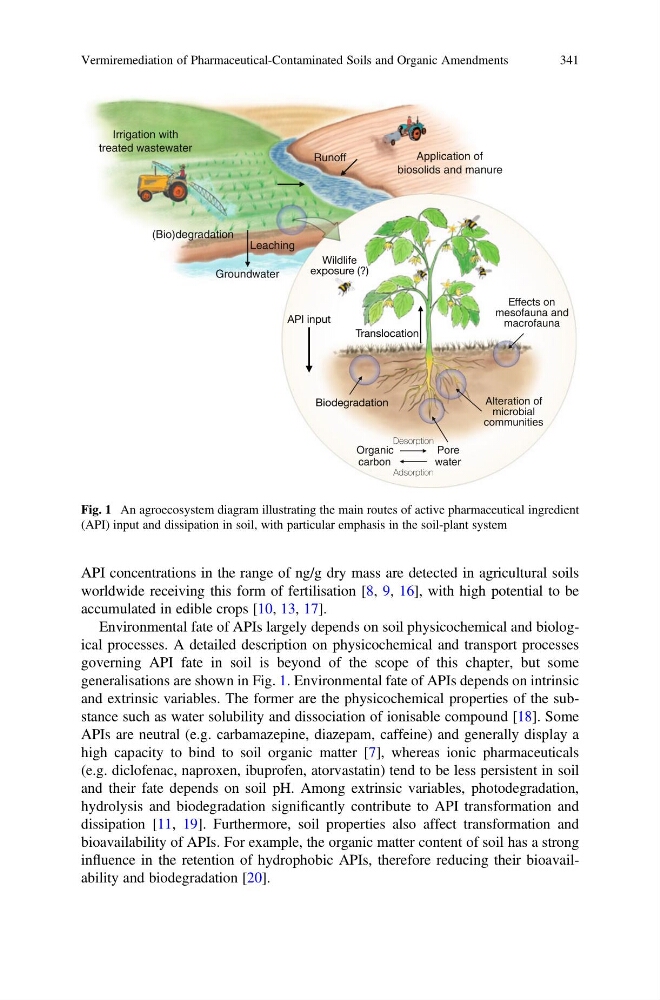
Environmental fate of APIs largely depends on soil physicochemical and biological processes. A detailed description on physicochemical and transport processes
governing API fate in soil is beyond of the scope of this chapter, but some
generalisations are shown in Fig. 1. Environmental fate of APIs depends on intrinsic
and extrinsic variables. The former are the physicochemical properties of the substance such as water solubility and dissociation of ionisable compound [18]. Some
APIs are neutral (e.g. carbamazepine, diazepam, caffeine) and generally display a
high capacity to bind to soil organic matter [7], whereas ionic pharmaceuticals
(e.g. diclofenac, naproxen, ibuprofen, atorvastatin) tend to be less persistent in soil
and their fate depends on soil pH. Among extrinsic variables, photodegradation,
hydrolysis and biodegradation significantly contribute to API transformation and
dissipation [11, 19]. Furthermore, soil properties also affect transformation and
bioavailability of APIs. For example, the organic matter content of soil has a strong
influence in the retention of hydrophobic APIs, therefore reducing their bioavailability and biodegradation [20].
Irrigation with
treated wastewater
Application of
biosolids and manure
Leaching
Runo
Groundwater
Pore
water
Alteration of
microbial
communities
Organic
carbon
(Bio)degradation
Adsorption
Desorption
E ects on
mesofauna and
macrofauna
Fig. 1 An agroecosystem diagram illustrating the main routes of active pharmaceutical ingredient
(API) input and dissipation in soil, with particular emphasis in the soil-plant system
Vermiremediation of Pharmaceutical-Contaminated Soils and Organic Amendments
341
worldwide receiving this form of fertilisation [8, 9, 16], with high potential to be
accumulated in edible crops [10, 13, 17].
Environmental fate of APIs largely depends on soil physicochemical and biological processes. A detailed description on physicochemical and transport processes
governing API fate in soil is beyond of the scope of this chapter, but some
generalisations are shown in Fig. 1. Environmental fate of APIs depends on intrinsic
and extrinsic variables. The former are the physicochemical properties of the substance such as water solubility and dissociation of ionisable compound [18]. Some
APIs are neutral (e.g. carbamazepine, diazepam, caffeine) and generally display a
high capacity to bind to soil organic matter [7], whereas ionic pharmaceuticals
(e.g. diclofenac, naproxen, ibuprofen, atorvastatin) tend to be less persistent in soil
and their fate depends on soil pH. Among extrinsic variables, photodegradation,
hydrolysis and biodegradation significantly contribute to API transformation and
dissipation [11, 19]. Furthermore, soil properties also affect transformation and
bioavailability of APIs. For example, the organic matter content of soil has a strong
influence in the retention of hydrophobic APIs, therefore reducing their bioavailability and biodegradation [20].
Irrigation with
treated wastewater
Application of
biosolids and manure
Leaching
Runo
Groundwater
Pore
water
Alteration of
microbial
communities
Organic
carbon
(Bio)degradation
Adsorption
Desorption
E ects on
mesofauna and
macrofauna
Fig. 1 An agroecosystem diagram illustrating the main routes of active pharmaceutical ingredient
(API) input and dissipation in soil, with particular emphasis in the soil-plant system
Vermiremediation of Pharmaceutical-Contaminated Soils and Organic Amendments
341