

3.2.2 Carbohydrate Conjugates and Derivatives
The most frequently detected phase II metabolic transformation of xenobiotics in
plants is the conjugation with sugars. This glycosylation facilitates the conjugation
of chlorinated phenols, anilines, and thiophenols as well as of carboxylic acids
[21]. When these functional groups (OH, NH, SH, COOH) are already present in
the structure of the parent compound, it can be directly conjugated; otherwise it
requires a preceding phase I reaction to unmask or introduce the respective functionality. For instance, AAP is transformed to AAP-Hex (Fig. 9) which is the
dominant plant metabolite (64%) in analogy to the prominent glucuronidation in
humans (40–67%) [26]. Plant glycosyltransferases also transform triclosan (TCS)
into TCS hexoside (TCS-Hex) and subsequently to disaccharide conjugates such as
TCS hexosyl hexoside (TCS-Hex-Hex) and TCS desoxyhexosyl hexoside
(TCS-DeOHex-Hex) [58] by linking a second sugar unit (hexose and desoxyhexose,
respectively) to the TCS-bound hexose [58].
Carbohydrate conjugates of xenobiotics can undergo further transformation with
malonic acid which is an important transformation step in plant detoxification. The
function of malonyltransferases resides in the transfer of malonyl from malonyl-CoA
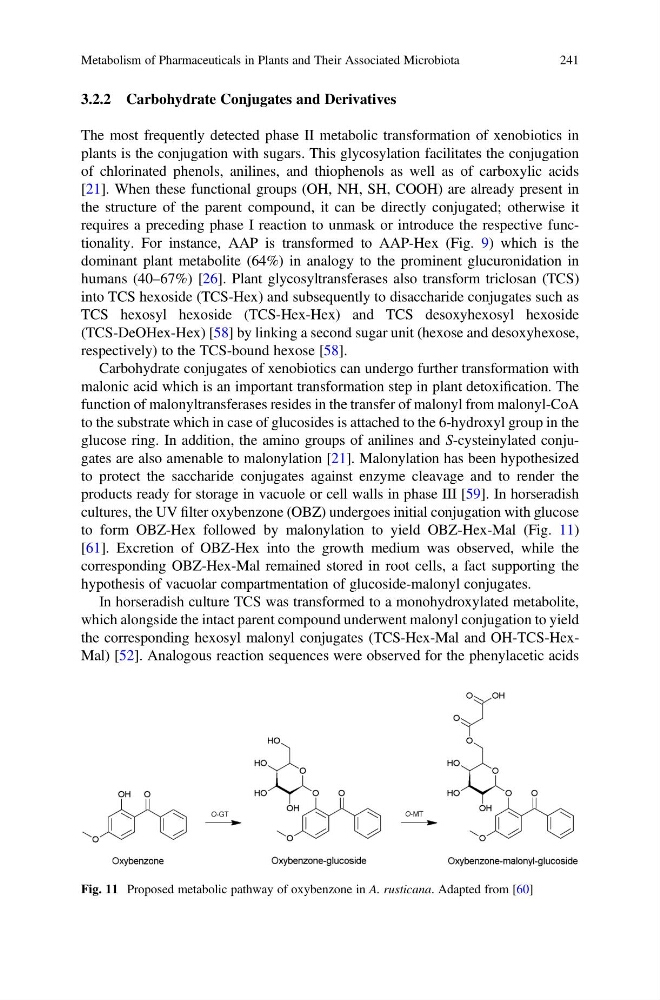
to the substrate which in case of glucosides is attached to the 6-hydroxyl group in the
glucose ring. In addition, the amino groups of anilines and S-cysteinylated conjugates are also amenable to malonylation [21]. Malonylation has been hypothesized
to protect the saccharide conjugates against enzyme cleavage and to render the
products ready for storage in vacuole or cell walls in phase III [59]. In horseradish
cultures, the UV filter oxybenzone (OBZ) undergoes initial conjugation with glucose
to form OBZ-Hex followed by malonylation to yield OBZ-Hex-Mal (Fig. 11)
[61]. Excretion of OBZ-Hex into the growth medium was observed, while the
corresponding OBZ-Hex-Mal remained stored in root cells, a fact supporting the
hypothesis of vacuolar compartmentation of glucoside-malonyl conjugates.
In horseradish culture TCS was transformed to a monohydroxylated metabolite,
which alongside the intact parent compound underwent malonyl conjugation to yield
the corresponding hexosyl malonyl conjugates (TCS-Hex-Mal and OH-TCS-HexMal) [52]. Analogous reaction sequences were observed for the phenylacetic acids
Fig. 11 Proposed metabolic pathway of oxybenzone in A. rusticana. Adapted from [60]
Metabolism of Pharmaceuticals in Plants and Their Associated Microbiota
241
The most frequently detected phase II metabolic transformation of xenobiotics in
plants is the conjugation with sugars. This glycosylation facilitates the conjugation
of chlorinated phenols, anilines, and thiophenols as well as of carboxylic acids
[21]. When these functional groups (OH, NH, SH, COOH) are already present in
the structure of the parent compound, it can be directly conjugated; otherwise it
requires a preceding phase I reaction to unmask or introduce the respective functionality. For instance, AAP is transformed to AAP-Hex (Fig. 9) which is the
dominant plant metabolite (64%) in analogy to the prominent glucuronidation in
humans (40–67%) [26]. Plant glycosyltransferases also transform triclosan (TCS)
into TCS hexoside (TCS-Hex) and subsequently to disaccharide conjugates such as
TCS hexosyl hexoside (TCS-Hex-Hex) and TCS desoxyhexosyl hexoside
(TCS-DeOHex-Hex) [58] by linking a second sugar unit (hexose and desoxyhexose,
respectively) to the TCS-bound hexose [58].
Carbohydrate conjugates of xenobiotics can undergo further transformation with
malonic acid which is an important transformation step in plant detoxification. The
function of malonyltransferases resides in the transfer of malonyl from malonyl-CoA
to the substrate which in case of glucosides is attached to the 6-hydroxyl group in the
glucose ring. In addition, the amino groups of anilines and S-cysteinylated conjugates are also amenable to malonylation [21]. Malonylation has been hypothesized
to protect the saccharide conjugates against enzyme cleavage and to render the
products ready for storage in vacuole or cell walls in phase III [59]. In horseradish
cultures, the UV filter oxybenzone (OBZ) undergoes initial conjugation with glucose
to form OBZ-Hex followed by malonylation to yield OBZ-Hex-Mal (Fig. 11)
[61]. Excretion of OBZ-Hex into the growth medium was observed, while the
corresponding OBZ-Hex-Mal remained stored in root cells, a fact supporting the
hypothesis of vacuolar compartmentation of glucoside-malonyl conjugates.
In horseradish culture TCS was transformed to a monohydroxylated metabolite,
which alongside the intact parent compound underwent malonyl conjugation to yield
the corresponding hexosyl malonyl conjugates (TCS-Hex-Mal and OH-TCS-HexMal) [52]. Analogous reaction sequences were observed for the phenylacetic acids
Fig. 11 Proposed metabolic pathway of oxybenzone in A. rusticana. Adapted from [60]
Metabolism of Pharmaceuticals in Plants and Their Associated Microbiota
241