

Viewing the metabolism of drugs as a detoxification mechanism of the human
body, the glutathione S-transferases (GST) truly play a pivotal role in the protection
against chemically reactive species [20]. This cytosolic enzyme class catalyzes the
transfer of the nucleophilic tripeptide glutathione (GSH), composed of γ-glutamic
acid-cysteine-glycine, to an electrophilic substrate by taking advantage of the nucleophilic character of the thiol group in the central amino acid. GSH conjugation is
most frequently observed following phase I-induced bioactivation that has led to the
formation of a strongly electron-deficient intermediate. In the absence of GSH as
scavenger, such activated drug metabolite may otherwise react with functional
groups of macromolecules, potentially compromising their cellular functions. In
fact, depletion of the cofactor GSH at the cellular level due to generation of high
amounts of reactive metabolite can result in acute liver failure. The classical example
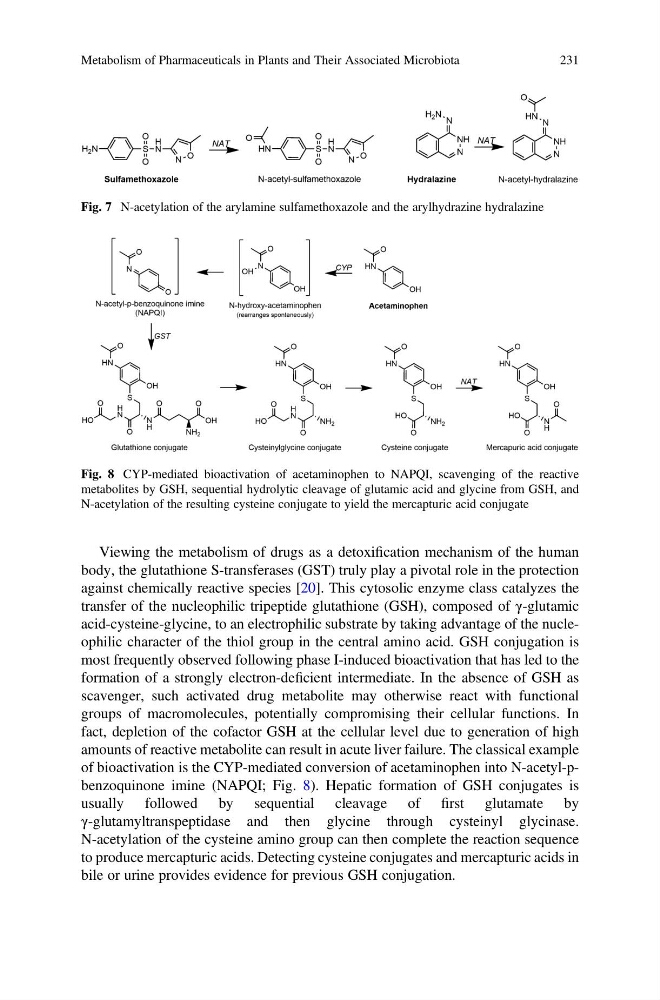
of bioactivation is the CYP-mediated conversion of acetaminophen into N-acetyl-pbenzoquinone imine (NAPQI; Fig. 8). Hepatic formation of GSH conjugates is
usually followed by sequential cleavage of first glutamate by
γ-glutamyltranspeptidase and then glycine through cysteinyl glycinase.
N-acetylation of the cysteine amino group can then complete the reaction sequence
to produce mercapturic acids. Detecting cysteine conjugates and mercapturic acids in
bile or urine provides evidence for previous GSH conjugation.
Fig. 7 N-acetylation of the arylamine sulfamethoxazole and the arylhydrazine hydralazine
Fig. 8 CYP-mediated bioactivation of acetaminophen to NAPQI, scavenging of the reactive
metabolites by GSH, sequential hydrolytic cleavage of glutamic acid and glycine from GSH, and
N-acetylation of the resulting cysteine conjugate to yield the mercapturic acid conjugate
Metabolism of Pharmaceuticals in Plants and Their Associated Microbiota
231
body, the glutathione S-transferases (GST) truly play a pivotal role in the protection
against chemically reactive species [20]. This cytosolic enzyme class catalyzes the
transfer of the nucleophilic tripeptide glutathione (GSH), composed of γ-glutamic
acid-cysteine-glycine, to an electrophilic substrate by taking advantage of the nucleophilic character of the thiol group in the central amino acid. GSH conjugation is
most frequently observed following phase I-induced bioactivation that has led to the
formation of a strongly electron-deficient intermediate. In the absence of GSH as
scavenger, such activated drug metabolite may otherwise react with functional
groups of macromolecules, potentially compromising their cellular functions. In
fact, depletion of the cofactor GSH at the cellular level due to generation of high
amounts of reactive metabolite can result in acute liver failure. The classical example
of bioactivation is the CYP-mediated conversion of acetaminophen into N-acetyl-pbenzoquinone imine (NAPQI; Fig. 8). Hepatic formation of GSH conjugates is
usually followed by sequential cleavage of first glutamate by
γ-glutamyltranspeptidase and then glycine through cysteinyl glycinase.
N-acetylation of the cysteine amino group can then complete the reaction sequence
to produce mercapturic acids. Detecting cysteine conjugates and mercapturic acids in
bile or urine provides evidence for previous GSH conjugation.
Fig. 7 N-acetylation of the arylamine sulfamethoxazole and the arylhydrazine hydralazine
Fig. 8 CYP-mediated bioactivation of acetaminophen to NAPQI, scavenging of the reactive
metabolites by GSH, sequential hydrolytic cleavage of glutamic acid and glycine from GSH, and
N-acetylation of the resulting cysteine conjugate to yield the mercapturic acid conjugate
Metabolism of Pharmaceuticals in Plants and Their Associated Microbiota
231