

Apart from the UGT-mediated conjugation of drugs containing carboxyl groups,
an alternative pathway, though of negligible significance in the human body, is the
formation of amino acid conjugates in the mitochondria via a multi-stage reaction in
which the substrate is first activated by conversion into a high-energy CoA thioester
[19]. In the subsequent nucleophilic reaction, it then establishes an amide bond with
the amino group of the amino acid. The very few reported cases in humans involve
glycine as the reaction partner. whereas animal species have been shown to form
carnitine conjugates as well as conjugates with taurine. A further, quite specific
phase II reaction is the N-acetylation of arylamines, arylhydroxylamines, and
arylhydrazines (Fig. 7). It is catalyzed by the cytosolic conjugating enzyme
N-acetyltransferase (NAT) which transfers an acetyl group from acetyl-CoA to the
drug acceptor substrate.
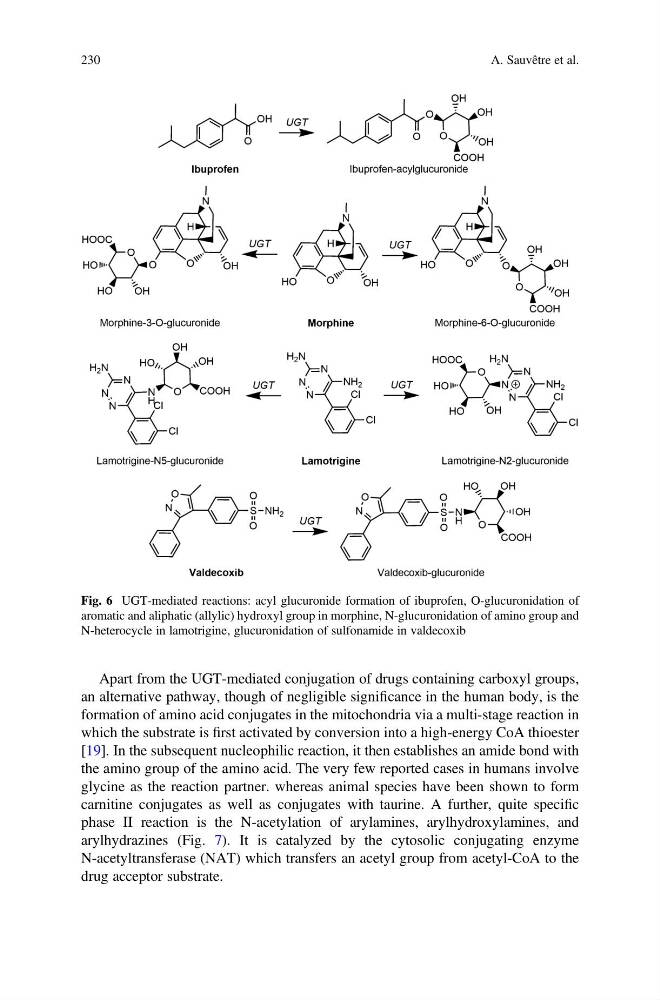
Fig. 6 UGT-mediated reactions: acyl glucuronide formation of ibuprofen, O-glucuronidation of
aromatic and aliphatic (allylic) hydroxyl group in morphine, N-glucuronidation of amino group and
N-heterocycle in lamotrigine, glucuronidation of sulfonamide in valdecoxib
230
A. Sauvêtre et al.
an alternative pathway, though of negligible significance in the human body, is the
formation of amino acid conjugates in the mitochondria via a multi-stage reaction in
which the substrate is first activated by conversion into a high-energy CoA thioester
[19]. In the subsequent nucleophilic reaction, it then establishes an amide bond with
the amino group of the amino acid. The very few reported cases in humans involve
glycine as the reaction partner. whereas animal species have been shown to form
carnitine conjugates as well as conjugates with taurine. A further, quite specific
phase II reaction is the N-acetylation of arylamines, arylhydroxylamines, and
arylhydrazines (Fig. 7). It is catalyzed by the cytosolic conjugating enzyme
N-acetyltransferase (NAT) which transfers an acetyl group from acetyl-CoA to the
drug acceptor substrate.
Fig. 6 UGT-mediated reactions: acyl glucuronide formation of ibuprofen, O-glucuronidation of
aromatic and aliphatic (allylic) hydroxyl group in morphine, N-glucuronidation of amino group and
N-heterocycle in lamotrigine, glucuronidation of sulfonamide in valdecoxib
230
A. Sauvêtre et al.