

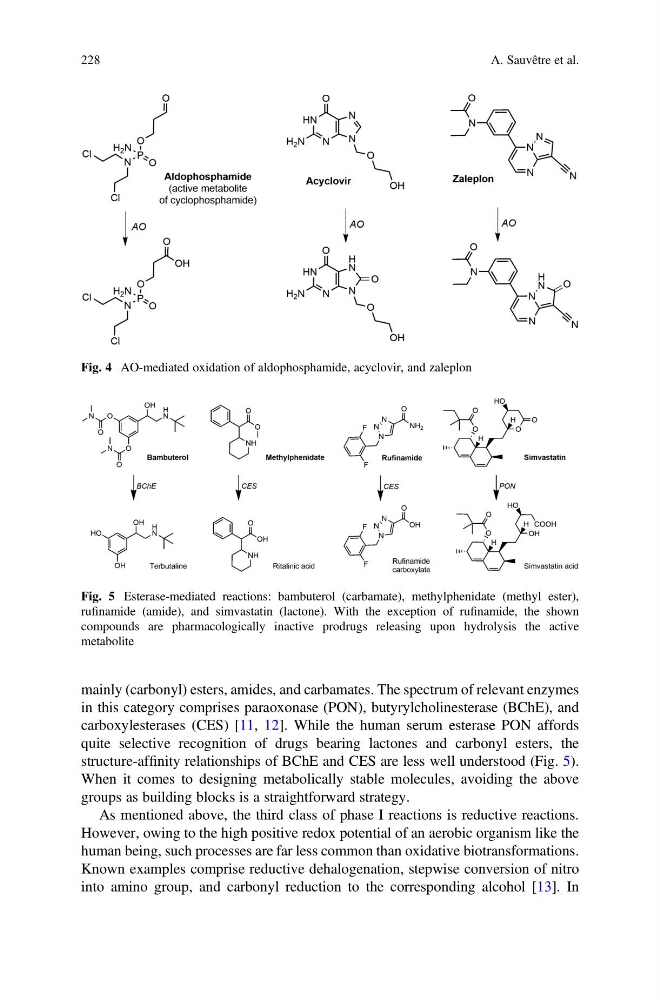
mainly (carbonyl) esters, amides, and carbamates. The spectrum of relevant enzymes
in this category comprises paraoxonase (PON), butyrylcholinesterase (BChE), and
carboxylesterases (CES) [11, 12]. While the human serum esterase PON affords
quite selective recognition of drugs bearing lactones and carbonyl esters, the
structure-affinity relationships of BChE and CES are less well understood (Fig. 5).
When it comes to designing metabolically stable molecules, avoiding the above
groups as building blocks is a straightforward strategy.
As mentioned above, the third class of phase I reactions is reductive reactions.
However, owing to the high positive redox potential of an aerobic organism like the
human being, such processes are far less common than oxidative biotransformations.
Known examples comprise reductive dehalogenation, stepwise conversion of nitro
into amino group, and carbonyl reduction to the corresponding alcohol [13]. In
Fig. 4 AO-mediated oxidation of aldophosphamide, acyclovir, and zaleplon
Fig. 5 Esterase-mediated reactions: bambuterol (carbamate), methylphenidate (methyl ester),
rufinamide (amide), and simvastatin (lactone). With the exception of rufinamide, the shown
compounds are pharmacologically inactive prodrugs releasing upon hydrolysis the active
metabolite
228
A. Sauvêtre et al.
in this category comprises paraoxonase (PON), butyrylcholinesterase (BChE), and
carboxylesterases (CES) [11, 12]. While the human serum esterase PON affords
quite selective recognition of drugs bearing lactones and carbonyl esters, the
structure-affinity relationships of BChE and CES are less well understood (Fig. 5).
When it comes to designing metabolically stable molecules, avoiding the above
groups as building blocks is a straightforward strategy.
As mentioned above, the third class of phase I reactions is reductive reactions.
However, owing to the high positive redox potential of an aerobic organism like the
human being, such processes are far less common than oxidative biotransformations.
Known examples comprise reductive dehalogenation, stepwise conversion of nitro
into amino group, and carbonyl reduction to the corresponding alcohol [13]. In
Fig. 4 AO-mediated oxidation of aldophosphamide, acyclovir, and zaleplon
Fig. 5 Esterase-mediated reactions: bambuterol (carbamate), methylphenidate (methyl ester),
rufinamide (amide), and simvastatin (lactone). With the exception of rufinamide, the shown
compounds are pharmacologically inactive prodrugs releasing upon hydrolysis the active
metabolite
228
A. Sauvêtre et al.