

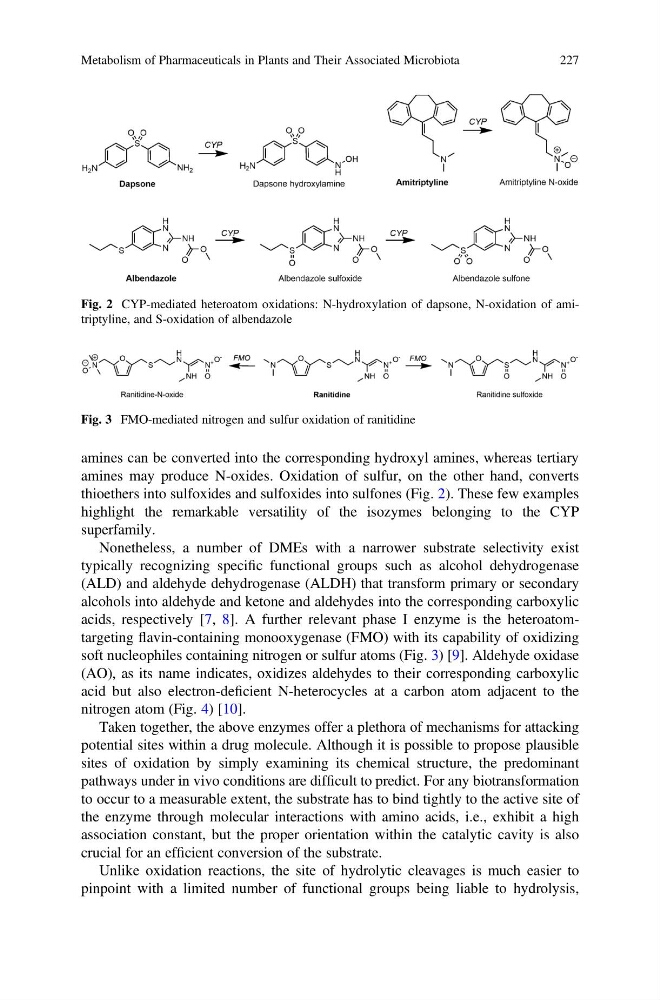
amines can be converted into the corresponding hydroxyl amines, whereas tertiary
amines may produce N-oxides. Oxidation of sulfur, on the other hand, converts
thioethers into sulfoxides and sulfoxides into sulfones (Fig. 2). These few examples
highlight the remarkable versatility of the isozymes belonging to the CYP
superfamily.
Nonetheless, a number of DMEs with a narrower substrate selectivity exist
typically recognizing specific functional groups such as alcohol dehydrogenase
(ALD) and aldehyde dehydrogenase (ALDH) that transform primary or secondary
alcohols into aldehyde and ketone and aldehydes into the corresponding carboxylic
acids, respectively [7, 8]. A further relevant phase I enzyme is the heteroatomtargeting flavin-containing monooxygenase (FMO) with its capability of oxidizing
soft nucleophiles containing nitrogen or sulfur atoms (Fig. 3) [9]. Aldehyde oxidase
(AO), as its name indicates, oxidizes aldehydes to their corresponding carboxylic
acid but also electron-deficient N-heterocycles at a carbon atom adjacent to the
nitrogen atom (Fig. 4) [10].
Taken together, the above enzymes offer a plethora of mechanisms for attacking
potential sites within a drug molecule. Although it is possible to propose plausible
sites of oxidation by simply examining its chemical structure, the predominant
pathways under in vivo conditions are difficult to predict. For any biotransformation
to occur to a measurable extent, the substrate has to bind tightly to the active site of
the enzyme through molecular interactions with amino acids, i.e., exhibit a high
association constant, but the proper orientation within the catalytic cavity is also
crucial for an efficient conversion of the substrate.
Unlike oxidation reactions, the site of hydrolytic cleavages is much easier to
pinpoint with a limited number of functional groups being liable to hydrolysis,
Fig. 2 CYP-mediated heteroatom oxidations: N-hydroxylation of dapsone, N-oxidation of amitriptyline, and S-oxidation of albendazole
Fig. 3 FMO-mediated nitrogen and sulfur oxidation of ranitidine
Metabolism of Pharmaceuticals in Plants and Their Associated Microbiota
227
amines may produce N-oxides. Oxidation of sulfur, on the other hand, converts
thioethers into sulfoxides and sulfoxides into sulfones (Fig. 2). These few examples
highlight the remarkable versatility of the isozymes belonging to the CYP
superfamily.
Nonetheless, a number of DMEs with a narrower substrate selectivity exist
typically recognizing specific functional groups such as alcohol dehydrogenase
(ALD) and aldehyde dehydrogenase (ALDH) that transform primary or secondary
alcohols into aldehyde and ketone and aldehydes into the corresponding carboxylic
acids, respectively [7, 8]. A further relevant phase I enzyme is the heteroatomtargeting flavin-containing monooxygenase (FMO) with its capability of oxidizing
soft nucleophiles containing nitrogen or sulfur atoms (Fig. 3) [9]. Aldehyde oxidase
(AO), as its name indicates, oxidizes aldehydes to their corresponding carboxylic
acid but also electron-deficient N-heterocycles at a carbon atom adjacent to the
nitrogen atom (Fig. 4) [10].
Taken together, the above enzymes offer a plethora of mechanisms for attacking
potential sites within a drug molecule. Although it is possible to propose plausible
sites of oxidation by simply examining its chemical structure, the predominant
pathways under in vivo conditions are difficult to predict. For any biotransformation
to occur to a measurable extent, the substrate has to bind tightly to the active site of
the enzyme through molecular interactions with amino acids, i.e., exhibit a high
association constant, but the proper orientation within the catalytic cavity is also
crucial for an efficient conversion of the substrate.
Unlike oxidation reactions, the site of hydrolytic cleavages is much easier to
pinpoint with a limited number of functional groups being liable to hydrolysis,
Fig. 2 CYP-mediated heteroatom oxidations: N-hydroxylation of dapsone, N-oxidation of amitriptyline, and S-oxidation of albendazole
Fig. 3 FMO-mediated nitrogen and sulfur oxidation of ranitidine
Metabolism of Pharmaceuticals in Plants and Their Associated Microbiota
227