

90
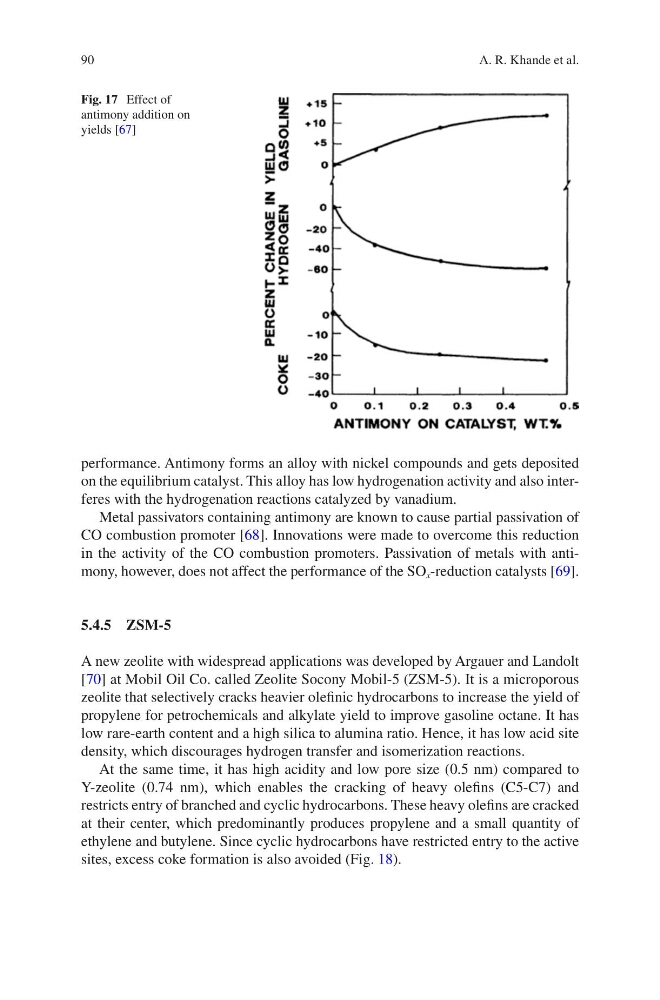
performance. Antimony forms an alloy with nickel compounds and gets deposited
on the equilibrium catalyst. This alloy has low hydrogenation activity and also interferes with the hydrogenation reactions catalyzed by vanadium.
Metal passivators containing antimony are known to cause partial passivation of
CO combustion promoter [68]. Innovations were made to overcome this reduction
in the activity of the CO combustion promoters. Passivation of metals with antimony, however, does not affect the performance of the SO x -reduction catalysts [69].
5.4.5 ZSM-5
A new zeolite with widespread applications was developed by Argauer and Landolt
[70] at Mobil Oil Co. called Zeolite Socony Mobil-5 (ZSM-5). It is a microporous
zeolite that selectively cracks heavier olefinic hydrocarbons to increase the yield of
propylene for petrochemicals and alkylate yield to improve gasoline octane. It has
low rare-earth content and a high silica to alumina ratio. Hence, it has low acid site
density, which discourages hydrogen transfer and isomerization reactions.
At the same time, it has high acidity and low pore size (0.5 nm) compared to
Y-zeolite (0.74 nm), which enables the cracking of heavy olefins (C5-C7) and
restricts entry of branched and cyclic hydrocarbons. These heavy olefins are cracked
at their center, which predominantly produces propylene and a small quantity of
ethylene and butylene. Since cyclic hydrocarbons have restricted entry to the active
sites, excess coke formation is also avoided (Fig. 18).
Fig. 17 Effect of
antimony addition on
yields [67]
A. R. Khande et al.
performance. Antimony forms an alloy with nickel compounds and gets deposited
on the equilibrium catalyst. This alloy has low hydrogenation activity and also interferes with the hydrogenation reactions catalyzed by vanadium.
Metal passivators containing antimony are known to cause partial passivation of
CO combustion promoter [68]. Innovations were made to overcome this reduction
in the activity of the CO combustion promoters. Passivation of metals with antimony, however, does not affect the performance of the SO x -reduction catalysts [69].
5.4.5 ZSM-5
A new zeolite with widespread applications was developed by Argauer and Landolt
[70] at Mobil Oil Co. called Zeolite Socony Mobil-5 (ZSM-5). It is a microporous
zeolite that selectively cracks heavier olefinic hydrocarbons to increase the yield of
propylene for petrochemicals and alkylate yield to improve gasoline octane. It has
low rare-earth content and a high silica to alumina ratio. Hence, it has low acid site
density, which discourages hydrogen transfer and isomerization reactions.
At the same time, it has high acidity and low pore size (0.5 nm) compared to
Y-zeolite (0.74 nm), which enables the cracking of heavy olefins (C5-C7) and
restricts entry of branched and cyclic hydrocarbons. These heavy olefins are cracked
at their center, which predominantly produces propylene and a small quantity of
ethylene and butylene. Since cyclic hydrocarbons have restricted entry to the active
sites, excess coke formation is also avoided (Fig. 18).
Fig. 17 Effect of
antimony addition on
yields [67]
A. R. Khande et al.