

91
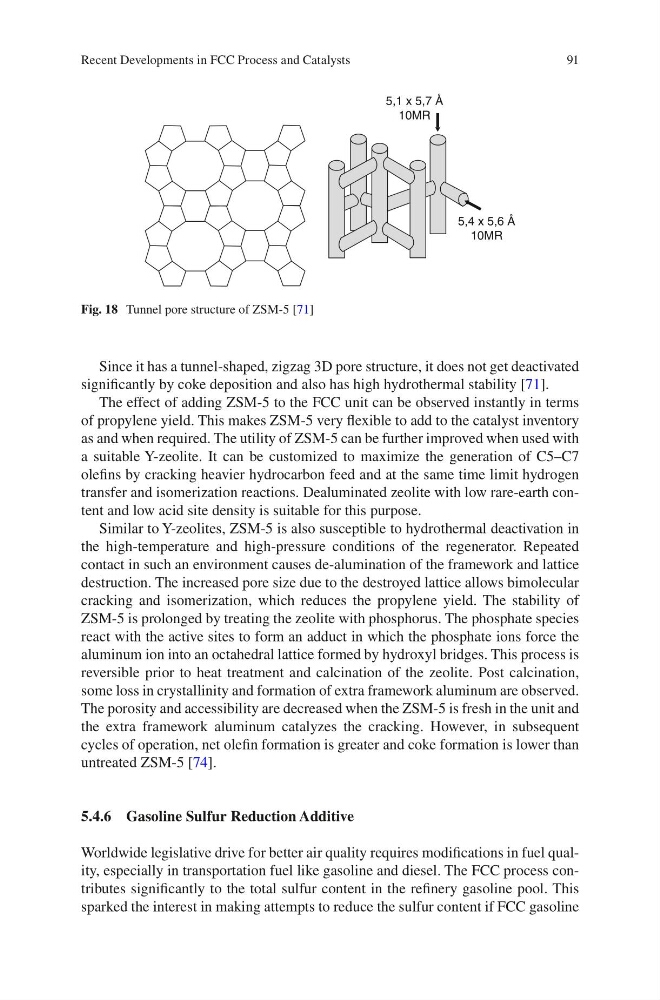
Since it has a tunnel-shaped, zigzag 3D pore structure, it does not get deactivated
significantly by coke deposition and also has high hydrothermal stability [71].
The effect of adding ZSM-5 to the FCC unit can be observed instantly in terms
of propylene yield. This makes ZSM-5 very flexible to add to the catalyst inventory
as and when required. The utility of ZSM-5 can be further improved when used with
a suitable Y-zeolite. It can be customized to maximize the generation of C5–C7
olefins by cracking heavier hydrocarbon feed and at the same time limit hydrogen
transfer and isomerization reactions. Dealuminated zeolite with low rare-earth content and low acid site density is suitable for this purpose.
Similar to Y-zeolites, ZSM-5 is also susceptible to hydrothermal deactivation in
the high-temperature and high-pressure conditions of the regenerator. Repeated
contact in such an environment causes de-alumination of the framework and lattice
destruction. The increased pore size due to the destroyed lattice allows bimolecular
cracking and isomerization, which reduces the propylene yield. The stability of
ZSM-5 is prolonged by treating the zeolite with phosphorus. The phosphate species
react with the active sites to form an adduct in which the phosphate ions force the
aluminum ion into an octahedral lattice formed by hydroxyl bridges. This process is
reversible prior to heat treatment and calcination of the zeolite. Post calcination,
some loss in crystallinity and formation of extra framework aluminum are observed.
The porosity and accessibility are decreased when the ZSM-5 is fresh in the unit and
the extra framework aluminum catalyzes the cracking. However, in subsequent
cycles of operation, net olefin formation is greater and coke formation is lower than
untreated ZSM-5 [74].
5.4.6 Gasoline Sulfur Reduction Additive
Worldwide legislative drive for better air quality requires modifications in fuel quality, especially in transportation fuel like gasoline and diesel. The FCC process contributes significantly to the total sulfur content in the refinery gasoline pool. This
sparked the interest in making attempts to reduce the sulfur content if FCC gasoline
5,1 x 5,7 Å
10MR
5,4 x 5,6 Å
10MR
Fig. 18 Tunnel pore structure of ZSM-5 [71]
Recent Developments in FCC Process and Catalysts
Since it has a tunnel-shaped, zigzag 3D pore structure, it does not get deactivated
significantly by coke deposition and also has high hydrothermal stability [71].
The effect of adding ZSM-5 to the FCC unit can be observed instantly in terms
of propylene yield. This makes ZSM-5 very flexible to add to the catalyst inventory
as and when required. The utility of ZSM-5 can be further improved when used with
a suitable Y-zeolite. It can be customized to maximize the generation of C5–C7
olefins by cracking heavier hydrocarbon feed and at the same time limit hydrogen
transfer and isomerization reactions. Dealuminated zeolite with low rare-earth content and low acid site density is suitable for this purpose.
Similar to Y-zeolites, ZSM-5 is also susceptible to hydrothermal deactivation in
the high-temperature and high-pressure conditions of the regenerator. Repeated
contact in such an environment causes de-alumination of the framework and lattice
destruction. The increased pore size due to the destroyed lattice allows bimolecular
cracking and isomerization, which reduces the propylene yield. The stability of
ZSM-5 is prolonged by treating the zeolite with phosphorus. The phosphate species
react with the active sites to form an adduct in which the phosphate ions force the
aluminum ion into an octahedral lattice formed by hydroxyl bridges. This process is
reversible prior to heat treatment and calcination of the zeolite. Post calcination,
some loss in crystallinity and formation of extra framework aluminum are observed.
The porosity and accessibility are decreased when the ZSM-5 is fresh in the unit and
the extra framework aluminum catalyzes the cracking. However, in subsequent
cycles of operation, net olefin formation is greater and coke formation is lower than
untreated ZSM-5 [74].
5.4.6 Gasoline Sulfur Reduction Additive
Worldwide legislative drive for better air quality requires modifications in fuel quality, especially in transportation fuel like gasoline and diesel. The FCC process contributes significantly to the total sulfur content in the refinery gasoline pool. This
sparked the interest in making attempts to reduce the sulfur content if FCC gasoline
5,1 x 5,7 Å
10MR
5,4 x 5,6 Å
10MR
Fig. 18 Tunnel pore structure of ZSM-5 [71]
Recent Developments in FCC Process and Catalysts