

88
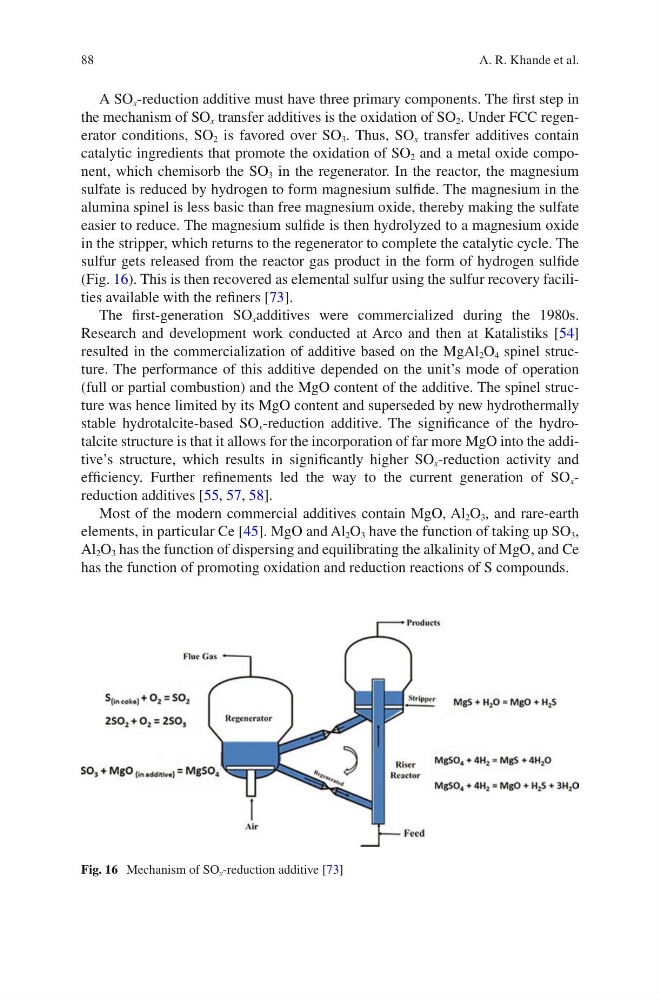
A SO x -reduction additive must have three primary components. The first step in
the mechanism of SO x transfer additives is the oxidation of SO 2 . Under FCC regenerator conditions, SO 2 is favored over SO 3 . Thus, SO x transfer additives contain
catalytic ingredients that promote the oxidation of SO 2 and a metal oxide component, which chemisorb the SO 3 in the regenerator. In the reactor, the magnesium
sulfate is reduced by hydrogen to form magnesium sulfide. The magnesium in the
alumina spinel is less basic than free magnesium oxide, thereby making the sulfate
easier to reduce. The magnesium sulfide is then hydrolyzed to a magnesium oxide
in the stripper, which returns to the regenerator to complete the catalytic cycle. The
sulfur gets released from the reactor gas product in the form of hydrogen sulfide
(Fig. 16). This is then recovered as elemental sulfur using the sulfur recovery facilities available with the refiners [73].
The first-generation SO x additives were commercialized during the 1980s.
Research and development work conducted at Arco and then at Katalistiks [54]
resulted in the commercialization of additive based on the MgAl 2 O 4 spinel structure. The performance of this additive depended on the unit’s mode of operation
(full or partial combustion) and the MgO content of the additive. The spinel structure was hence limited by its MgO content and superseded by new hydrothermally
stable hydrotalcite-based SO x -reduction additive. The significance of the hydrotalcite structure is that it allows for the incorporation of far more MgO into the additive’s structure, which results in significantly higher SO x -reduction activity and
efficiency. Further refinements led the way to the current generation of SO x -
reduction additives [55, 57, 58].
Most of the modern commercial additives contain MgO, Al 2 O 3 , and rare-earth
elements, in particular Ce [45]. MgO and Al 2 O 3 have the function of taking up SO 3 ,
Al 2 O 3 has the function of dispersing and equilibrating the alkalinity of MgO, and Ce
has the function of promoting oxidation and reduction reactions of S compounds.
Fig. 16 Mechanism of SO x -reduction additive [73]
A. R. Khande et al.
A SO x -reduction additive must have three primary components. The first step in
the mechanism of SO x transfer additives is the oxidation of SO 2 . Under FCC regenerator conditions, SO 2 is favored over SO 3 . Thus, SO x transfer additives contain
catalytic ingredients that promote the oxidation of SO 2 and a metal oxide component, which chemisorb the SO 3 in the regenerator. In the reactor, the magnesium
sulfate is reduced by hydrogen to form magnesium sulfide. The magnesium in the
alumina spinel is less basic than free magnesium oxide, thereby making the sulfate
easier to reduce. The magnesium sulfide is then hydrolyzed to a magnesium oxide
in the stripper, which returns to the regenerator to complete the catalytic cycle. The
sulfur gets released from the reactor gas product in the form of hydrogen sulfide
(Fig. 16). This is then recovered as elemental sulfur using the sulfur recovery facilities available with the refiners [73].
The first-generation SO x additives were commercialized during the 1980s.
Research and development work conducted at Arco and then at Katalistiks [54]
resulted in the commercialization of additive based on the MgAl 2 O 4 spinel structure. The performance of this additive depended on the unit’s mode of operation
(full or partial combustion) and the MgO content of the additive. The spinel structure was hence limited by its MgO content and superseded by new hydrothermally
stable hydrotalcite-based SO x -reduction additive. The significance of the hydrotalcite structure is that it allows for the incorporation of far more MgO into the additive’s structure, which results in significantly higher SO x -reduction activity and
efficiency. Further refinements led the way to the current generation of SO x -
reduction additives [55, 57, 58].
Most of the modern commercial additives contain MgO, Al 2 O 3 , and rare-earth
elements, in particular Ce [45]. MgO and Al 2 O 3 have the function of taking up SO 3 ,
Al 2 O 3 has the function of dispersing and equilibrating the alkalinity of MgO, and Ce
has the function of promoting oxidation and reduction reactions of S compounds.
Fig. 16 Mechanism of SO x -reduction additive [73]
A. R. Khande et al.