

87
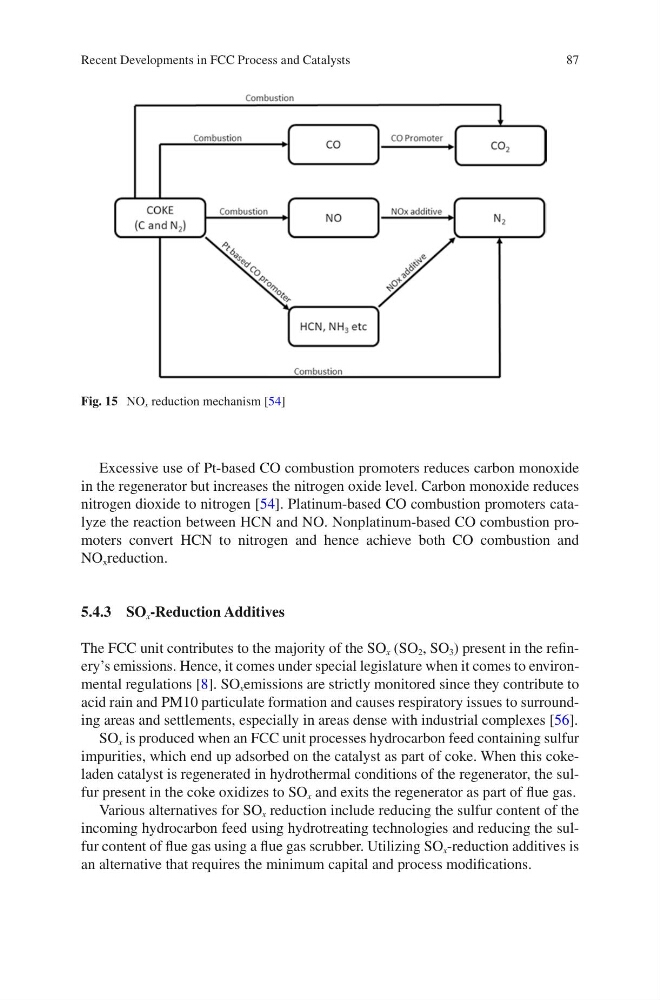
Excessive use of Pt-based CO combustion promoters reduces carbon monoxide
in the regenerator but increases the nitrogen oxide level. Carbon monoxide reduces
nitrogen dioxide to nitrogen [54]. Platinum-based CO combustion promoters catalyze the reaction between HCN and NO. Nonplatinum-based CO combustion promoters convert HCN to nitrogen and hence achieve both CO combustion and
NO x reduction.
5.4.3 SO x -Reduction Additives
The FCC unit contributes to the majority of the SO x (SO 2 , SO 3 ) present in the refinery’s emissions. Hence, it comes under special legislature when it comes to environmental regulations [8]. SO x emissions are strictly monitored since they contribute to
acid rain and PM10 particulate formation and causes respiratory issues to surrounding areas and settlements, especially in areas dense with industrial complexes [56].
SO x is produced when an FCC unit processes hydrocarbon feed containing sulfur
impurities, which end up adsorbed on the catalyst as part of coke. When this cokeladen catalyst is regenerated in hydrothermal conditions of the regenerator, the sulfur present in the coke oxidizes to SO x and exits the regenerator as part of flue gas.
Various alternatives for SO x reduction include reducing the sulfur content of the
incoming hydrocarbon feed using hydrotreating technologies and reducing the sulfur content of flue gas using a flue gas scrubber. Utilizing SO x -reduction additives is
an alternative that requires the minimum capital and process modifications.
Fig. 15 NO x reduction mechanism [54]
Recent Developments in FCC Process and Catalysts
Excessive use of Pt-based CO combustion promoters reduces carbon monoxide
in the regenerator but increases the nitrogen oxide level. Carbon monoxide reduces
nitrogen dioxide to nitrogen [54]. Platinum-based CO combustion promoters catalyze the reaction between HCN and NO. Nonplatinum-based CO combustion promoters convert HCN to nitrogen and hence achieve both CO combustion and
NO x reduction.
5.4.3 SO x -Reduction Additives
The FCC unit contributes to the majority of the SO x (SO 2 , SO 3 ) present in the refinery’s emissions. Hence, it comes under special legislature when it comes to environmental regulations [8]. SO x emissions are strictly monitored since they contribute to
acid rain and PM10 particulate formation and causes respiratory issues to surrounding areas and settlements, especially in areas dense with industrial complexes [56].
SO x is produced when an FCC unit processes hydrocarbon feed containing sulfur
impurities, which end up adsorbed on the catalyst as part of coke. When this cokeladen catalyst is regenerated in hydrothermal conditions of the regenerator, the sulfur present in the coke oxidizes to SO x and exits the regenerator as part of flue gas.
Various alternatives for SO x reduction include reducing the sulfur content of the
incoming hydrocarbon feed using hydrotreating technologies and reducing the sulfur content of flue gas using a flue gas scrubber. Utilizing SO x -reduction additives is
an alternative that requires the minimum capital and process modifications.
Fig. 15 NO x reduction mechanism [54]
Recent Developments in FCC Process and Catalysts