

84
metals in the hydrocarbon feed. Because of this, the zeolite is prevented from getting deactivated, and hence catalyst life is increased.
5.3 Binder and Filler
The binder serves to hold the catalyst particle together. It may or may not contribute
to the catalyst’s activity. The filler is mainly used to dilute the activity of the catalyst. Both binder and filler are some forms of macroporous silica and alumina clays
(e.g., kaolin clay). They serve to provide mechanical strength, pore accessibility,
attrition resistance, and a heat transfer medium to the FCC catalyst. If the pore
accessibility of the FCC catalyst is poor, the stripping of the catalyst gets affected,
leading to higher hydrogen and dry gas yields. Low mechanical strength and attrition resistance cause loss of catalyst in the form of fines that escape from the top of
the regenerator. Furthermore, the reaction of binder’s aluminum ions with zeolite
produces new acidic sites, which can modify the surface acidity of the zeolite and
alter the activity of the catalyst.
5.4 FCC Catalyst Additives
A modern FCC unit in its lifetime may face hydrocarbon feeds that drastically vary
from one another. For maximum refinery margins, various production and environmental constraints are laid down on the unit’s operation. FCC additives are added in
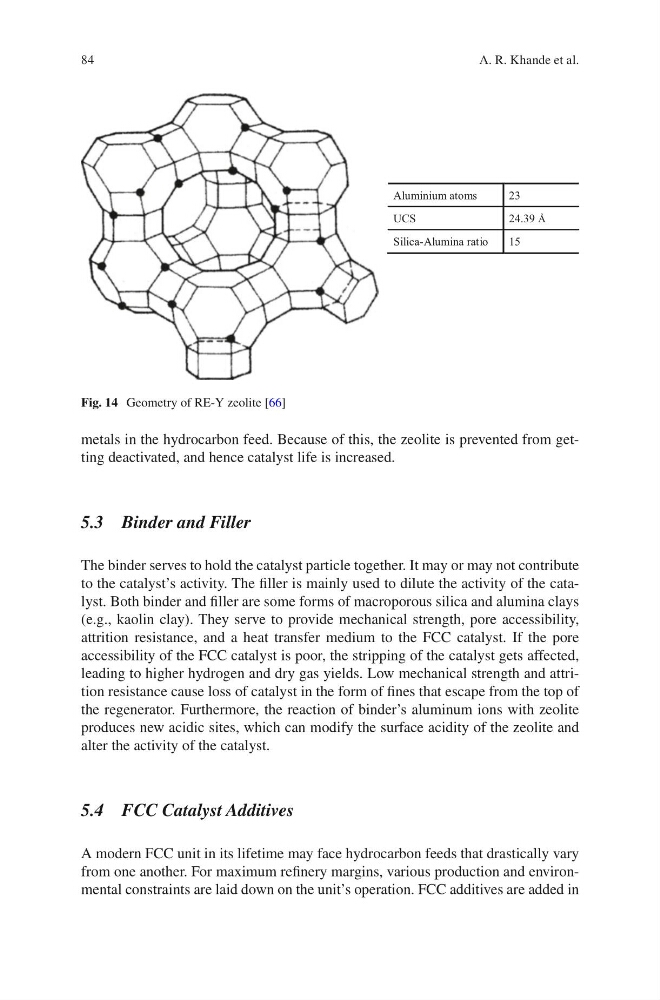
Aluminium atoms
23
UCS
24.39 Å
Silica-Alumina ratio
15
Fig. 14 Geometry of RE-Y zeolite [66]
A. R. Khande et al.
metals in the hydrocarbon feed. Because of this, the zeolite is prevented from getting deactivated, and hence catalyst life is increased.
5.3 Binder and Filler
The binder serves to hold the catalyst particle together. It may or may not contribute
to the catalyst’s activity. The filler is mainly used to dilute the activity of the catalyst. Both binder and filler are some forms of macroporous silica and alumina clays
(e.g., kaolin clay). They serve to provide mechanical strength, pore accessibility,
attrition resistance, and a heat transfer medium to the FCC catalyst. If the pore
accessibility of the FCC catalyst is poor, the stripping of the catalyst gets affected,
leading to higher hydrogen and dry gas yields. Low mechanical strength and attrition resistance cause loss of catalyst in the form of fines that escape from the top of
the regenerator. Furthermore, the reaction of binder’s aluminum ions with zeolite
produces new acidic sites, which can modify the surface acidity of the zeolite and
alter the activity of the catalyst.
5.4 FCC Catalyst Additives
A modern FCC unit in its lifetime may face hydrocarbon feeds that drastically vary
from one another. For maximum refinery margins, various production and environmental constraints are laid down on the unit’s operation. FCC additives are added in
Aluminium atoms
23
UCS
24.39 Å
Silica-Alumina ratio
15
Fig. 14 Geometry of RE-Y zeolite [66]
A. R. Khande et al.