

724
result, the water phase is separated at the bottom and oil phase at the top. Further,
the aqueous phase is sent to the second stage of desalting or an effluent treatment
plant, and the crude oil is sent for downstream processes.
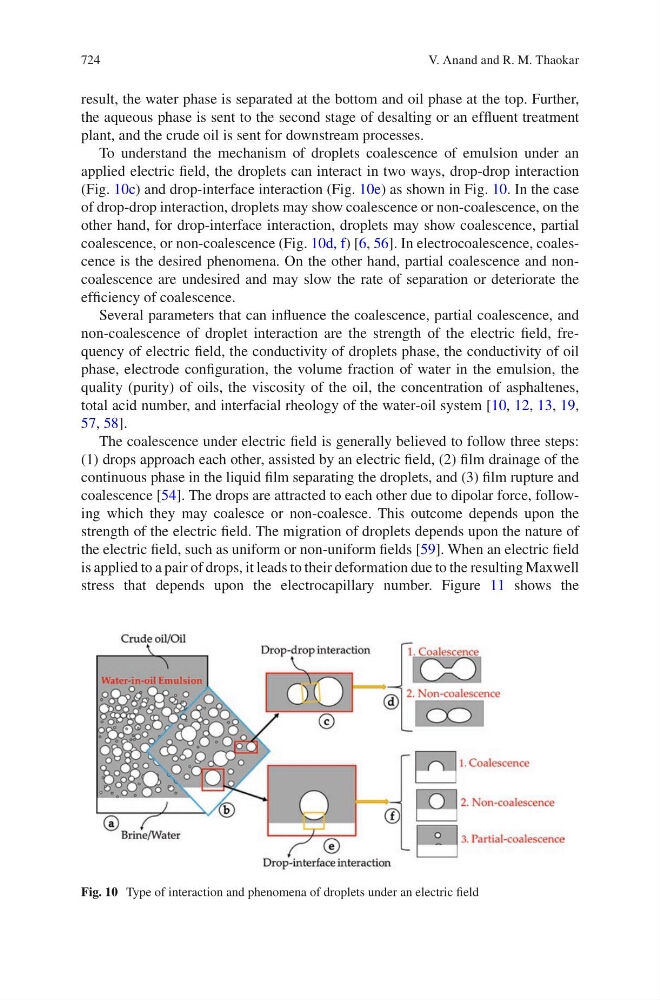
To understand the mechanism of droplets coalescence of emulsion under an
applied electric field, the droplets can interact in two ways, drop-drop interaction
(Fig. 10c) and drop-interface interaction (Fig. 10e) as shown in Fig. 10. In the case
of drop-drop interaction, droplets may show coalescence or non-coalescence, on the
other hand, for drop-interface interaction, droplets may show coalescence, partial
coalescence, or non-coalescence (Fig. 10d, f) [6, 56]. In electrocoalescence, coalescence is the desired phenomena. On the other hand, partial coalescence and noncoalescence are undesired and may slow the rate of separation or deteriorate the
efficiency of coalescence.
Several parameters that can influence the coalescence, partial coalescence, and
non-coalescence of droplet interaction are the strength of the electric field, frequency of electric field, the conductivity of droplets phase, the conductivity of oil
phase, electrode configuration, the volume fraction of water in the emulsion, the
quality (purity) of oils, the viscosity of the oil, the concentration of asphaltenes,
total acid number, and interfacial rheology of the water-oil system [10, 12, 13, 19,
57, 58].
The coalescence under electric field is generally believed to follow three steps:
(1) drops approach each other, assisted by an electric field, (2) film drainage of the
continuous phase in the liquid film separating the droplets, and (3) film rupture and
coalescence [54]. The drops are attracted to each other due to dipolar force, following which they may coalesce or non-coalesce. This outcome depends upon the
strength of the electric field. The migration of droplets depends upon the nature of
the electric field, such as uniform or non-uniform fields [59]. When an electric field
is applied to a pair of drops, it leads to their deformation due to the resulting Maxwell
stress that depends upon the electrocapillary number. Figure 11 shows the
Fig. 10 Type of interaction and phenomena of droplets under an electric field
V. Anand and R. M. Thaokar