

717
separation of the water-in-oil emulsion system. The separation of water data
recorded as a function of time and the relative stability can be compared under different experimental condition.
3 Desalting
Desalting of crude oils is a process of removing brine from crude oil emulsions. The
crude oil contains brine which can cause various problems in the downstream processes such as deactivation of the catalyst and corrosion, thereby reducing the plant
efficiency and increasing the operational costs. To avoid this problem, a two-stage
desalting is done at the crude oil production site followed by another at the refinery
site to get crude specifications corresponding to the industry regulation. In desalting
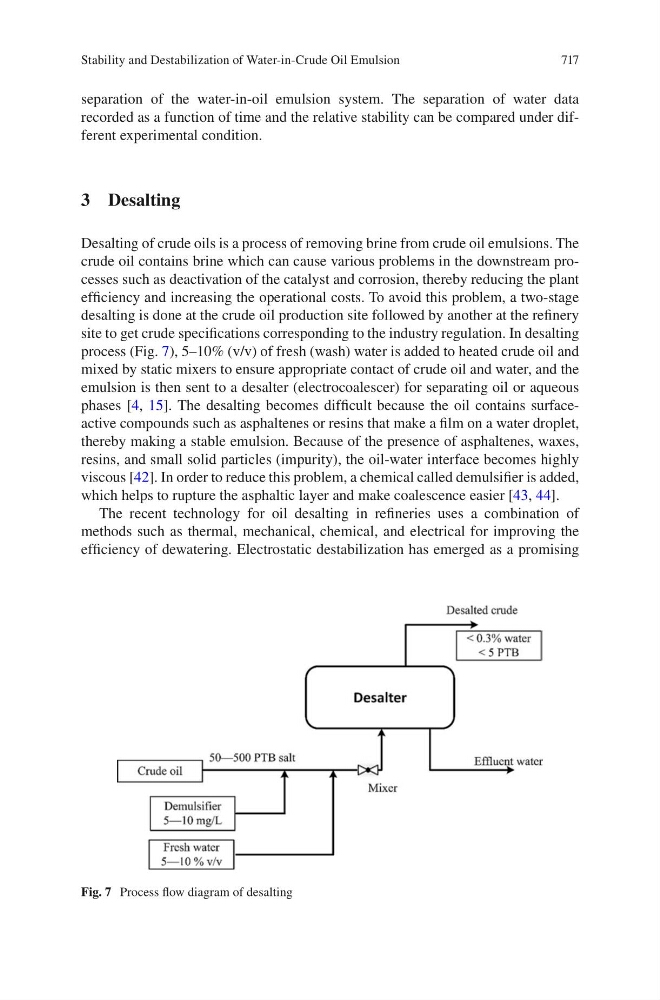
process (Fig. 7), 5–10% (v/v) of fresh (wash) water is added to heated crude oil and
mixed by static mixers to ensure appropriate contact of crude oil and water, and the
emulsion is then sent to a desalter (electrocoalescer) for separating oil or aqueous
phases [4, 15]. The desalting becomes difficult because the oil contains surfaceactive compounds such as asphaltenes or resins that make a film on a water droplet,
thereby making a stable emulsion. Because of the presence of asphaltenes, waxes,
resins, and small solid particles (impurity), the oil-water interface becomes highly
viscous [42]. In order to reduce this problem, a chemical called demulsifier is added,
which helps to rupture the asphaltic layer and make coalescence easier [43, 44].
The recent technology for oil desalting in refineries uses a combination of
methods such as thermal, mechanical, chemical, and electrical for improving the
efficiency of dewatering. Electrostatic destabilization has emerged as a promising
Fig. 7 Process flow diagram of desalting
Stability and Destabilization of Water-in-Crude Oil Emulsion