

716
tension. Because of low interfacial tension, water drops may be picked up by oil
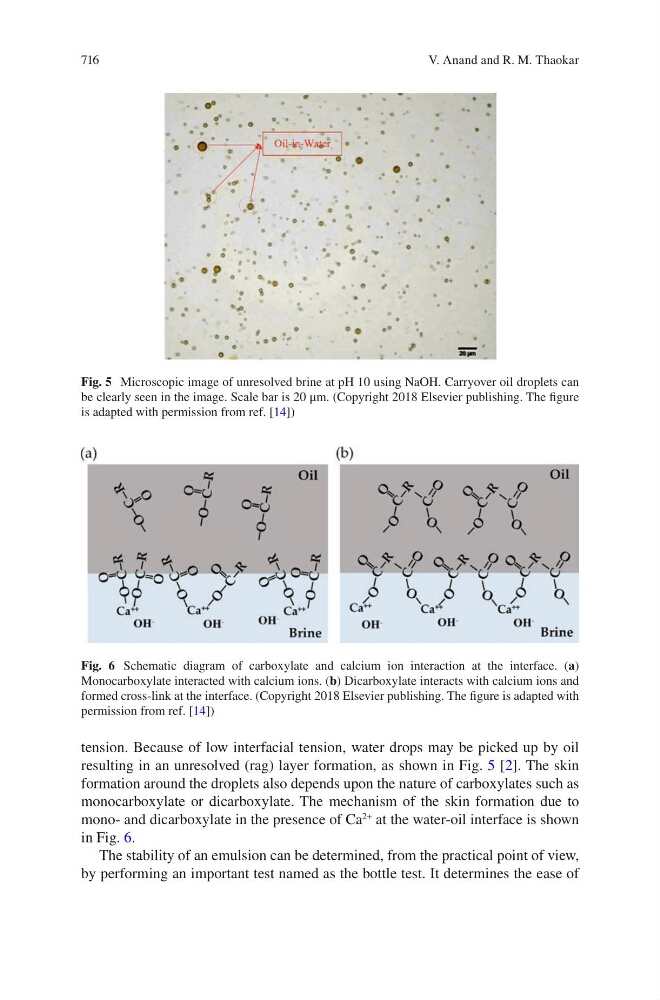
resulting in an unresolved (rag) layer formation, as shown in Fig. 5 [2]. The skin
formation around the droplets also depends upon the nature of carboxylates such as
monocarboxylate or dicarboxylate. The mechanism of the skin formation due to
mono- and dicarboxylate in the presence of Ca
2+
at the water-oil interface is shown
in Fig. 6.
The stability of an emulsion can be determined, from the practical point of view,
by performing an important test named as the bottle test. It determines the ease of
Fig. 5 Microscopic image of unresolved brine at pH 10 using NaOH. Carryover oil droplets can
be clearly seen in the image. Scale bar is 20 μm. (Copyright 2018 Elsevier publishing. The figure
is adapted with permission from ref. [14])
Fig. 6 Schematic diagram of carboxylate and calcium ion interaction at the interface. (a)
Monocarboxylate interacted with calcium ions. (b) Dicarboxylate interacts with calcium ions and
formed cross-link at the interface. (Copyright 2018 Elsevier publishing. The figure is adapted with
permission from ref. [14])
V. Anand and R. M. Thaokar