

701
propargyl ether possessing ~100% labeling efficiency was used as a labeling agent
via a coordination-insertion reaction to count the number of active sites in the catalyst [67]. Lately, single-site group four metal-based catalysts are developed to control the polymerization and stereochemistry of the product. Kinetic modeling is
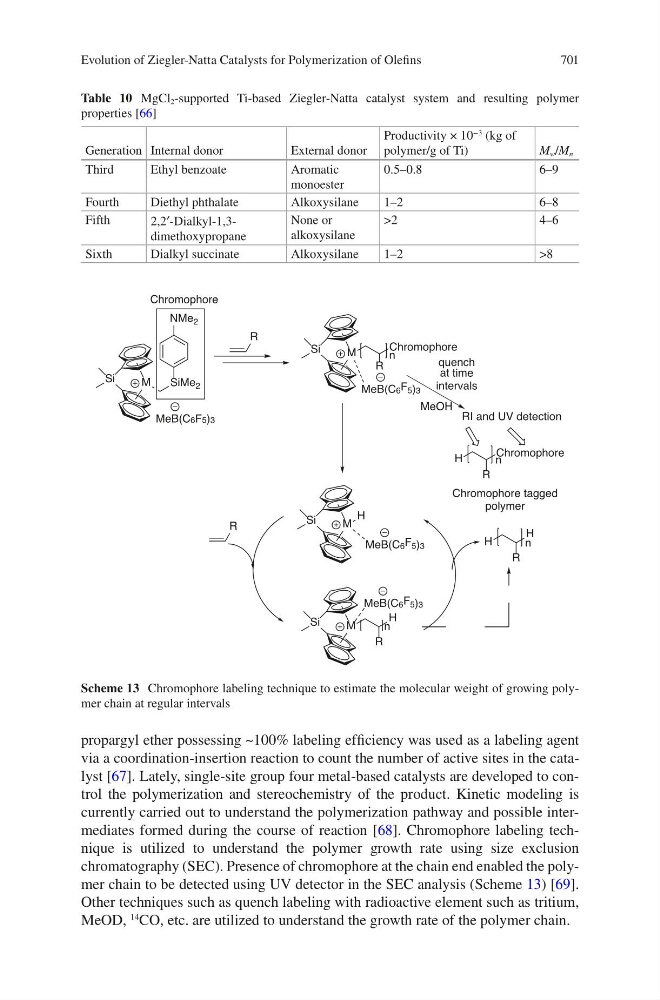
currently carried out to understand the polymerization pathway and possible intermediates formed during the course of reaction [68]. Chromophore labeling technique is utilized to understand the polymer growth rate using size exclusion
chromatography (SEC). Presence of chromophore at the chain end enabled the polymer chain to be detected using UV detector in the SEC analysis (Scheme 13) [69].
Other techniques such as quench labeling with radioactive element such as tritium,
MeOD,
14
CO, etc. are utilized to understand the growth rate of the polymer chain.
Table 10 MgCl 2 -supported Ti-based Ziegler-Natta catalyst system and resulting polymer
properties [66]
Generation Internal donor
External donor
Productivity × 10
−3 (kg of
polymer/g of Ti)
M w /M n
Third
Ethyl benzoate
Aromatic
monoester
0.5–0.8
6–9
Fourth
Diethyl phthalate
Alkoxysilane
1–2
6–8
Fifth
2,2′-Dialkyl-1,3dimethoxypropane
None or
alkoxysilane
>2
4–6
Sixth
Dialkyl succinate
Alkoxysilane
1–2
>8
M
Si
SiMe 2
NMe 2
Chromophore
MeB(C6F5)3
R
M
Si
MeB(C6 F 5)3
Chromophore
R
n
MeOH
quench
at time
intervals
M
Si
MeB(C6 F 5)3
H
M
Si
MeB(C6 F 5)3
H
R
n
R
H
H
R
n
H
Chromophore
R
n
Chromophore tagged
polymer
RI and UV detection
Scheme 13 Chromophore labeling technique to estimate the molecular weight of growing polymer chain at regular intervals
Evolution of Ziegler-Natta Catalysts for Polymerization of Olefins