

695
6 Vanadium-Based Complexes for Precise
Polyolefin Synthesis
It is well-known that in case of classical Ziegler-type catalyst system, the vanadiumbased catalyst produced high molecular weight polyolefin with narrow molecular
weight distribution at high activity (1000 kg PE/mol V h) [43]. The M w /M n value (1.5)
of the polymer obtained from V-based catalyst was much lower compared to that of
the Ti-based catalyst (15–30). This fact strongly suggested the formation of a single
catalytically active species in this catalysis [44]. The V-based catalyst also allowed
copolymerization of ethylene and propylene to produce high molecular weight amorphous polymers [45]. The catalyst system was subsequently extended to synthesis of
ethylene/propylene/diene copolymers (EPDM), which were commercialized as synthetic rubbers [46]. The ethylene-cyclic olefin copolymers (COC) synthesized using
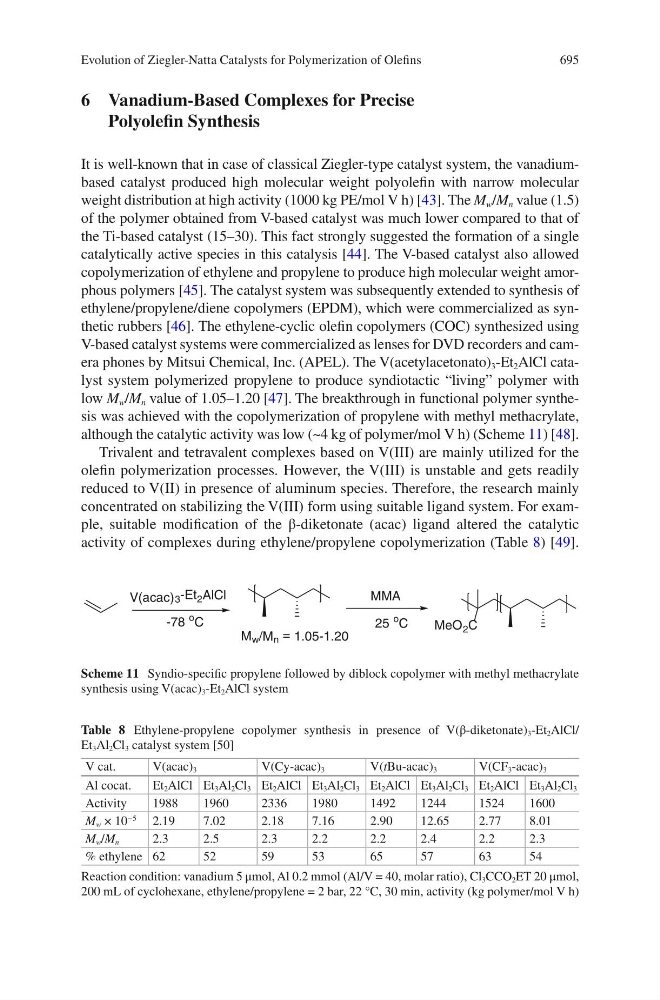
V-based catalyst systems were commercialized as lenses for DVD recorders and camera phones by Mitsui Chemical, Inc. (APEL). The V(acetylacetonato) 3 -Et 2 AlCl catalyst system polymerized propylene to produce syndiotactic “living” polymer with
low M w /M n value of 1.05–1.20 [47]. The breakthrough in functional polymer synthesis was achieved with the copolymerization of propylene with methyl methacrylate,
although the catalytic activity was low (~4 kg of polymer/mol V h) (Scheme 11) [48].
Trivalent and tetravalent complexes based on V(III) are mainly utilized for the
olefin polymerization processes. However, the V(III) is unstable and gets readily
reduced to V(II) in presence of aluminum species. Therefore, the research mainly
concentrated on stabilizing the V(III) form using suitable ligand system. For example, suitable modification of the β-diketonate (acac) ligand altered the catalytic
activity of complexes during ethylene/propylene copolymerization (Table 8) [49].
V(acac)3 -Et 2 AlCl
-78
o C
M w /M n = 1.05-1.20
MMA
25
o C
MeO 2 C
Scheme 11 Syndio-specific propylene followed by diblock copolymer with methyl methacrylate
synthesis using V(acac) 3 -Et 2 AlCl system
Table 8 Ethylene-propylene copolymer synthesis in presence of V(β-diketonate) 3 -Et 2 AlCl/
Et 3 Al 2 Cl 3 catalyst system [50]
V cat.
V(acac) 3
V(Cy-acac) 3
V(tBu-acac) 3
V(CF 3 -acac) 3
Al cocat.
Et 2 AlCl Et 3 Al 2 Cl 3 Et 2 AlCl Et 3 Al 2 Cl 3 Et 2 AlCl Et 3 Al 2 Cl 3 Et 2 AlCl Et 3 Al 2 Cl 3
Activity
1988
1960
2336
1980
1492
1244
1524
1600
M w × 10
−5
2.19
7.02
2.18
7.16
2.90
12.65
2.77
8.01
M w /M n
2.3
2.5
2.3
2.2
2.2
2.4
2.2
2.3
% ethylene 62
52
59
53
65
57
63
54
Reaction condition: vanadium 5 μmol, Al 0.2 mmol (Al/V = 40, molar ratio), Cl 3 CCO 2 ET 20 μmol,
200 mL of cyclohexane, ethylene/propylene = 2 bar, 22 °C, 30 min, activity (kg polymer/mol V h)
Evolution of Ziegler-Natta Catalysts for Polymerization of Olefins