

653
3.2.2 Task-Specific Ionic Liquids
The carbon dioxide solubility in the room temperature ionic liquids is very less;
therefore, further research has been focused to enhance the CO 2 solubility in ILs by
adding the functional groups. The task-specific ionic liquids (TSILs), also referred
as functionalized ionic liquids, are tailor-made for specific task to be executed. The
designer aspects of the ionic liquids are utilized in a sense that various functional
groups can be incorporated to the ionic liquid. The first TSIL was synthesized by
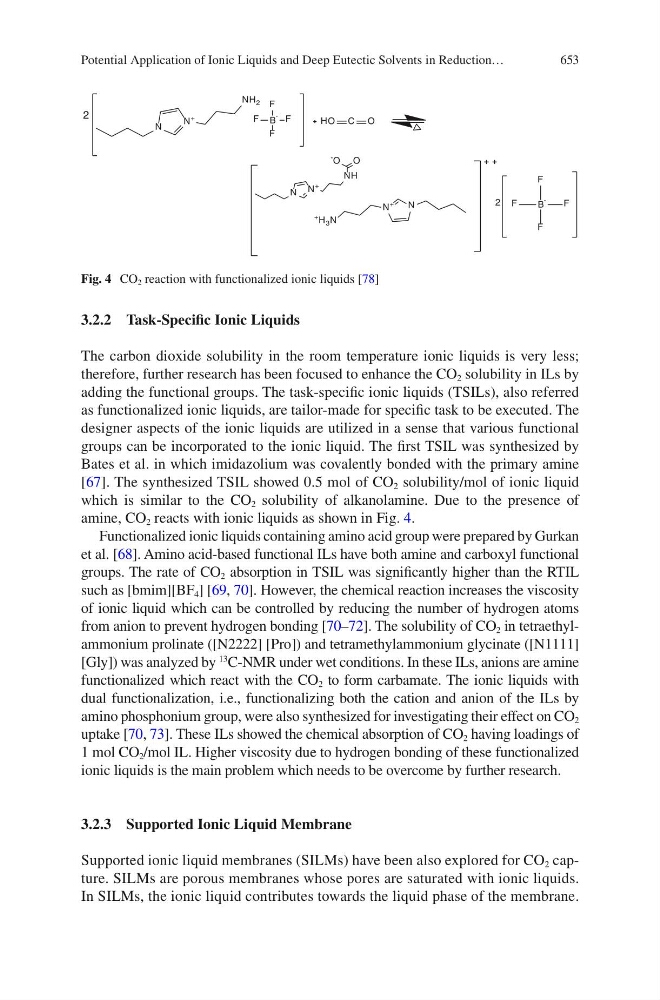
Bates et al. in which imidazolium was covalently bonded with the primary amine
[67]. The synthesized TSIL showed 0.5 mol of CO 2 solubility/mol of ionic liquid
which is similar to the CO 2 solubility of alkanolamine. Due to the presence of
amine, CO 2 reacts with ionic liquids as shown in Fig. 4.
Functionalized ionic liquids containing amino acid group were prepared by Gurkan
et al. [68]. Amino acid-based functional ILs have both amine and carboxyl functional
groups. The rate of CO 2 absorption in TSIL was significantly higher than the RTIL
such as [bmim][BF 4 ] [69, 70]. However, the chemical reaction increases the viscosity
of ionic liquid which can be controlled by reducing the number of hydrogen atoms
from anion to prevent hydrogen bonding [70–72]. The solubility of CO 2 in tetraethylammonium prolinate ([N2222] [Pro]) and tetramethylammonium glycinate ([N1111]
[Gly]) was analyzed by
13
C-NMR under wet conditions. In these ILs, anions are amine
functionalized which react with the CO 2 to form carbamate. The ionic liquids with
dual functionalization, i.e., functionalizing both the cation and anion of the ILs by
amino phosphonium group, were also synthesized for investigating their effect on CO 2
uptake [70, 73]. These ILs showed the chemical absorption of CO 2 having loadings of
1 mol CO 2 /mol IL. Higher viscosity due to hydrogen bonding of these functionalized
ionic liquids is the main problem which needs to be overcome by further research.
3.2.3 Supported Ionic Liquid Membrane
Supported ionic liquid membranes (SILMs) have been also explored for CO 2 capture. SILMs are porous membranes whose pores are saturated with ionic liquids.
In SILMs, the ionic liquid contributes towards the liquid phase of the membrane.
N
+
N
NH 2
B
-
F
F
F
F
C O
HO
N
+
N
NH
N
+
N
+ H 3 N
O
- O
B
-
F
F
F
F
2
2
Fig. 4 CO 2 reaction with functionalized ionic liquids [78]
Potential Application of Ionic Liquids and Deep Eutectic Solvents in Reduction…