

652
However, increasing the number of fluorine atoms on cation does not significantly
affect the CO 2 solubility [53]. The CO 2 absorption increases due to strong columbic
interaction suggesting that the effect of anion-IL interaction is more dominant as
compared to the cation-IL [54].
The 1-n-butyl-3-methylimidazolium acetate [bmim][Ac] has been found to be
RTIL which can absorb CO 2 through chemical reaction. Similarly, Yokozeki et al.
performed experiments for CO 2 solubility in 18 RTIL, eight of which showed chemisorption [55]. The imidazolium-based ILs have been widely studied for CO 2
solubility as well as for their interaction. The most acidic protonic carbon atom of
the imidazolium is considered to be responsible for CO 2 -IL interaction [56]. Similar
experiments by Kanakubo et al. asserted that there is preferentially CO 2 absorption
in PF 6 anion [57]. The selectivity of the conventional ionic liquid (bmim[PF 6 ]) was
highest for CO 2 compared to other gases. CO 2 selectivity of the ionic liquids was
further enhanced by using amine moieties such as [MDEA][Cl]-ionic liquids [58–
60]. IL consisting of guanidinium lactate anion has shown the higher CO 2 solubility
than [bmim][PF 6 ] [60]. Similar to lactate anion, CO 2 solubility can also be increased
by increasing the number of potential sites for CO 2 -IL interaction [61]. The CO 2
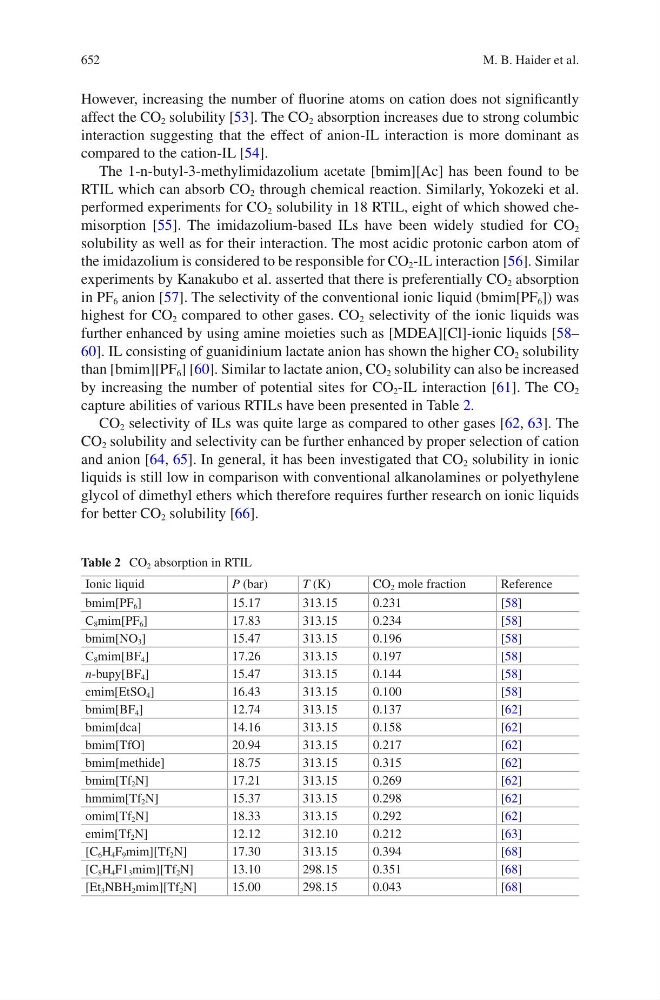
capture abilities of various RTILs have been presented in Table 2.
CO 2 selectivity of ILs was quite large as compared to other gases [62, 63]. The
CO 2 solubility and selectivity can be further enhanced by proper selection of cation
and anion [64, 65]. In general, it has been investigated that CO 2 solubility in ionic
liquids is still low in comparison with conventional alkanolamines or polyethylene
glycol of dimethyl ethers which therefore requires further research on ionic liquids
for better CO 2 solubility [66].
Table 2 CO 2 absorption in RTIL
Ionic liquid
P (bar)
T (K)
CO 2 mole fraction
Reference
bmim[PF 6 ]
15.17
313.15
0.231
[58]
C 8 mim[PF 6 ]
17.83
313.15
0.234
[58]
bmim[NO 3 ]
15.47
313.15
0.196
[58]
C 8 mim[BF 4 ]
17.26
313.15
0.197
[58]
n-bupy[BF 4 ]
15.47
313.15
0.144
[58]
emim[EtSO 4 ]
16.43
313.15
0.100
[58]
bmim[BF 4 ]
12.74
313.15
0.137
[62]
bmim[dca]
14.16
313.15
0.158
[62]
bmim[TfO]
20.94
313.15
0.217
[62]
bmim[methide]
18.75
313.15
0.315
[62]
bmim[Tf 2 N]
17.21
313.15
0.269
[62]
hmmim[Tf 2 N]
15.37
313.15
0.298
[62]
omim[Tf 2 N]
18.33
313.15
0.292
[62]
emim[Tf 2 N]
12.12
312.10
0.212
[63]
[C 6 H 4 F 9 mim][Tf 2 N]
17.30
313.15
0.394
[68]
[C 8 H 4 F1 3 mim][Tf 2 N]
13.10
298.15
0.351
[68]
[Et 3 NBH 2 mim][Tf 2 N]
15.00
298.15
0.043
[68]
M. B. Haider et al.