

587
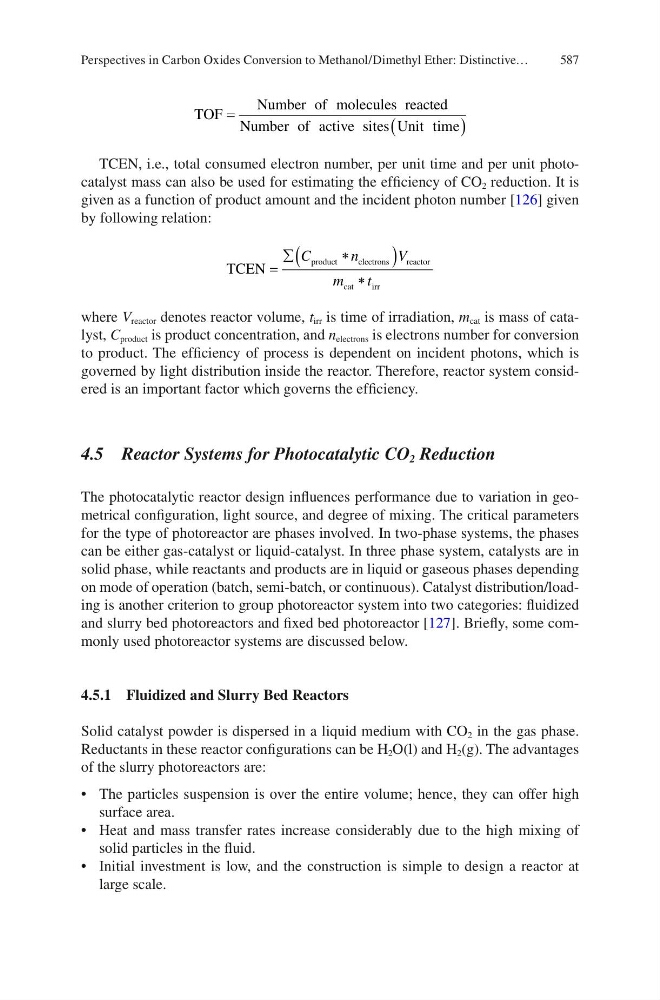
TOF
Number of molecules reacted
Number of active sites Unit time
=
(
)
TCEN, i.e., total consumed electron number, per unit time and per unit photocatalyst mass can also be used for estimating the efficiency of CO 2 reduction. It is
given as a function of product amount and the incident photon number [126] given
by following relation:
TCEN
product
e lectrons
reactor
cat
irr
=
∑
∗
(
)
∗
C
n
V
m
t
where V reactor denotes reactor volume, t irr is time of irradiation, m cat is mass of catalyst, C product is product concentration, and n electrons is electrons number for conversion
to product. The efficiency of process is dependent on incident photons, which is
governed by light distribution inside the reactor. Therefore, reactor system considered is an important factor which governs the efficiency.
4.5 Reactor Systems for Photocatalytic CO 2 Reduction
The photocatalytic reactor design influences performance due to variation in geometrical configuration, light source, and degree of mixing. The critical parameters
for the type of photoreactor are phases involved. In two-phase systems, the phases
can be either gas-catalyst or liquid-catalyst. In three phase system, catalysts are in
solid phase, while reactants and products are in liquid or gaseous phases depending
on mode of operation (batch, semi-batch, or continuous). Catalyst distribution/loading is another criterion to group photoreactor system into two categories: fluidized
and slurry bed photoreactors and fixed bed photoreactor [127]. Briefly, some commonly used photoreactor systems are discussed below.
4.5.1 Fluidized and Slurry Bed Reactors
Solid catalyst powder is dispersed in a liquid medium with CO 2 in the gas phase.
Reductants in these reactor configurations can be H 2 O(l) and H 2 (g). The advantages
of the slurry photoreactors are:
• The particles suspension is over the entire volume; hence, they can offer high
surface area.
• Heat and mass transfer rates increase considerably due to the high mixing of
solid particles in the fluid.
• Initial investment is low, and the construction is simple to design a reactor at
large scale.
Perspectives in Carbon Oxides Conversion to Methanol/Dimethyl Ether: Distinctive…
TOF
Number of molecules reacted
Number of active sites Unit time
=
(
)
TCEN, i.e., total consumed electron number, per unit time and per unit photocatalyst mass can also be used for estimating the efficiency of CO 2 reduction. It is
given as a function of product amount and the incident photon number [126] given
by following relation:
TCEN
product
e lectrons
reactor
cat
irr
=
∑
∗
(
)
∗
C
n
V
m
t
where V reactor denotes reactor volume, t irr is time of irradiation, m cat is mass of catalyst, C product is product concentration, and n electrons is electrons number for conversion
to product. The efficiency of process is dependent on incident photons, which is
governed by light distribution inside the reactor. Therefore, reactor system considered is an important factor which governs the efficiency.
4.5 Reactor Systems for Photocatalytic CO 2 Reduction
The photocatalytic reactor design influences performance due to variation in geometrical configuration, light source, and degree of mixing. The critical parameters
for the type of photoreactor are phases involved. In two-phase systems, the phases
can be either gas-catalyst or liquid-catalyst. In three phase system, catalysts are in
solid phase, while reactants and products are in liquid or gaseous phases depending
on mode of operation (batch, semi-batch, or continuous). Catalyst distribution/loading is another criterion to group photoreactor system into two categories: fluidized
and slurry bed photoreactors and fixed bed photoreactor [127]. Briefly, some commonly used photoreactor systems are discussed below.
4.5.1 Fluidized and Slurry Bed Reactors
Solid catalyst powder is dispersed in a liquid medium with CO 2 in the gas phase.
Reductants in these reactor configurations can be H 2 O(l) and H 2 (g). The advantages
of the slurry photoreactors are:
• The particles suspension is over the entire volume; hence, they can offer high
surface area.
• Heat and mass transfer rates increase considerably due to the high mixing of
solid particles in the fluid.
• Initial investment is low, and the construction is simple to design a reactor at
large scale.
Perspectives in Carbon Oxides Conversion to Methanol/Dimethyl Ether: Distinctive…