

586
therefore, to qualitatively select a catalyst uniform scale to quantify, the activity is
required.
Efficiency Measurement
The photocatalytic reaction rate can be measured as product yield expressed in
μmolg
−1
h
−1
or pm g
−1
h
−1
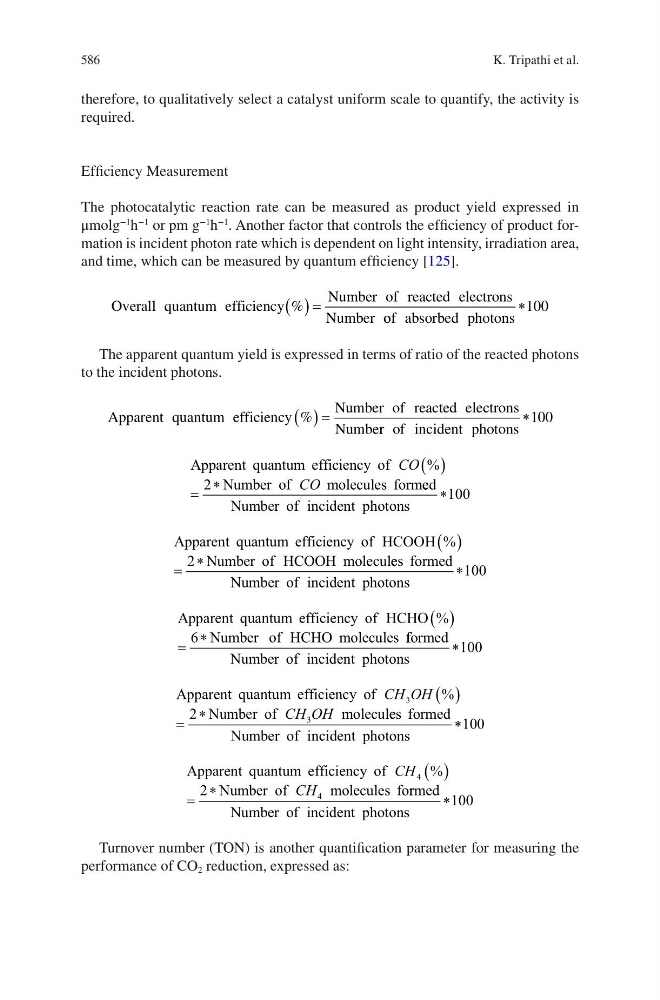
. Another factor that controls the efficiency of product formation is incident photon rate which is dependent on light intensity, irradiation area,
and time, which can be measured by quantum efficiency [125].
Overall quantum efficiency
Number of reacted electrons
Number
%
( ) =
o of absorbed photons
∗100
The apparent quantum yield is expressed in terms of ratio of the reacted photons
to the incident photons.
Apparent quantum efficiency
Number of reacted electrons
Numbe
%
( ) =
r r of incident photons
∗100
Apparent quantum efficiency of
Number of
molecules form
CO
CO
%
( )
=
∗
2
e ed
Number of incident photons
∗100
Apparent quantum efficiency of HCOOH
Number of HCOOH molecul
%
( )
=
∗
2
e es formed
Number of incident photons
∗100
Apparent quantum efficiency of HCHO
Number of HCHO molecules
%
( )
=
∗
6
f formed
Number of incident photons
∗100
Apparent quantum efficiency of
Number of
molecul
CH OH
CH OH
3
3
2
%
( )
=
∗
e es formed
Number of incident photons
∗100
Apparent quantum efficiency of
Number of
molecules fo
CH
CH
4
4
2
%
( )
=
∗
r rmed
Number of incident photons
∗100
Turnover number (TON) is another quantification parameter for measuring the
performance of CO 2 reduction, expressed as:
K. Tripathi et al.
therefore, to qualitatively select a catalyst uniform scale to quantify, the activity is
required.
Efficiency Measurement
The photocatalytic reaction rate can be measured as product yield expressed in
μmolg
−1
h
−1
or pm g
−1
h
−1
. Another factor that controls the efficiency of product formation is incident photon rate which is dependent on light intensity, irradiation area,
and time, which can be measured by quantum efficiency [125].
Overall quantum efficiency
Number of reacted electrons
Number
%
( ) =
o of absorbed photons
∗100
The apparent quantum yield is expressed in terms of ratio of the reacted photons
to the incident photons.
Apparent quantum efficiency
Number of reacted electrons
Numbe
%
( ) =
r r of incident photons
∗100
Apparent quantum efficiency of
Number of
molecules form
CO
CO
%
( )
=
∗
2
e ed
Number of incident photons
∗100
Apparent quantum efficiency of HCOOH
Number of HCOOH molecul
%
( )
=
∗
2
e es formed
Number of incident photons
∗100
Apparent quantum efficiency of HCHO
Number of HCHO molecules
%
( )
=
∗
6
f formed
Number of incident photons
∗100
Apparent quantum efficiency of
Number of
molecul
CH OH
CH OH
3
3
2
%
( )
=
∗
e es formed
Number of incident photons
∗100
Apparent quantum efficiency of
Number of
molecules fo
CH
CH
4
4
2
%
( )
=
∗
r rmed
Number of incident photons
∗100
Turnover number (TON) is another quantification parameter for measuring the
performance of CO 2 reduction, expressed as:
K. Tripathi et al.