

550
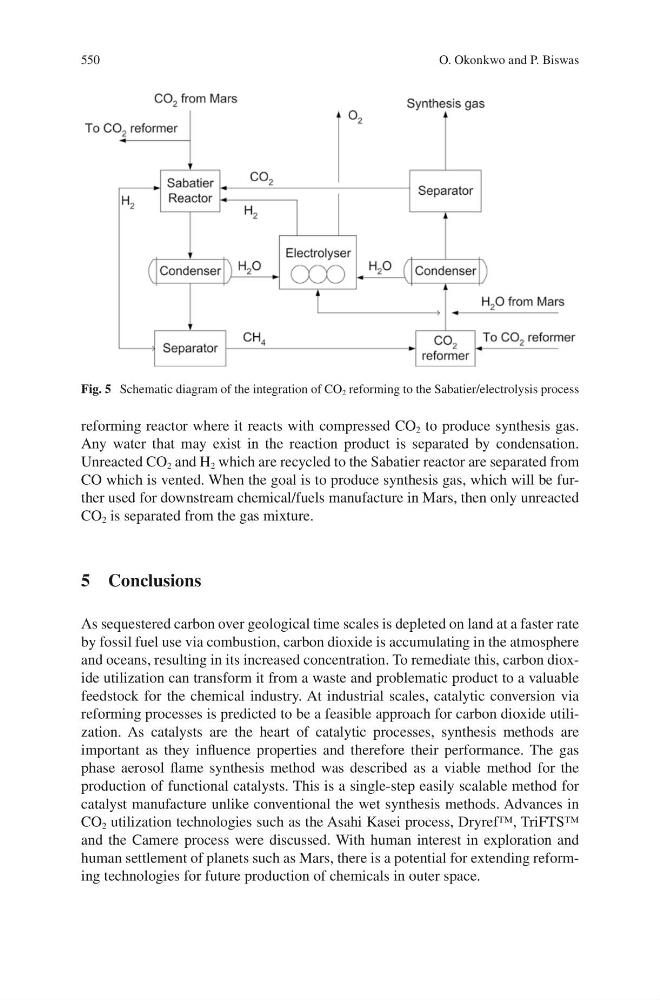
reforming reactor where it reacts with compressed CO 2 to produce synthesis gas.
Any water that may exist in the reaction product is separated by condensation.
Unreacted CO 2 and H 2 which are recycled to the Sabatier reactor are separated from
CO which is vented. When the goal is to produce synthesis gas, which will be further used for downstream chemical/fuels manufacture in Mars, then only unreacted
CO 2 is separated from the gas mixture.
5 Conclusions
As sequestered carbon over geological time scales is depleted on land at a faster rate
by fossil fuel use via combustion, carbon dioxide is accumulating in the atmosphere
and oceans, resulting in its increased concentration. To remediate this, carbon dioxide utilization can transform it from a waste and problematic product to a valuable
feedstock for the chemical industry. At industrial scales, catalytic conversion via
reforming processes is predicted to be a feasible approach for carbon dioxide utilization. As catalysts are the heart of catalytic processes, synthesis methods are
important as they influence properties and therefore their performance. The gas
phase aerosol flame synthesis method was described as a viable method for the
production of functional catalysts. This is a single-step easily scalable method for
catalyst manufacture unlike conventional the wet synthesis methods. Advances in
CO 2 utilization technologies such as the Asahi Kasei process, Dryref™, TriFTS™
and the Camere process were discussed. With human interest in exploration and
human settlement of planets such as Mars, there is a potential for extending reforming technologies for future production of chemicals in outer space.
Fig. 5 Schematic diagram of the integration of CO 2 reforming to the Sabatier/electrolysis process
O. Okonkwo and P. Biswas
reforming reactor where it reacts with compressed CO 2 to produce synthesis gas.
Any water that may exist in the reaction product is separated by condensation.
Unreacted CO 2 and H 2 which are recycled to the Sabatier reactor are separated from
CO which is vented. When the goal is to produce synthesis gas, which will be further used for downstream chemical/fuels manufacture in Mars, then only unreacted
CO 2 is separated from the gas mixture.
5 Conclusions
As sequestered carbon over geological time scales is depleted on land at a faster rate
by fossil fuel use via combustion, carbon dioxide is accumulating in the atmosphere
and oceans, resulting in its increased concentration. To remediate this, carbon dioxide utilization can transform it from a waste and problematic product to a valuable
feedstock for the chemical industry. At industrial scales, catalytic conversion via
reforming processes is predicted to be a feasible approach for carbon dioxide utilization. As catalysts are the heart of catalytic processes, synthesis methods are
important as they influence properties and therefore their performance. The gas
phase aerosol flame synthesis method was described as a viable method for the
production of functional catalysts. This is a single-step easily scalable method for
catalyst manufacture unlike conventional the wet synthesis methods. Advances in
CO 2 utilization technologies such as the Asahi Kasei process, Dryref™, TriFTS™
and the Camere process were discussed. With human interest in exploration and
human settlement of planets such as Mars, there is a potential for extending reforming technologies for future production of chemicals in outer space.
Fig. 5 Schematic diagram of the integration of CO 2 reforming to the Sabatier/electrolysis process
O. Okonkwo and P. Biswas