

549
The oxygen can be used as a propellant or life support while the hydrogen is recycled back to the Sabatier reactor. An external source of H 2 is required for continuous
operation, as only half the amount of H 2 utilised by the Sabatier process is generated
by electrolysis. Electrolysis of water obtained from Mars can be used to provide the
additional hydrogen required while producing oxygen at the right ratio (3.4:1 O 2 /
methane mass ratio) for the combustion of methane as rocket fuel [101].
Dry reforming has the potential to improve space missions and human colonisation of Mars in two distinct ways.
1. In life support systems, based on the Sabatier/electrolysis process, produced
methane can be reformed with carbon dioxide to produce hydrogen which will
close the loop and potentially eliminate the need for additional hydrogen for the
Sabatier reaction
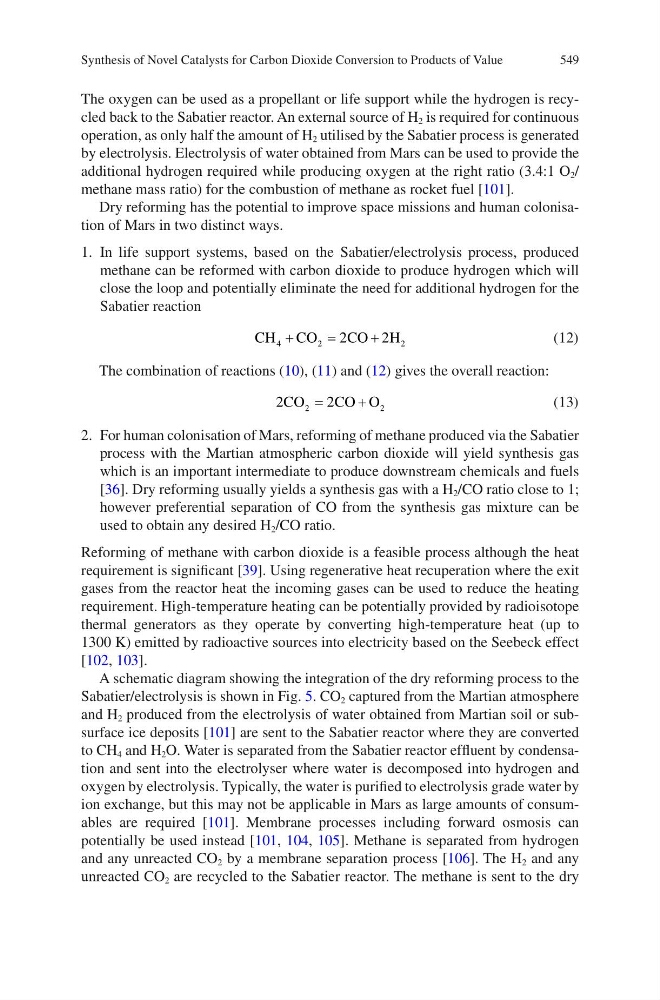
CH CO
CO H
4
2
2
2
2
+
=
+
(12)
The combination of reactions (10), (11) and (12) gives the overall reaction:
2
2
2
2
CO
CO O
=
+
(13)
2. For human colonisation of Mars, reforming of methane produced via the Sabatier
process with the Martian atmospheric carbon dioxide will yield synthesis gas
which is an important intermediate to produce downstream chemicals and fuels
[36]. Dry reforming usually yields a synthesis gas with a H 2 /CO ratio close to 1;
however preferential separation of CO from the synthesis gas mixture can be
used to obtain any desired H 2 /CO ratio.
Reforming of methane with carbon dioxide is a feasible process although the heat
requirement is significant [39]. Using regenerative heat recuperation where the exit
gases from the reactor heat the incoming gases can be used to reduce the heating
requirement. High-temperature heating can be potentially provided by radioisotope
thermal generators as they operate by converting high-temperature heat (up to
1300 K) emitted by radioactive sources into electricity based on the Seebeck effect
[102, 103].
A schematic diagram showing the integration of the dry reforming process to the
Sabatier/electrolysis is shown in Fig. 5. CO 2 captured from the Martian atmosphere
and H 2 produced from the electrolysis of water obtained from Martian soil or subsurface ice deposits [101] are sent to the Sabatier reactor where they are converted
to CH 4 and H 2 O. Water is separated from the Sabatier reactor effluent by condensation and sent into the electrolyser where water is decomposed into hydrogen and
oxygen by electrolysis. Typically, the water is purified to electrolysis grade water by
ion exchange, but this may not be applicable in Mars as large amounts of consumables are required [101]. Membrane processes including forward osmosis can
potentially be used instead [101, 104, 105]. Methane is separated from hydrogen
and any unreacted CO 2 by a membrane separation process [106]. The H 2 and any
unreacted CO 2 are recycled to the Sabatier reactor. The methane is sent to the dry
Synthesis of Novel Catalysts for Carbon Dioxide Conversion to Products of Value
The oxygen can be used as a propellant or life support while the hydrogen is recycled back to the Sabatier reactor. An external source of H 2 is required for continuous
operation, as only half the amount of H 2 utilised by the Sabatier process is generated
by electrolysis. Electrolysis of water obtained from Mars can be used to provide the
additional hydrogen required while producing oxygen at the right ratio (3.4:1 O 2 /
methane mass ratio) for the combustion of methane as rocket fuel [101].
Dry reforming has the potential to improve space missions and human colonisation of Mars in two distinct ways.
1. In life support systems, based on the Sabatier/electrolysis process, produced
methane can be reformed with carbon dioxide to produce hydrogen which will
close the loop and potentially eliminate the need for additional hydrogen for the
Sabatier reaction
CH CO
CO H
4
2
2
2
2
+
=
+
(12)
The combination of reactions (10), (11) and (12) gives the overall reaction:
2
2
2
2
CO
CO O
=
+
(13)
2. For human colonisation of Mars, reforming of methane produced via the Sabatier
process with the Martian atmospheric carbon dioxide will yield synthesis gas
which is an important intermediate to produce downstream chemicals and fuels
[36]. Dry reforming usually yields a synthesis gas with a H 2 /CO ratio close to 1;
however preferential separation of CO from the synthesis gas mixture can be
used to obtain any desired H 2 /CO ratio.
Reforming of methane with carbon dioxide is a feasible process although the heat
requirement is significant [39]. Using regenerative heat recuperation where the exit
gases from the reactor heat the incoming gases can be used to reduce the heating
requirement. High-temperature heating can be potentially provided by radioisotope
thermal generators as they operate by converting high-temperature heat (up to
1300 K) emitted by radioactive sources into electricity based on the Seebeck effect
[102, 103].
A schematic diagram showing the integration of the dry reforming process to the
Sabatier/electrolysis is shown in Fig. 5. CO 2 captured from the Martian atmosphere
and H 2 produced from the electrolysis of water obtained from Martian soil or subsurface ice deposits [101] are sent to the Sabatier reactor where they are converted
to CH 4 and H 2 O. Water is separated from the Sabatier reactor effluent by condensation and sent into the electrolyser where water is decomposed into hydrogen and
oxygen by electrolysis. Typically, the water is purified to electrolysis grade water by
ion exchange, but this may not be applicable in Mars as large amounts of consumables are required [101]. Membrane processes including forward osmosis can
potentially be used instead [101, 104, 105]. Methane is separated from hydrogen
and any unreacted CO 2 by a membrane separation process [106]. The H 2 and any
unreacted CO 2 are recycled to the Sabatier reactor. The methane is sent to the dry
Synthesis of Novel Catalysts for Carbon Dioxide Conversion to Products of Value