

508
Stevens rearrangement to form a methylethyl oxonium ion. This intermediate further leads to formation of ethylene and methanol. However, if the resultant ethylene
reacts with the methyl carbocation, it results in propylene formation as depicted in
Scheme 1.
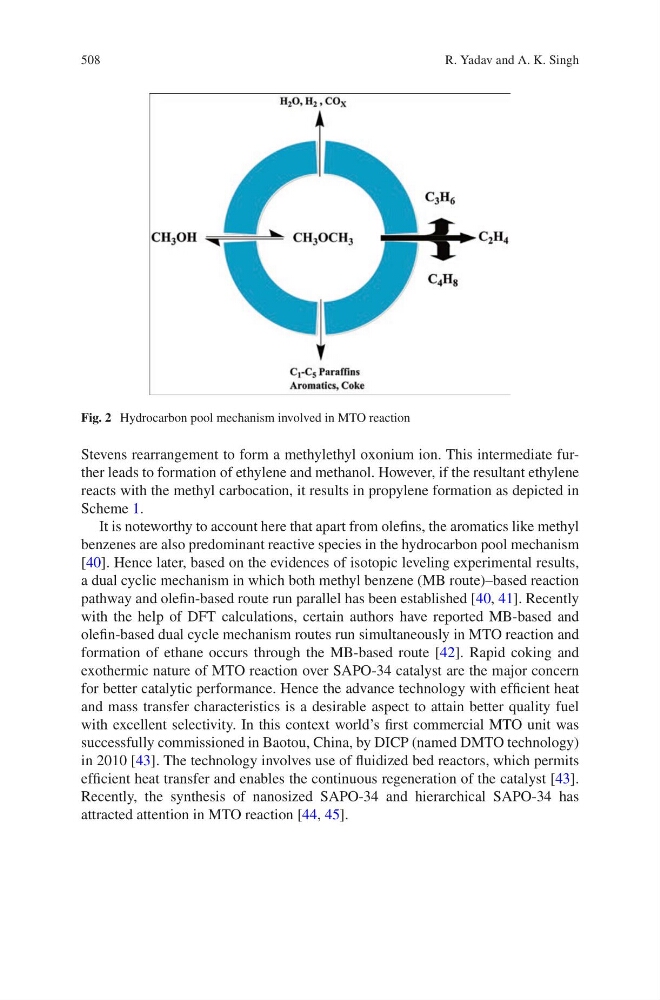
It is noteworthy to account here that apart from olefins, the aromatics like methyl
benzenes are also predominant reactive species in the hydrocarbon pool mechanism
[40]. Hence later, based on the evidences of isotopic leveling experimental results,
a dual cyclic mechanism in which both methyl benzene (MB route)–based reaction
pathway and olefin-based route run parallel has been established [40, 41]. Recently
with the help of DFT calculations, certain authors have reported MB-based and
olefin-based dual cycle mechanism routes run simultaneously in MTO reaction and
formation of ethane occurs through the MB-based route [42]. Rapid coking and
exothermic nature of MTO reaction over SAPO-34 catalyst are the major concern
for better catalytic performance. Hence the advance technology with efficient heat
and mass transfer characteristics is a desirable aspect to attain better quality fuel
with excellent selectivity. In this context world’s first commercial MTO unit was
successfully commissioned in Baotou, China, by DICP (named DMTO technology)
in 2010 [43]. The technology involves use of fluidized bed reactors, which permits
efficient heat transfer and enables the continuous regeneration of the catalyst [43].
Recently, the synthesis of nanosized SAPO-34 and hierarchical SAPO-34 has
attracted attention in MTO reaction [44, 45].
Fig. 2 Hydrocarbon pool mechanism involved in MTO reaction
R. Yadav and A. K. Singh
Stevens rearrangement to form a methylethyl oxonium ion. This intermediate further leads to formation of ethylene and methanol. However, if the resultant ethylene
reacts with the methyl carbocation, it results in propylene formation as depicted in
Scheme 1.
It is noteworthy to account here that apart from olefins, the aromatics like methyl
benzenes are also predominant reactive species in the hydrocarbon pool mechanism
[40]. Hence later, based on the evidences of isotopic leveling experimental results,
a dual cyclic mechanism in which both methyl benzene (MB route)–based reaction
pathway and olefin-based route run parallel has been established [40, 41]. Recently
with the help of DFT calculations, certain authors have reported MB-based and
olefin-based dual cycle mechanism routes run simultaneously in MTO reaction and
formation of ethane occurs through the MB-based route [42]. Rapid coking and
exothermic nature of MTO reaction over SAPO-34 catalyst are the major concern
for better catalytic performance. Hence the advance technology with efficient heat
and mass transfer characteristics is a desirable aspect to attain better quality fuel
with excellent selectivity. In this context world’s first commercial MTO unit was
successfully commissioned in Baotou, China, by DICP (named DMTO technology)
in 2010 [43]. The technology involves use of fluidized bed reactors, which permits
efficient heat transfer and enables the continuous regeneration of the catalyst [43].
Recently, the synthesis of nanosized SAPO-34 and hierarchical SAPO-34 has
attracted attention in MTO reaction [44, 45].
Fig. 2 Hydrocarbon pool mechanism involved in MTO reaction
R. Yadav and A. K. Singh