

39
Zhou et al. [11] studied the HDS and HDN of FCC diesel using NiMo/USY
zeolite catalysts modified with gallium, phosphorous, and a combination of gallium
and phosphorous. Ga- and P-modified USY zeolite catalysts showed higher HDS
and HDN efficiencies compared to conventional NiMo-based catalysts. Higher
HDS activity of gallium- and phosphorous-modified USY catalysts, especially for
the removal of refractory organosulfur compounds present in FCC diesel, was
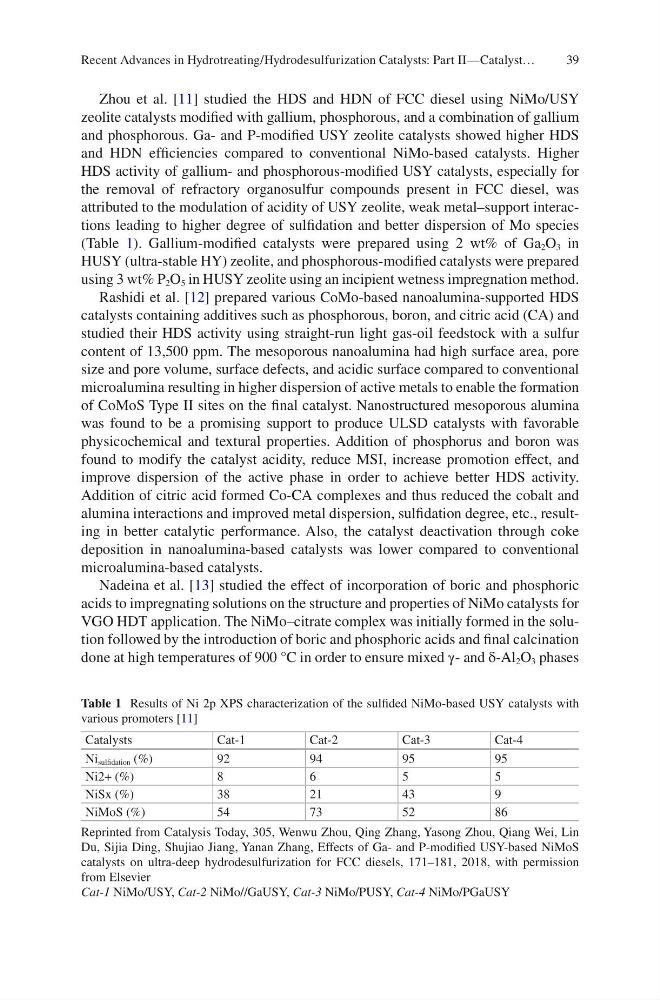
attributed to the modulation of acidity of USY zeolite, weak metal–support interactions leading to higher degree of sulfidation and better dispersion of Mo species
(Table 1). Gallium-modified catalysts were prepared using 2 wt% of Ga 2 O 3 in
HUSY (ultra-stable HY) zeolite, and phosphorous-modified catalysts were prepared
using 3 wt% P 2 O 5 in HUSY zeolite using an incipient wetness impregnation method.
Rashidi et al. [12] prepared various CoMo-based nanoalumina-supported HDS
catalysts containing additives such as phosphorous, boron, and citric acid (CA) and
studied their HDS activity using straight-run light gas-oil feedstock with a sulfur
content of 13,500 ppm. The mesoporous nanoalumina had high surface area, pore
size and pore volume, surface defects, and acidic surface compared to conventional
microalumina resulting in higher dispersion of active metals to enable the formation
of CoMoS Type II sites on the final catalyst. Nanostructured mesoporous alumina
was found to be a promising support to produce ULSD catalysts with favorable
physicochemical and textural properties. Addition of phosphorus and boron was
found to modify the catalyst acidity, reduce MSI, increase promotion effect, and
improve dispersion of the active phase in order to achieve better HDS activity.
Addition of citric acid formed Co-CA complexes and thus reduced the cobalt and
alumina interactions and improved metal dispersion, sulfidation degree, etc., resulting in better catalytic performance. Also, the catalyst deactivation through coke
deposition in nanoalumina-based catalysts was lower compared to conventional
microalumina-based catalysts.
Nadeina et al. [13] studied the effect of incorporation of boric and phosphoric
acids to impregnating solutions on the structure and properties of NiMo catalysts for
VGO HDT application. The NiMo–citrate complex was initially formed in the solution followed by the introduction of boric and phosphoric acids and final calcination
done at high temperatures of 900 °C in order to ensure mixed γ- and δ-Al 2 O 3 phases
Table 1 Results of Ni 2p XPS characterization of the sulfided NiMo-based USY catalysts with
various promoters [11]
Catalysts
Cat-1
Cat-2
Cat-3
Cat-4
Ni sulfidation (%)
92
94
95
95
Ni2+ (%)
8
6
5
5
NiSx (%)
38
21
43
9
NiMoS (%)
54
73
52
86
Reprinted from Catalysis Today, 305, Wenwu Zhou, Qing Zhang, Yasong Zhou, Qiang Wei, Lin
Du, Sijia Ding, Shujiao Jiang, Yanan Zhang, Effects of Ga- and P-modified USY-based NiMoS
catalysts on ultra-deep hydrodesulfurization for FCC diesels, 171–181, 2018, with permission
from Elsevier
Cat-1 NiMo/USY, Cat-2 NiMo//GaUSY, Cat-3 NiMo/PUSY, Cat-4 NiMo/PGaUSY
Recent Advances in Hydrotreating/Hydrodesulfurization Catalysts: Part II—Catalyst…
Zhou et al. [11] studied the HDS and HDN of FCC diesel using NiMo/USY
zeolite catalysts modified with gallium, phosphorous, and a combination of gallium
and phosphorous. Ga- and P-modified USY zeolite catalysts showed higher HDS
and HDN efficiencies compared to conventional NiMo-based catalysts. Higher
HDS activity of gallium- and phosphorous-modified USY catalysts, especially for
the removal of refractory organosulfur compounds present in FCC diesel, was
attributed to the modulation of acidity of USY zeolite, weak metal–support interactions leading to higher degree of sulfidation and better dispersion of Mo species
(Table 1). Gallium-modified catalysts were prepared using 2 wt% of Ga 2 O 3 in
HUSY (ultra-stable HY) zeolite, and phosphorous-modified catalysts were prepared
using 3 wt% P 2 O 5 in HUSY zeolite using an incipient wetness impregnation method.
Rashidi et al. [12] prepared various CoMo-based nanoalumina-supported HDS
catalysts containing additives such as phosphorous, boron, and citric acid (CA) and
studied their HDS activity using straight-run light gas-oil feedstock with a sulfur
content of 13,500 ppm. The mesoporous nanoalumina had high surface area, pore
size and pore volume, surface defects, and acidic surface compared to conventional
microalumina resulting in higher dispersion of active metals to enable the formation
of CoMoS Type II sites on the final catalyst. Nanostructured mesoporous alumina
was found to be a promising support to produce ULSD catalysts with favorable
physicochemical and textural properties. Addition of phosphorus and boron was
found to modify the catalyst acidity, reduce MSI, increase promotion effect, and
improve dispersion of the active phase in order to achieve better HDS activity.
Addition of citric acid formed Co-CA complexes and thus reduced the cobalt and
alumina interactions and improved metal dispersion, sulfidation degree, etc., resulting in better catalytic performance. Also, the catalyst deactivation through coke
deposition in nanoalumina-based catalysts was lower compared to conventional
microalumina-based catalysts.
Nadeina et al. [13] studied the effect of incorporation of boric and phosphoric
acids to impregnating solutions on the structure and properties of NiMo catalysts for
VGO HDT application. The NiMo–citrate complex was initially formed in the solution followed by the introduction of boric and phosphoric acids and final calcination
done at high temperatures of 900 °C in order to ensure mixed γ- and δ-Al 2 O 3 phases
Table 1 Results of Ni 2p XPS characterization of the sulfided NiMo-based USY catalysts with
various promoters [11]
Catalysts
Cat-1
Cat-2
Cat-3
Cat-4
Ni sulfidation (%)
92
94
95
95
Ni2+ (%)
8
6
5
5
NiSx (%)
38
21
43
9
NiMoS (%)
54
73
52
86
Reprinted from Catalysis Today, 305, Wenwu Zhou, Qing Zhang, Yasong Zhou, Qiang Wei, Lin
Du, Sijia Ding, Shujiao Jiang, Yanan Zhang, Effects of Ga- and P-modified USY-based NiMoS
catalysts on ultra-deep hydrodesulfurization for FCC diesels, 171–181, 2018, with permission
from Elsevier
Cat-1 NiMo/USY, Cat-2 NiMo//GaUSY, Cat-3 NiMo/PUSY, Cat-4 NiMo/PGaUSY
Recent Advances in Hydrotreating/Hydrodesulfurization Catalysts: Part II—Catalyst…