

38
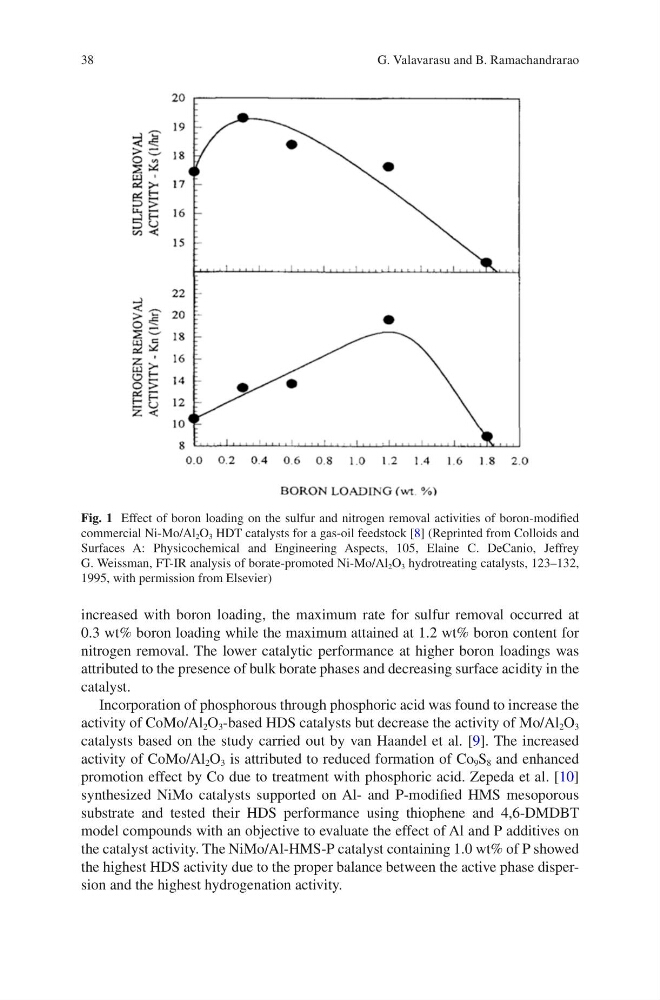
increased with boron loading, the maximum rate for sulfur removal occurred at
0.3 wt% boron loading while the maximum attained at 1.2 wt% boron content for
nitrogen removal. The lower catalytic performance at higher boron loadings was
attributed to the presence of bulk borate phases and decreasing surface acidity in the
catalyst.
Incorporation of phosphorous through phosphoric acid was found to increase the
activity of CoMo/Al 2 O 3 -based HDS catalysts but decrease the activity of Mo/Al 2 O 3
catalysts based on the study carried out by van Haandel et al. [9]. The increased
activity of CoMo/Al 2 O 3 is attributed to reduced formation of Co 9 S 8 and enhanced
promotion effect by Co due to treatment with phosphoric acid. Zepeda et al. [10]
synthesized NiMo catalysts supported on Al- and P-modified HMS mesoporous
substrate and tested their HDS performance using thiophene and 4,6-DMDBT
model compounds with an objective to evaluate the effect of Al and P additives on
the catalyst activity. The NiMo/Al-HMS-P catalyst containing 1.0 wt% of P showed
the highest HDS activity due to the proper balance between the active phase dispersion and the highest hydrogenation activity.
Fig. 1 Effect of boron loading on the sulfur and nitrogen removal activities of boron-modified
commercial Ni-Mo/Al 2 O 3 HDT catalysts for a gas-oil feedstock [8] (Reprinted from Colloids and
Surfaces A: Physicochemical and Engineering Aspects, 105, Elaine C. DeCanio, Jeffrey
G. Weissman, FT-IR analysis of borate-promoted Ni-Mo/Al 2 O 3 hydrotreating catalysts, 123–132,
1995, with permission from Elsevier)
G. Valavarasu and B. Ramachandrarao
increased with boron loading, the maximum rate for sulfur removal occurred at
0.3 wt% boron loading while the maximum attained at 1.2 wt% boron content for
nitrogen removal. The lower catalytic performance at higher boron loadings was
attributed to the presence of bulk borate phases and decreasing surface acidity in the
catalyst.
Incorporation of phosphorous through phosphoric acid was found to increase the
activity of CoMo/Al 2 O 3 -based HDS catalysts but decrease the activity of Mo/Al 2 O 3
catalysts based on the study carried out by van Haandel et al. [9]. The increased
activity of CoMo/Al 2 O 3 is attributed to reduced formation of Co 9 S 8 and enhanced
promotion effect by Co due to treatment with phosphoric acid. Zepeda et al. [10]
synthesized NiMo catalysts supported on Al- and P-modified HMS mesoporous
substrate and tested their HDS performance using thiophene and 4,6-DMDBT
model compounds with an objective to evaluate the effect of Al and P additives on
the catalyst activity. The NiMo/Al-HMS-P catalyst containing 1.0 wt% of P showed
the highest HDS activity due to the proper balance between the active phase dispersion and the highest hydrogenation activity.
Fig. 1 Effect of boron loading on the sulfur and nitrogen removal activities of boron-modified
commercial Ni-Mo/Al 2 O 3 HDT catalysts for a gas-oil feedstock [8] (Reprinted from Colloids and
Surfaces A: Physicochemical and Engineering Aspects, 105, Elaine C. DeCanio, Jeffrey
G. Weissman, FT-IR analysis of borate-promoted Ni-Mo/Al 2 O 3 hydrotreating catalysts, 123–132,
1995, with permission from Elsevier)
G. Valavarasu and B. Ramachandrarao