

463
some recent implications of various model results, the shortcomings, and the advantage of the general mechanistic modeling approach of the Fischer-Tropsch reaction.
2 FTS Mechanism
Over the years, authors have proposed various mechanisms for the FTS process. In
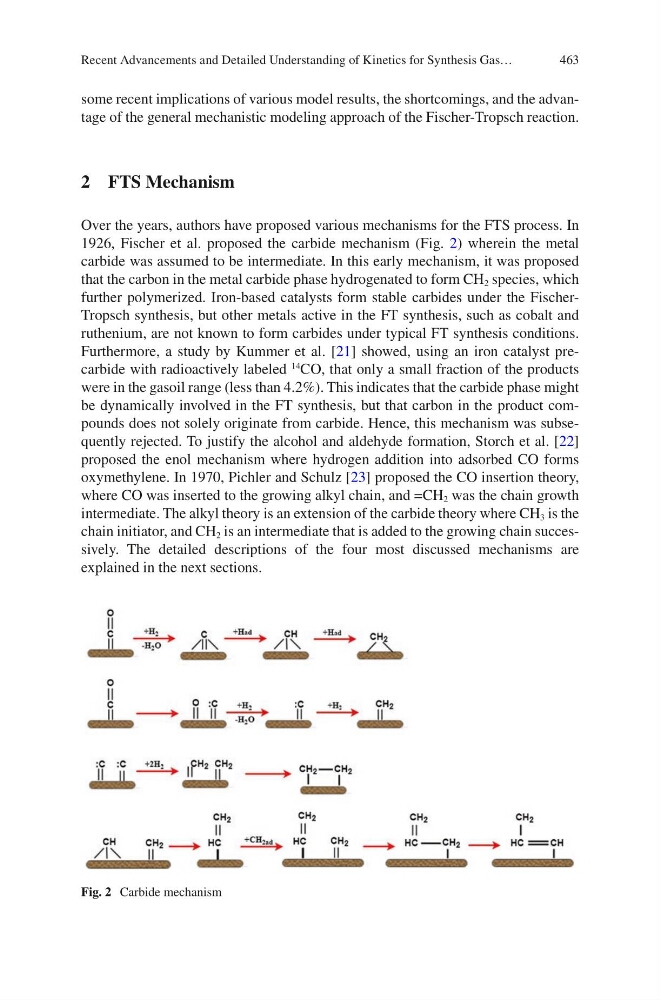
1926, Fischer et al. proposed the carbide mechanism (Fig. 2) wherein the metal
carbide was assumed to be intermediate. In this early mechanism, it was proposed
that the carbon in the metal carbide phase hydrogenated to form CH 2 species, which
further polymerized. Iron-based catalysts form stable carbides under the FischerTropsch synthesis, but other metals active in the FT synthesis, such as cobalt and
ruthenium, are not known to form carbides under typical FT synthesis conditions.
Furthermore, a study by Kummer et al. [21] showed, using an iron catalyst precarbide with radioactively labeled
14
CO, that only a small fraction of the products
were in the gasoil range (less than 4.2%). This indicates that the carbide phase might
be dynamically involved in the FT synthesis, but that carbon in the product compounds does not solely originate from carbide. Hence, this mechanism was subsequently rejected. To justify the alcohol and aldehyde formation, Storch et al. [22]
proposed the enol mechanism where hydrogen addition into adsorbed CO forms
oxymethylene. In 1970, Pichler and Schulz [23] proposed the CO insertion theory,
where CO was inserted to the growing alkyl chain, and =CH 2 was the chain growth
intermediate. The alkyl theory is an extension of the carbide theory where CH 3 is the
chain initiator, and CH 2 is an intermediate that is added to the growing chain successively. The detailed descriptions of the four most discussed mechanisms are
explained in the next sections.
Fig. 2 Carbide mechanism
Recent Advancements and Detailed Understanding of Kinetics for Synthesis Gas…
some recent implications of various model results, the shortcomings, and the advantage of the general mechanistic modeling approach of the Fischer-Tropsch reaction.
2 FTS Mechanism
Over the years, authors have proposed various mechanisms for the FTS process. In
1926, Fischer et al. proposed the carbide mechanism (Fig. 2) wherein the metal
carbide was assumed to be intermediate. In this early mechanism, it was proposed
that the carbon in the metal carbide phase hydrogenated to form CH 2 species, which
further polymerized. Iron-based catalysts form stable carbides under the FischerTropsch synthesis, but other metals active in the FT synthesis, such as cobalt and
ruthenium, are not known to form carbides under typical FT synthesis conditions.
Furthermore, a study by Kummer et al. [21] showed, using an iron catalyst precarbide with radioactively labeled
14
CO, that only a small fraction of the products
were in the gasoil range (less than 4.2%). This indicates that the carbide phase might
be dynamically involved in the FT synthesis, but that carbon in the product compounds does not solely originate from carbide. Hence, this mechanism was subsequently rejected. To justify the alcohol and aldehyde formation, Storch et al. [22]
proposed the enol mechanism where hydrogen addition into adsorbed CO forms
oxymethylene. In 1970, Pichler and Schulz [23] proposed the CO insertion theory,
where CO was inserted to the growing alkyl chain, and =CH 2 was the chain growth
intermediate. The alkyl theory is an extension of the carbide theory where CH 3 is the
chain initiator, and CH 2 is an intermediate that is added to the growing chain successively. The detailed descriptions of the four most discussed mechanisms are
explained in the next sections.
Fig. 2 Carbide mechanism
Recent Advancements and Detailed Understanding of Kinetics for Synthesis Gas…