

462
FT synthesis process is a complex reaction system yielding a spectrum of products
and is difficult to predict a certain pathway of product formation. It differs along
with the catalyst selection, physicochemical properties of the catalyst, and reaction
conditions. Therefore, for each of the three steps, various mechanisms have been
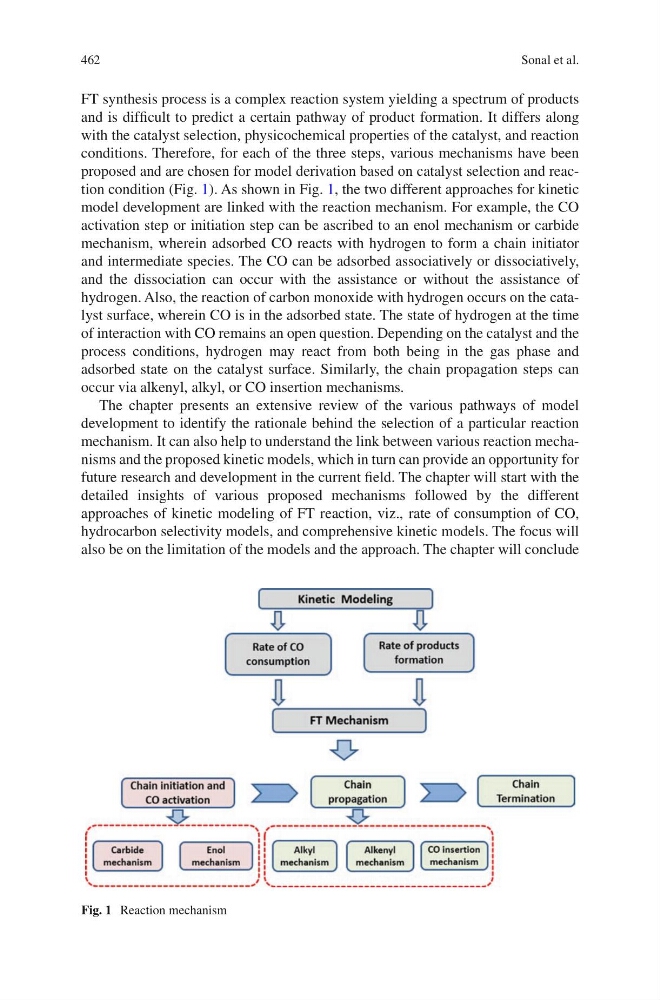
proposed and are chosen for model derivation based on catalyst selection and reaction condition (Fig. 1). As shown in Fig. 1, the two different approaches for kinetic
model development are linked with the reaction mechanism. For example, the CO
activation step or initiation step can be ascribed to an enol mechanism or carbide
mechanism, wherein adsorbed CO reacts with hydrogen to form a chain initiator
and intermediate species. The CO can be adsorbed associatively or dissociatively,
and the dissociation can occur with the assistance or without the assistance of
hydrogen. Also, the reaction of carbon monoxide with hydrogen occurs on the catalyst surface, wherein CO is in the adsorbed state. The state of hydrogen at the time
of interaction with CO remains an open question. Depending on the catalyst and the
process conditions, hydrogen may react from both being in the gas phase and
adsorbed state on the catalyst surface. Similarly, the chain propagation steps can
occur via alkenyl, alkyl, or CO insertion mechanisms.
The chapter presents an extensive review of the various pathways of model
development to identify the rationale behind the selection of a particular reaction
mechanism. It can also help to understand the link between various reaction mechanisms and the proposed kinetic models, which in turn can provide an opportunity for
future research and development in the current field. The chapter will start with the
detailed insights of various proposed mechanisms followed by the different
approaches of kinetic modeling of FT reaction, viz., rate of consumption of CO,
hydrocarbon selectivity models, and comprehensive kinetic models. The focus will
also be on the limitation of the models and the approach. The chapter will conclude
Fig. 1 Reaction mechanism
Sonal et al.
FT synthesis process is a complex reaction system yielding a spectrum of products
and is difficult to predict a certain pathway of product formation. It differs along
with the catalyst selection, physicochemical properties of the catalyst, and reaction
conditions. Therefore, for each of the three steps, various mechanisms have been
proposed and are chosen for model derivation based on catalyst selection and reaction condition (Fig. 1). As shown in Fig. 1, the two different approaches for kinetic
model development are linked with the reaction mechanism. For example, the CO
activation step or initiation step can be ascribed to an enol mechanism or carbide
mechanism, wherein adsorbed CO reacts with hydrogen to form a chain initiator
and intermediate species. The CO can be adsorbed associatively or dissociatively,
and the dissociation can occur with the assistance or without the assistance of
hydrogen. Also, the reaction of carbon monoxide with hydrogen occurs on the catalyst surface, wherein CO is in the adsorbed state. The state of hydrogen at the time
of interaction with CO remains an open question. Depending on the catalyst and the
process conditions, hydrogen may react from both being in the gas phase and
adsorbed state on the catalyst surface. Similarly, the chain propagation steps can
occur via alkenyl, alkyl, or CO insertion mechanisms.
The chapter presents an extensive review of the various pathways of model
development to identify the rationale behind the selection of a particular reaction
mechanism. It can also help to understand the link between various reaction mechanisms and the proposed kinetic models, which in turn can provide an opportunity for
future research and development in the current field. The chapter will start with the
detailed insights of various proposed mechanisms followed by the different
approaches of kinetic modeling of FT reaction, viz., rate of consumption of CO,
hydrocarbon selectivity models, and comprehensive kinetic models. The focus will
also be on the limitation of the models and the approach. The chapter will conclude
Fig. 1 Reaction mechanism
Sonal et al.