

453
Fischer- Tropsch (FT) synthesis. The performance of the catalysts with and without
the structural promoters of Al and Si was evaluated in a tubular reactor with 7.8 mm
inside diameter and 15.2 mm length. Each catalyst was mixed with SiC at 1:6 volumetric ratio of catalyst to SiC to achieve an isothermal condition along the reaction
bed during the experiments. A model syngas at a composition of
54%H 2 /10%CO/29%CO 2 /7%N 2 was used during the experiments. The model syngas represented typical syngas produced by oxygen/steam gasification of biomass
with the composition reported in literature [51]. N 2 was used as an internal standard
for the GC analysis and the representative of inert components in the syngas. The
feed gas was introduced into the reactor at 30 mL/(h⋅g-cat) STP. The reaction was
carried out at 300 °C and 2 MPa for 72 h [52].
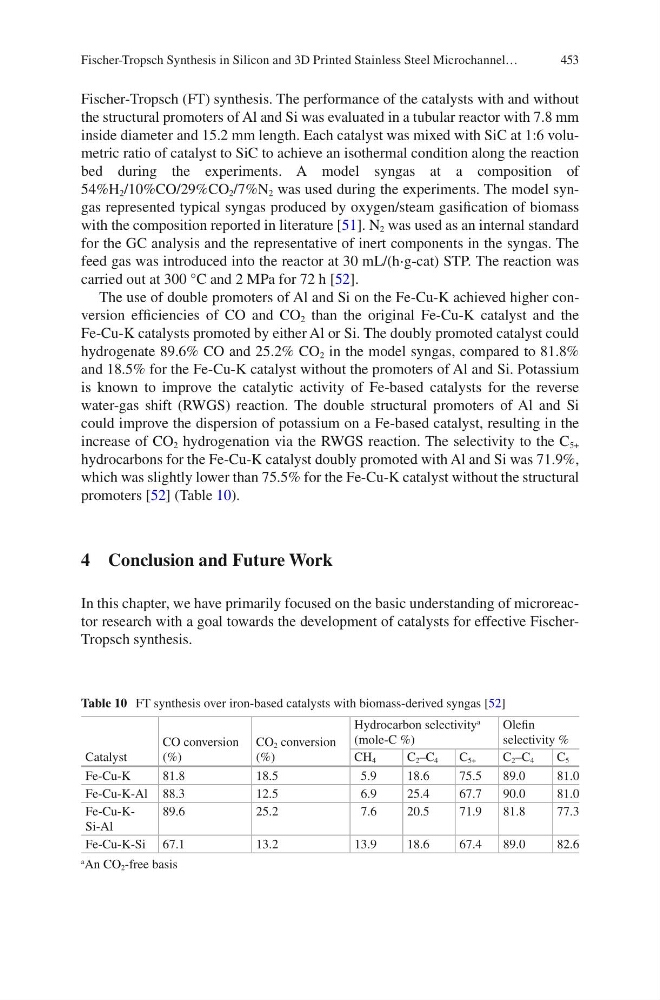
The use of double promoters of Al and Si on the Fe-Cu-K achieved higher conversion efficiencies of CO and CO 2 than the original Fe-Cu-K catalyst and the
Fe-Cu-K catalysts promoted by either Al or Si. The doubly promoted catalyst could
hydrogenate 89.6% CO and 25.2% CO 2 in the model syngas, compared to 81.8%
and 18.5% for the Fe-Cu-K catalyst without the promoters of Al and Si. Potassium
is known to improve the catalytic activity of Fe-based catalysts for the reverse
water-gas shift (RWGS) reaction. The double structural promoters of Al and Si
could improve the dispersion of potassium on a Fe-based catalyst, resulting in the
increase of CO 2 hydrogenation via the RWGS reaction. The selectivity to the C 5+
hydrocarbons for the Fe-Cu-K catalyst doubly promoted with Al and Si was 71.9%,
which was slightly lower than 75.5% for the Fe-Cu-K catalyst without the structural
promoters [52] (Table 10).
4 Conclusion and Future Work
In this chapter, we have primarily focused on the basic understanding of microreactor research with a goal towards the development of catalysts for effective FischerTropsch synthesis.
Table 10 FT synthesis over iron-based catalysts with biomass-derived syngas [52]
Catalyst
CO conversion
(%)
CO 2 conversion
(%)
Hydrocarbon selectivity
a
(mole-C %)
Olefin
selectivity %
CH 4
C 2 –C 4
C 5+
C 2 –C 4
C 5
Fe-Cu-K
81.8
18.5
5.9
18.6
75.5
89.0
81.0
Fe-Cu-K-Al 88.3
12.5
6.9
25.4
67.7
90.0
81.0
Fe-Cu-KSi-Al
89.6
25.2
7.6
20.5
71.9
81.8
77.3
Fe-Cu-K-Si 67.1
13.2
13.9
18.6
67.4
89.0
82.6
a
An CO 2 -free basis
Fischer-Tropsch Synthesis in Silicon and 3D Printed Stainless Steel Microchannel…
Fischer- Tropsch (FT) synthesis. The performance of the catalysts with and without
the structural promoters of Al and Si was evaluated in a tubular reactor with 7.8 mm
inside diameter and 15.2 mm length. Each catalyst was mixed with SiC at 1:6 volumetric ratio of catalyst to SiC to achieve an isothermal condition along the reaction
bed during the experiments. A model syngas at a composition of
54%H 2 /10%CO/29%CO 2 /7%N 2 was used during the experiments. The model syngas represented typical syngas produced by oxygen/steam gasification of biomass
with the composition reported in literature [51]. N 2 was used as an internal standard
for the GC analysis and the representative of inert components in the syngas. The
feed gas was introduced into the reactor at 30 mL/(h⋅g-cat) STP. The reaction was
carried out at 300 °C and 2 MPa for 72 h [52].
The use of double promoters of Al and Si on the Fe-Cu-K achieved higher conversion efficiencies of CO and CO 2 than the original Fe-Cu-K catalyst and the
Fe-Cu-K catalysts promoted by either Al or Si. The doubly promoted catalyst could
hydrogenate 89.6% CO and 25.2% CO 2 in the model syngas, compared to 81.8%
and 18.5% for the Fe-Cu-K catalyst without the promoters of Al and Si. Potassium
is known to improve the catalytic activity of Fe-based catalysts for the reverse
water-gas shift (RWGS) reaction. The double structural promoters of Al and Si
could improve the dispersion of potassium on a Fe-based catalyst, resulting in the
increase of CO 2 hydrogenation via the RWGS reaction. The selectivity to the C 5+
hydrocarbons for the Fe-Cu-K catalyst doubly promoted with Al and Si was 71.9%,
which was slightly lower than 75.5% for the Fe-Cu-K catalyst without the structural
promoters [52] (Table 10).
4 Conclusion and Future Work
In this chapter, we have primarily focused on the basic understanding of microreactor research with a goal towards the development of catalysts for effective FischerTropsch synthesis.
Table 10 FT synthesis over iron-based catalysts with biomass-derived syngas [52]
Catalyst
CO conversion
(%)
CO 2 conversion
(%)
Hydrocarbon selectivity
a
(mole-C %)
Olefin
selectivity %
CH 4
C 2 –C 4
C 5+
C 2 –C 4
C 5
Fe-Cu-K
81.8
18.5
5.9
18.6
75.5
89.0
81.0
Fe-Cu-K-Al 88.3
12.5
6.9
25.4
67.7
90.0
81.0
Fe-Cu-KSi-Al
89.6
25.2
7.6
20.5
71.9
81.8
77.3
Fe-Cu-K-Si 67.1
13.2
13.9
18.6
67.4
89.0
82.6
a
An CO 2 -free basis
Fischer-Tropsch Synthesis in Silicon and 3D Printed Stainless Steel Microchannel…