

452
experimental data obtained in the microreactor using Co-Ni-SiO 2 catalyst. They
observed that the activation energy of Co-Ni-SiO 2 was around 84 kJ mol
−1
using a
tubular reactor. The single support system has disadvantages of the high surface
area and lacks catalyst activity and reactivity; therefore the composite support may
be an option to enhance the FT activity
Sub-case-2: Composite Oxide Support Catalysts for FT Synthesis in 3D Printed
Stainless Steel Microreactor
In order to investigate the effect of mixed-oxide supports on FT synthesis, a binary
support with a combination of silica, titania, and alumina was synthesized. Bepari
et al. [50] synthesized 10% Fe, 10%Fe 5%Co, 10%Fe 5%Ru impregnated on SiO 2 -
Al 2 O 3 mixed support prepared one-pot hydrothermal method. The H 2 -TPR studies
show much lower reduction temperatures for Co and Fe in binary supports when
compared to the catalysts with a single support. The low-angle X-ray diffraction
studies showed that the mesoporous structure of impregnated catalysts was conserved after the incorporation of Fe, Co, and Ru metals. The composite oxides mesoporous support have surface areas in the range of 380–650 m
2
/g with improved
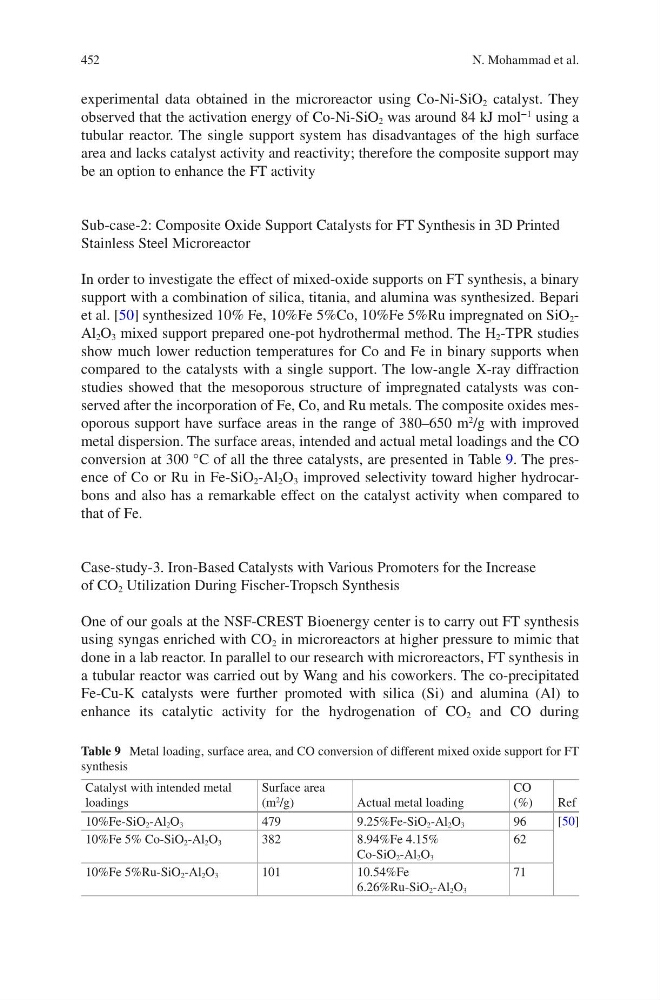
metal dispersion. The surface areas, intended and actual metal loadings and the CO
conversion at 300 °C of all the three catalysts, are presented in Table 9. The presence of Co or Ru in Fe-SiO 2 -Al 2 O 3 improved selectivity toward higher hydrocarbons and also has a remarkable effect on the catalyst activity when compared to
that of Fe.
Case-study-3. Iron-Based Catalysts with Various Promoters for the Increase
of CO 2 Utilization During Fischer-Tropsch Synthesis
One of our goals at the NSF-CREST Bioenergy center is to carry out FT synthesis
using syngas enriched with CO 2 in microreactors at higher pressure to mimic that
done in a lab reactor. In parallel to our research with microreactors, FT synthesis in
a tubular reactor was carried out by Wang and his coworkers. The co-precipitated
Fe-Cu-K catalysts were further promoted with silica (Si) and alumina (Al) to
enhance its catalytic activity for the hydrogenation of CO 2 and CO during
Table 9 Metal loading, surface area, and CO conversion of different mixed oxide support for FT
synthesis
Catalyst with intended metal
loadings
Surface area
(m
2 /g)
Actual metal loading
CO
(%)
Ref
10%Fe-SiO 2 -Al 2 O 3
479
9.25%Fe-SiO 2 -Al 2 O 3
96
[50]
10%Fe 5% Co-SiO 2 -Al 2 O 3
382
8.94%Fe 4.15%
Co-SiO 2 -Al 2 O 3
62
10%Fe 5%Ru-SiO 2 -Al 2 O 3
101
10.54%Fe
6.26%Ru-SiO 2 -Al 2 O 3
71
N. Mohammad et al.
experimental data obtained in the microreactor using Co-Ni-SiO 2 catalyst. They
observed that the activation energy of Co-Ni-SiO 2 was around 84 kJ mol
−1
using a
tubular reactor. The single support system has disadvantages of the high surface
area and lacks catalyst activity and reactivity; therefore the composite support may
be an option to enhance the FT activity
Sub-case-2: Composite Oxide Support Catalysts for FT Synthesis in 3D Printed
Stainless Steel Microreactor
In order to investigate the effect of mixed-oxide supports on FT synthesis, a binary
support with a combination of silica, titania, and alumina was synthesized. Bepari
et al. [50] synthesized 10% Fe, 10%Fe 5%Co, 10%Fe 5%Ru impregnated on SiO 2 -
Al 2 O 3 mixed support prepared one-pot hydrothermal method. The H 2 -TPR studies
show much lower reduction temperatures for Co and Fe in binary supports when
compared to the catalysts with a single support. The low-angle X-ray diffraction
studies showed that the mesoporous structure of impregnated catalysts was conserved after the incorporation of Fe, Co, and Ru metals. The composite oxides mesoporous support have surface areas in the range of 380–650 m
2
/g with improved
metal dispersion. The surface areas, intended and actual metal loadings and the CO
conversion at 300 °C of all the three catalysts, are presented in Table 9. The presence of Co or Ru in Fe-SiO 2 -Al 2 O 3 improved selectivity toward higher hydrocarbons and also has a remarkable effect on the catalyst activity when compared to
that of Fe.
Case-study-3. Iron-Based Catalysts with Various Promoters for the Increase
of CO 2 Utilization During Fischer-Tropsch Synthesis
One of our goals at the NSF-CREST Bioenergy center is to carry out FT synthesis
using syngas enriched with CO 2 in microreactors at higher pressure to mimic that
done in a lab reactor. In parallel to our research with microreactors, FT synthesis in
a tubular reactor was carried out by Wang and his coworkers. The co-precipitated
Fe-Cu-K catalysts were further promoted with silica (Si) and alumina (Al) to
enhance its catalytic activity for the hydrogenation of CO 2 and CO during
Table 9 Metal loading, surface area, and CO conversion of different mixed oxide support for FT
synthesis
Catalyst with intended metal
loadings
Surface area
(m
2 /g)
Actual metal loading
CO
(%)
Ref
10%Fe-SiO 2 -Al 2 O 3
479
9.25%Fe-SiO 2 -Al 2 O 3
96
[50]
10%Fe 5% Co-SiO 2 -Al 2 O 3
382
8.94%Fe 4.15%
Co-SiO 2 -Al 2 O 3
62
10%Fe 5%Ru-SiO 2 -Al 2 O 3
101
10.54%Fe
6.26%Ru-SiO 2 -Al 2 O 3
71
N. Mohammad et al.