

445
the syngas mole ratio showed a significant effect on the FT reaction. The highest FT
reactivity was observed for Ru-SiO 2 with 5% selectivity toward butane. A 90% CO
conversion was obtained for Co-SiO 2 with 44% selectivity toward propane. More
significantly, Co-SiO 2 showed the highest resistance to stability followed by Fe-SiO 2
and Ru-SiO 2 .
Table 6 shows the surface areas, intended and actual metal loadings from EDX,
optimum reaction temperature and conversion of catalysts used for FT synthesis in
silicon microreactor.
These results are consistent with that reported in literature. Cobalt is indeed
widely used in the industry for FT synthesis. These studies show that the SiO 2 support has control over metal, particle size, and the degree of reduction.
In order to investigate the effect of support and metal-support interaction on FT
synthesis, silica was replaced with TiO 2 . Abrokwah et al. [25] prepared TiO 2 as support for metals Fe, Co, and Ru and carried out FT synthesis in the range of
150–300 °C at 1 atm in a silicon microreactor. TPR profiles show the reduction
profiles with strong metal-support interaction with the Co and Fe than that of Ru.
The rutile phase of TiO 2 increased the stability of Ru-TiO 2 which was not observed
in the case of Fe-TiO 2 and Co-TiO 2 , causing quick deactivation of these catalysts.
The optimum stability and the selectivity toward hydrocarbons were dependent on
the reaction temperature for the different metals in the TiO 2 support. Based on deactivation studies, Ru-TiO 2 > Fe-TiO 2 > Co-TiO 2 . However, these results from FT
studies with TiO 2 support are in sharp contrast from that with SiO 2 . It has been
reported in the literature that the rutile phase is important for FT activity of the catalysts. After careful examination of the XRD data, we noticed that Ru-TiO 2 also has
a rutile phase in contrast to its absence in Co-TiO 2 and Fe-TiO 2 . Our results are
consistent that are reported in literature. Thus, the presence of the rutile phase in
Ru-TiO 2 suggests its higher stability and activity compared to its lower activity
observed in silica.
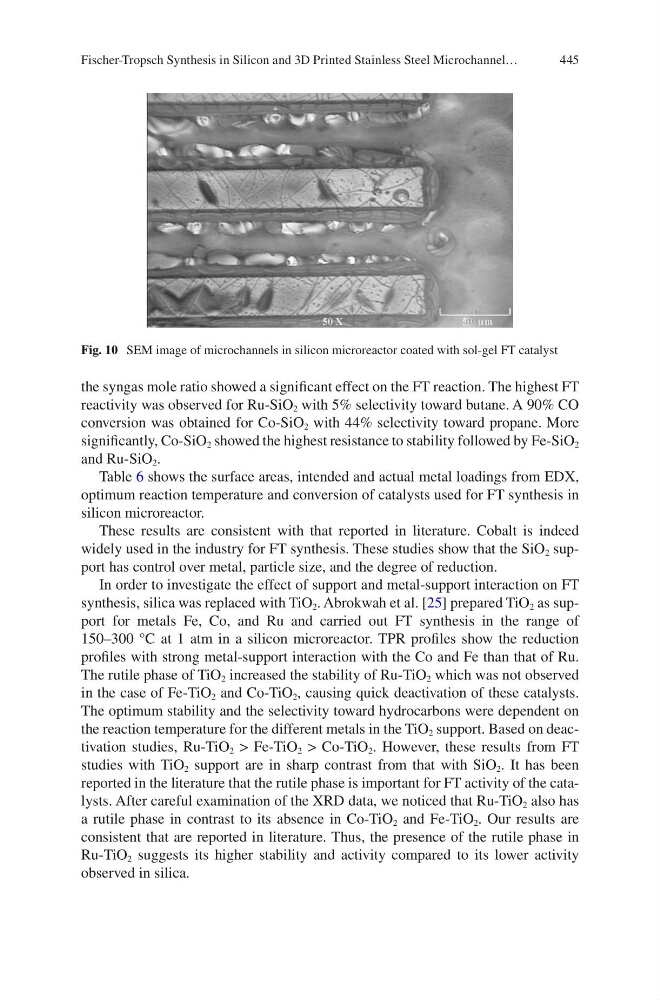
Fig. 10 SEM image of microchannels in silicon microreactor coated with sol-gel FT catalyst
Fischer-Tropsch Synthesis in Silicon and 3D Printed Stainless Steel Microchannel…
the syngas mole ratio showed a significant effect on the FT reaction. The highest FT
reactivity was observed for Ru-SiO 2 with 5% selectivity toward butane. A 90% CO
conversion was obtained for Co-SiO 2 with 44% selectivity toward propane. More
significantly, Co-SiO 2 showed the highest resistance to stability followed by Fe-SiO 2
and Ru-SiO 2 .
Table 6 shows the surface areas, intended and actual metal loadings from EDX,
optimum reaction temperature and conversion of catalysts used for FT synthesis in
silicon microreactor.
These results are consistent with that reported in literature. Cobalt is indeed
widely used in the industry for FT synthesis. These studies show that the SiO 2 support has control over metal, particle size, and the degree of reduction.
In order to investigate the effect of support and metal-support interaction on FT
synthesis, silica was replaced with TiO 2 . Abrokwah et al. [25] prepared TiO 2 as support for metals Fe, Co, and Ru and carried out FT synthesis in the range of
150–300 °C at 1 atm in a silicon microreactor. TPR profiles show the reduction
profiles with strong metal-support interaction with the Co and Fe than that of Ru.
The rutile phase of TiO 2 increased the stability of Ru-TiO 2 which was not observed
in the case of Fe-TiO 2 and Co-TiO 2 , causing quick deactivation of these catalysts.
The optimum stability and the selectivity toward hydrocarbons were dependent on
the reaction temperature for the different metals in the TiO 2 support. Based on deactivation studies, Ru-TiO 2 > Fe-TiO 2 > Co-TiO 2 . However, these results from FT
studies with TiO 2 support are in sharp contrast from that with SiO 2 . It has been
reported in the literature that the rutile phase is important for FT activity of the catalysts. After careful examination of the XRD data, we noticed that Ru-TiO 2 also has
a rutile phase in contrast to its absence in Co-TiO 2 and Fe-TiO 2 . Our results are
consistent that are reported in literature. Thus, the presence of the rutile phase in
Ru-TiO 2 suggests its higher stability and activity compared to its lower activity
observed in silica.
Fig. 10 SEM image of microchannels in silicon microreactor coated with sol-gel FT catalyst
Fischer-Tropsch Synthesis in Silicon and 3D Printed Stainless Steel Microchannel…