

431
Steam reforming CH H O
CO H
4
2
2
3
+
«
+
(1)
CO reforming CH CO
CO H
2
4
2
2
2
2
+
«
+
(2)
Partial oxidation CH
O
CO H
4
2
2
0 5
2
+
«
+
.
(3)
Coal gasification C H O
CO H
+
«
+
2
2
(4)
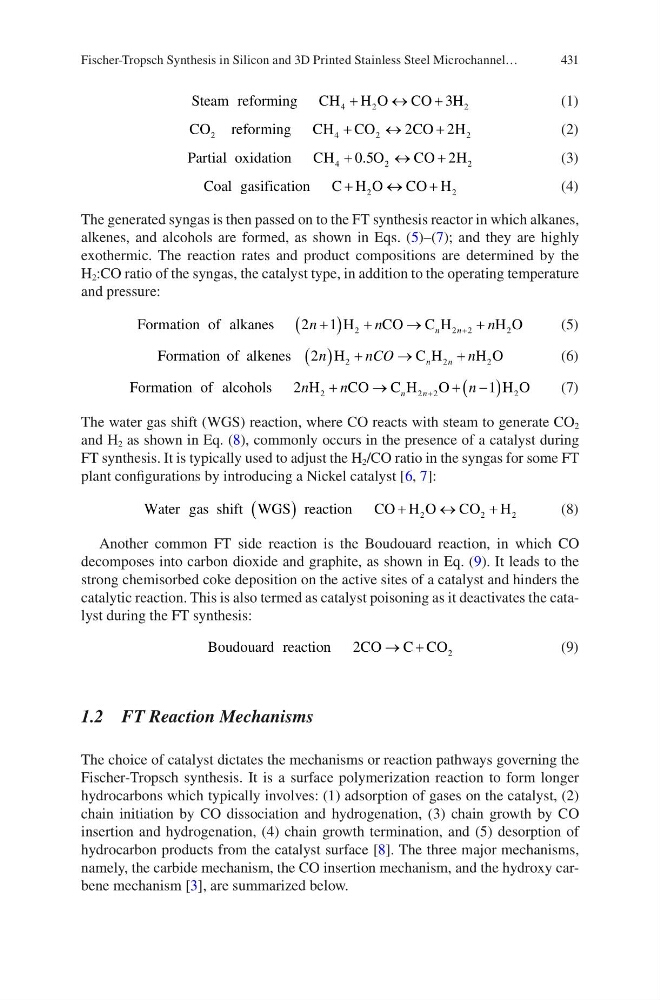
The generated syngas is then passed on to the FT synthesis reactor in which alkanes,
alkenes, and alcohols are formed, as shown in Eqs. (5)–(7); and they are highly
exothermic. The reaction rates and product compositions are determined by the
H 2 :CO ratio of the syngas, the catalyst type, in addition to the operating temperature
and pressure:
Formation of alkanes
H
CO C H
H O
2 1 2
2 2
2
n
n
n
n
n
+
(
) +
®
+
+
(5)
Formation of alkenes
H
CH
H O
2
2
2
2
n
nCO
n
n
n
( ) +
®
+
(6)
Formation of alcohols
H
CO C H O
HO
2
1
2
2 2
2
n
n
n
n
n
+
®
+ -
( )
+
(7)
The water gas shift (WGS) reaction, where CO reacts with steam to generate CO 2
and H 2 as shown in Eq. (8), commonly occurs in the presence of a catalyst during
FT synthesis. It is typically used to adjust the H 2 /CO ratio in the syngas for some FT
plant configurations by introducing a Nickel catalyst [6, 7]:
Water gas shift WGS reaction CO H O
CO H
(
)
+
«
+
2
2
2
(8)
Another common FT side reaction is the Boudouard reaction, in which CO
decomposes into carbon dioxide and graphite, as shown in Eq. (9). It leads to the
strong chemisorbed coke deposition on the active sites of a catalyst and hinders the
catalytic reaction. This is also termed as catalyst poisoning as it deactivates the catalyst during the FT synthesis:
Boudouard reaction
CO C CO
2
2
® +
(9)
1.2 FT Reaction Mechanisms
The choice of catalyst dictates the mechanisms or reaction pathways governing the
Fischer-Tropsch synthesis. It is a surface polymerization reaction to form longer
hydrocarbons which typically involves: (1) adsorption of gases on the catalyst, (2)
chain initiation by CO dissociation and hydrogenation, (3) chain growth by CO
insertion and hydrogenation, (4) chain growth termination, and (5) desorption of
hydrocarbon products from the catalyst surface [8]. The three major mechanisms,
namely, the carbide mechanism, the CO insertion mechanism, and the hydroxy carbene mechanism [3], are summarized below.
Fischer-Tropsch Synthesis in Silicon and 3D Printed Stainless Steel Microchannel…
Steam reforming CH H O
CO H
4
2
2
3
+
«
+
(1)
CO reforming CH CO
CO H
2
4
2
2
2
2
+
«
+
(2)
Partial oxidation CH
O
CO H
4
2
2
0 5
2
+
«
+
.
(3)
Coal gasification C H O
CO H
+
«
+
2
2
(4)
The generated syngas is then passed on to the FT synthesis reactor in which alkanes,
alkenes, and alcohols are formed, as shown in Eqs. (5)–(7); and they are highly
exothermic. The reaction rates and product compositions are determined by the
H 2 :CO ratio of the syngas, the catalyst type, in addition to the operating temperature
and pressure:
Formation of alkanes
H
CO C H
H O
2 1 2
2 2
2
n
n
n
n
n
+
(
) +
®
+
+
(5)
Formation of alkenes
H
CH
H O
2
2
2
2
n
nCO
n
n
n
( ) +
®
+
(6)
Formation of alcohols
H
CO C H O
HO
2
1
2
2 2
2
n
n
n
n
n
+
®
+ -
( )
+
(7)
The water gas shift (WGS) reaction, where CO reacts with steam to generate CO 2
and H 2 as shown in Eq. (8), commonly occurs in the presence of a catalyst during
FT synthesis. It is typically used to adjust the H 2 /CO ratio in the syngas for some FT
plant configurations by introducing a Nickel catalyst [6, 7]:
Water gas shift WGS reaction CO H O
CO H
(
)
+
«
+
2
2
2
(8)
Another common FT side reaction is the Boudouard reaction, in which CO
decomposes into carbon dioxide and graphite, as shown in Eq. (9). It leads to the
strong chemisorbed coke deposition on the active sites of a catalyst and hinders the
catalytic reaction. This is also termed as catalyst poisoning as it deactivates the catalyst during the FT synthesis:
Boudouard reaction
CO C CO
2
2
® +
(9)
1.2 FT Reaction Mechanisms
The choice of catalyst dictates the mechanisms or reaction pathways governing the
Fischer-Tropsch synthesis. It is a surface polymerization reaction to form longer
hydrocarbons which typically involves: (1) adsorption of gases on the catalyst, (2)
chain initiation by CO dissociation and hydrogenation, (3) chain growth by CO
insertion and hydrogenation, (4) chain growth termination, and (5) desorption of
hydrocarbon products from the catalyst surface [8]. The three major mechanisms,
namely, the carbide mechanism, the CO insertion mechanism, and the hydroxy carbene mechanism [3], are summarized below.
Fischer-Tropsch Synthesis in Silicon and 3D Printed Stainless Steel Microchannel…