

430
version, and stability. Conversion of syngas enriched with CO 2 and CO 2 utilization
in FT synthesis are the key factors in the production of next-generation biofuels. A
case study on the effect of silica and alumina promoters on Co-Fe-K precipitated
catalysts in a lab-scale reactor to enhance CO 2 utilization in FT synthesis is also
included.
Keywords Fischer-Tropsch synthesis · Syngas conversion · Microreactors
fabrication · Microchannel reactors · Microreactor 3D printing
1 Introduction
1.1 Fischer-Tropsch Synthesis
Fischer-Tropsch (FT) synthesis enables the conversion of carbon-containing
resources, such as coal, biomass, and natural gas into value-added chemicals and
fuels. In this process, syngas, which is a mixture of CO and H 2 , catalytically reacts
to generate primarily linear alkanes and alkenes. Significant details discussing the
FT process and economics have been discussed extensively elsewhere [1, 2]. The
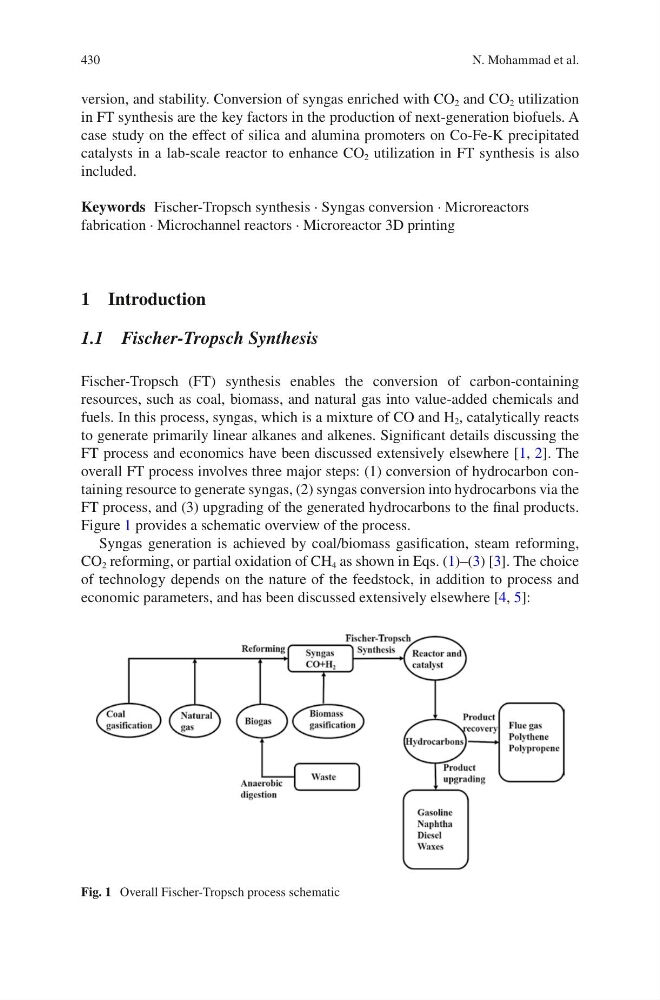
overall FT process involves three major steps: (1) conversion of hydrocarbon containing resource to generate syngas, (2) syngas conversion into hydrocarbons via the
FT process, and (3) upgrading of the generated hydrocarbons to the final products.
Figure 1 provides a schematic overview of the process.
Syngas generation is achieved by coal/biomass gasification, steam reforming,
CO 2 reforming, or partial oxidation of CH 4 as shown in Eqs. (1)–(3) [3]. The choice
of technology depends on the nature of the feedstock, in addition to process and
economic parameters, and has been discussed extensively elsewhere [4, 5]:
Fig. 1 Overall Fischer-Tropsch process schematic
N. Mohammad et al.
version, and stability. Conversion of syngas enriched with CO 2 and CO 2 utilization
in FT synthesis are the key factors in the production of next-generation biofuels. A
case study on the effect of silica and alumina promoters on Co-Fe-K precipitated
catalysts in a lab-scale reactor to enhance CO 2 utilization in FT synthesis is also
included.
Keywords Fischer-Tropsch synthesis · Syngas conversion · Microreactors
fabrication · Microchannel reactors · Microreactor 3D printing
1 Introduction
1.1 Fischer-Tropsch Synthesis
Fischer-Tropsch (FT) synthesis enables the conversion of carbon-containing
resources, such as coal, biomass, and natural gas into value-added chemicals and
fuels. In this process, syngas, which is a mixture of CO and H 2 , catalytically reacts
to generate primarily linear alkanes and alkenes. Significant details discussing the
FT process and economics have been discussed extensively elsewhere [1, 2]. The
overall FT process involves three major steps: (1) conversion of hydrocarbon containing resource to generate syngas, (2) syngas conversion into hydrocarbons via the
FT process, and (3) upgrading of the generated hydrocarbons to the final products.
Figure 1 provides a schematic overview of the process.
Syngas generation is achieved by coal/biomass gasification, steam reforming,
CO 2 reforming, or partial oxidation of CH 4 as shown in Eqs. (1)–(3) [3]. The choice
of technology depends on the nature of the feedstock, in addition to process and
economic parameters, and has been discussed extensively elsewhere [4, 5]:
Fig. 1 Overall Fischer-Tropsch process schematic
N. Mohammad et al.