

411
pyrolysis and char gasification showed lowest activation energy of 33.65 and
47.15 kJ/mol, respectively, at 25% H 2 O; and these values increased with the increase
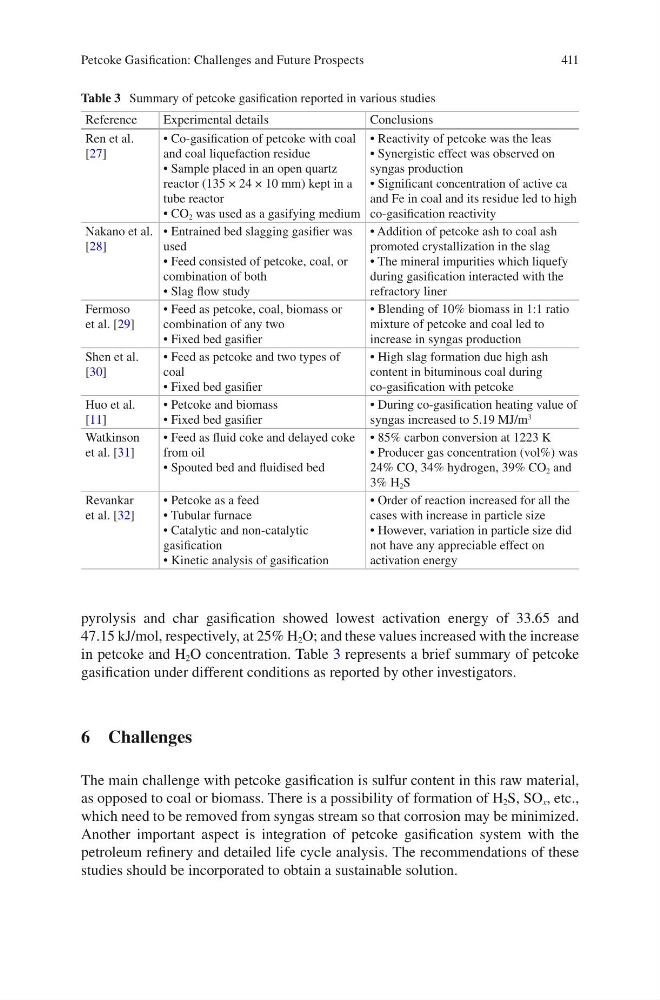
in petcoke and H 2 O concentration. Table 3 represents a brief summary of petcoke
gasification under different conditions as reported by other investigators.
6 Challenges
The main challenge with petcoke gasification is sulfur content in this raw material,
as opposed to coal or biomass. There is a possibility of formation of H 2 S, SO x , etc.,
which need to be removed from syngas stream so that corrosion may be minimized.
Another important aspect is integration of petcoke gasification system with the
petroleum refinery and detailed life cycle analysis. The recommendations of these
studies should be incorporated to obtain a sustainable solution.
Table 3 Summary of petcoke gasification reported in various studies
Reference
Experimental details
Conclusions
Ren et al.
[27]
• Co-gasification of petcoke with coal
and coal liquefaction residue
• Sample placed in an open quartz
reactor (135 × 24 × 10 mm) kept in a
tube reactor
• CO 2 was used as a gasifying medium
• Reactivity of petcoke was the leas
• Synergistic effect was observed on
syngas production
• Significant concentration of active ca
and Fe in coal and its residue led to high
co-gasification reactivity
Nakano et al.
[28]
• Entrained bed slagging gasifier was
used
• Feed consisted of petcoke, coal, or
combination of both
• Slag flow study
• Addition of petcoke ash to coal ash
promoted crystallization in the slag
• The mineral impurities which liquefy
during gasification interacted with the
refractory liner
Fermoso
et al. [29]
• Feed as petcoke, coal, biomass or
combination of any two
• Fixed bed gasifier
• Blending of 10% biomass in 1:1 ratio
mixture of petcoke and coal led to
increase in syngas production
Shen et al.
[30]
• Feed as petcoke and two types of
coal
• Fixed bed gasifier
• High slag formation due high ash
content in bituminous coal during
co-gasification with petcoke
Huo et al.
[11]
• Petcoke and biomass
• Fixed bed gasifier
• During co-gasification heating value of
syngas increased to 5.19 MJ/m
3
Watkinson
et al. [31]
• Feed as fluid coke and delayed coke
from oil
• Spouted bed and fluidised bed
• 85% carbon conversion at 1223 K
• Producer gas concentration (vol%) was
24% CO, 34% hydrogen, 39% CO 2 and
3% H 2 S
Revankar
et al. [32]
• Petcoke as a feed
• Tubular furnace
• Catalytic and non-catalytic
gasification
• Kinetic analysis of gasification
• Order of reaction increased for all the
cases with increase in particle size
• However, variation in particle size did
not have any appreciable effect on
activation energy
Petcoke Gasification: Challenges and Future Prospects
pyrolysis and char gasification showed lowest activation energy of 33.65 and
47.15 kJ/mol, respectively, at 25% H 2 O; and these values increased with the increase
in petcoke and H 2 O concentration. Table 3 represents a brief summary of petcoke
gasification under different conditions as reported by other investigators.
6 Challenges
The main challenge with petcoke gasification is sulfur content in this raw material,
as opposed to coal or biomass. There is a possibility of formation of H 2 S, SO x , etc.,
which need to be removed from syngas stream so that corrosion may be minimized.
Another important aspect is integration of petcoke gasification system with the
petroleum refinery and detailed life cycle analysis. The recommendations of these
studies should be incorporated to obtain a sustainable solution.
Table 3 Summary of petcoke gasification reported in various studies
Reference
Experimental details
Conclusions
Ren et al.
[27]
• Co-gasification of petcoke with coal
and coal liquefaction residue
• Sample placed in an open quartz
reactor (135 × 24 × 10 mm) kept in a
tube reactor
• CO 2 was used as a gasifying medium
• Reactivity of petcoke was the leas
• Synergistic effect was observed on
syngas production
• Significant concentration of active ca
and Fe in coal and its residue led to high
co-gasification reactivity
Nakano et al.
[28]
• Entrained bed slagging gasifier was
used
• Feed consisted of petcoke, coal, or
combination of both
• Slag flow study
• Addition of petcoke ash to coal ash
promoted crystallization in the slag
• The mineral impurities which liquefy
during gasification interacted with the
refractory liner
Fermoso
et al. [29]
• Feed as petcoke, coal, biomass or
combination of any two
• Fixed bed gasifier
• Blending of 10% biomass in 1:1 ratio
mixture of petcoke and coal led to
increase in syngas production
Shen et al.
[30]
• Feed as petcoke and two types of
coal
• Fixed bed gasifier
• High slag formation due high ash
content in bituminous coal during
co-gasification with petcoke
Huo et al.
[11]
• Petcoke and biomass
• Fixed bed gasifier
• During co-gasification heating value of
syngas increased to 5.19 MJ/m
3
Watkinson
et al. [31]
• Feed as fluid coke and delayed coke
from oil
• Spouted bed and fluidised bed
• 85% carbon conversion at 1223 K
• Producer gas concentration (vol%) was
24% CO, 34% hydrogen, 39% CO 2 and
3% H 2 S
Revankar
et al. [32]
• Petcoke as a feed
• Tubular furnace
• Catalytic and non-catalytic
gasification
• Kinetic analysis of gasification
• Order of reaction increased for all the
cases with increase in particle size
• However, variation in particle size did
not have any appreciable effect on
activation energy
Petcoke Gasification: Challenges and Future Prospects