

409
heat transfer characteristics, excellent gas-to-solids contact, better temperature control, high volumetric capacity, etc. They operate at pressure more than atmospheric.
They are commercially viable at higher capacities, more than 30 MW, because of
the need to have expensive control systems and not-so-simple design. Fluidized bed
gasifiers are classified as bubbling, circulating, and spouted beds.
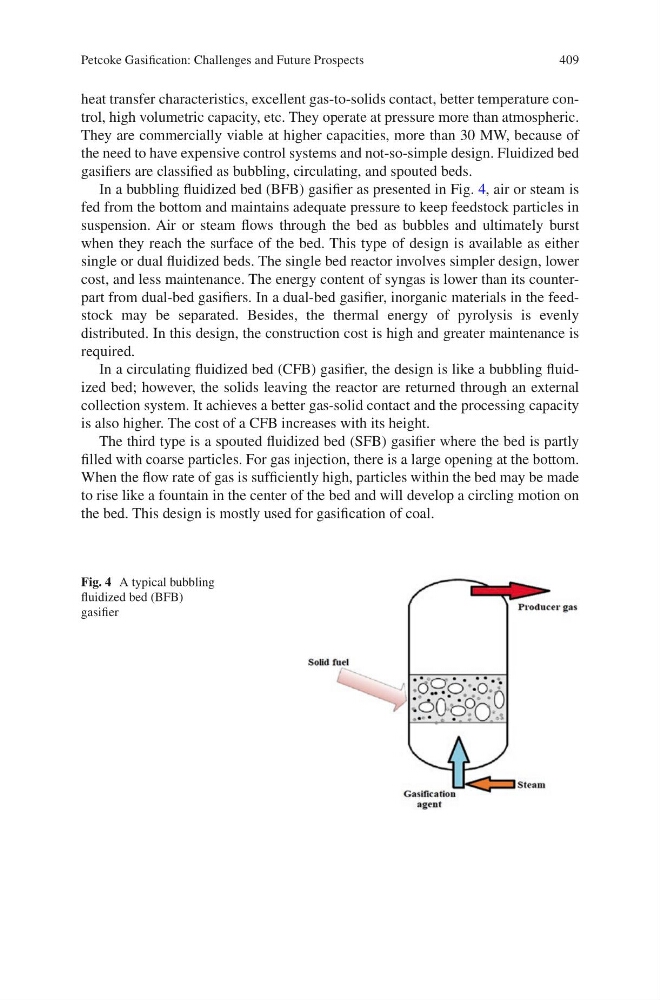
In a bubbling fluidized bed (BFB) gasifier as presented in Fig. 4, air or steam is
fed from the bottom and maintains adequate pressure to keep feedstock particles in
suspension. Air or steam flows through the bed as bubbles and ultimately burst
when they reach the surface of the bed. This type of design is available as either
single or dual fluidized beds. The single bed reactor involves simpler design, lower
cost, and less maintenance. The energy content of syngas is lower than its counterpart from dual-bed gasifiers. In a dual-bed gasifier, inorganic materials in the feedstock may be separated. Besides, the thermal energy of pyrolysis is evenly
distributed. In this design, the construction cost is high and greater maintenance is
required.
In a circulating fluidized bed (CFB) gasifier, the design is like a bubbling fluidized bed; however, the solids leaving the reactor are returned through an external
collection system. It achieves a better gas-solid contact and the processing capacity
is also higher. The cost of a CFB increases with its height.
The third type is a spouted fluidized bed (SFB) gasifier where the bed is partly
filled with coarse particles. For gas injection, there is a large opening at the bottom.
When the flow rate of gas is sufficiently high, particles within the bed may be made
to rise like a fountain in the center of the bed and will develop a circling motion on
the bed. This design is mostly used for gasification of coal.
Fig. 4 A typical bubbling
fluidized bed (BFB)
gasifier
Petcoke Gasification: Challenges and Future Prospects
heat transfer characteristics, excellent gas-to-solids contact, better temperature control, high volumetric capacity, etc. They operate at pressure more than atmospheric.
They are commercially viable at higher capacities, more than 30 MW, because of
the need to have expensive control systems and not-so-simple design. Fluidized bed
gasifiers are classified as bubbling, circulating, and spouted beds.
In a bubbling fluidized bed (BFB) gasifier as presented in Fig. 4, air or steam is
fed from the bottom and maintains adequate pressure to keep feedstock particles in
suspension. Air or steam flows through the bed as bubbles and ultimately burst
when they reach the surface of the bed. This type of design is available as either
single or dual fluidized beds. The single bed reactor involves simpler design, lower
cost, and less maintenance. The energy content of syngas is lower than its counterpart from dual-bed gasifiers. In a dual-bed gasifier, inorganic materials in the feedstock may be separated. Besides, the thermal energy of pyrolysis is evenly
distributed. In this design, the construction cost is high and greater maintenance is
required.
In a circulating fluidized bed (CFB) gasifier, the design is like a bubbling fluidized bed; however, the solids leaving the reactor are returned through an external
collection system. It achieves a better gas-solid contact and the processing capacity
is also higher. The cost of a CFB increases with its height.
The third type is a spouted fluidized bed (SFB) gasifier where the bed is partly
filled with coarse particles. For gas injection, there is a large opening at the bottom.
When the flow rate of gas is sufficiently high, particles within the bed may be made
to rise like a fountain in the center of the bed and will develop a circling motion on
the bed. This design is mostly used for gasification of coal.
Fig. 4 A typical bubbling
fluidized bed (BFB)
gasifier
Petcoke Gasification: Challenges and Future Prospects