

408
(15–60 min), operating temperatures (350–650 °C), and feed concentrations
(15–30 wt%). They also used nickel-impregnated activated carbon catalyst for the
enhancement of syngas production at the optimum condition (60 min, 650 °C and
15 wt%). The use of catalyst showed an encouraging results in the enhancement of
the syngas production for asphaltene (total syngas yield was 11.97 mmol/g) as compared to that of petcoke (8.04 mmol/g of total syngas yield). The supercritical water
gasification operated at the optimum condition coupled with 5 wt% Ni/AC catalyst
had the total hydrogen yield of 2.98 mmol/g for petcoke while 4.17 mmol/g for
asphaltene. However, the catalytic gasification of petcoke and asphaltene at the
same operating condition had the yield of 1.07 and 2.54 mmol/g, respectively, for
the methane (CH 4 ) production. Azargohar et al. [19] studied the co-gasification of
petcoke with lignite coal in a fluidized bed reactor. They studied the effect of average particle size, feed ratio, and equivalence ratio on the production of syngas. The
central composite model (CCD) in response to surface methodology was used to
study the effect of operating parameters on the response. There was a positive synergistic effect of petcoke with lignite coal on syngas yield with carbon efficiency
reaching up to 70.2% and H 2 + CO yield being 33.2 mol/kg of feed. Improvement
in the gasification performance was observed with an increase in equivalence ratio,
and at the same time reduction in heating value of syngas was observed.
A fluidized bed gasifier has a bed consisting of inert materials like sand, char, etc.
The bed material is used to transport heat to petcoke or other feedstock being gasified. Air or air/steam mixture is blown through a distributor plate at a controlled
rate. In fluidized bed there is no distinct reaction zone; hence drying, pyrolysis, and
reduction occur simultaneously. Some of the advantages of this design are: good
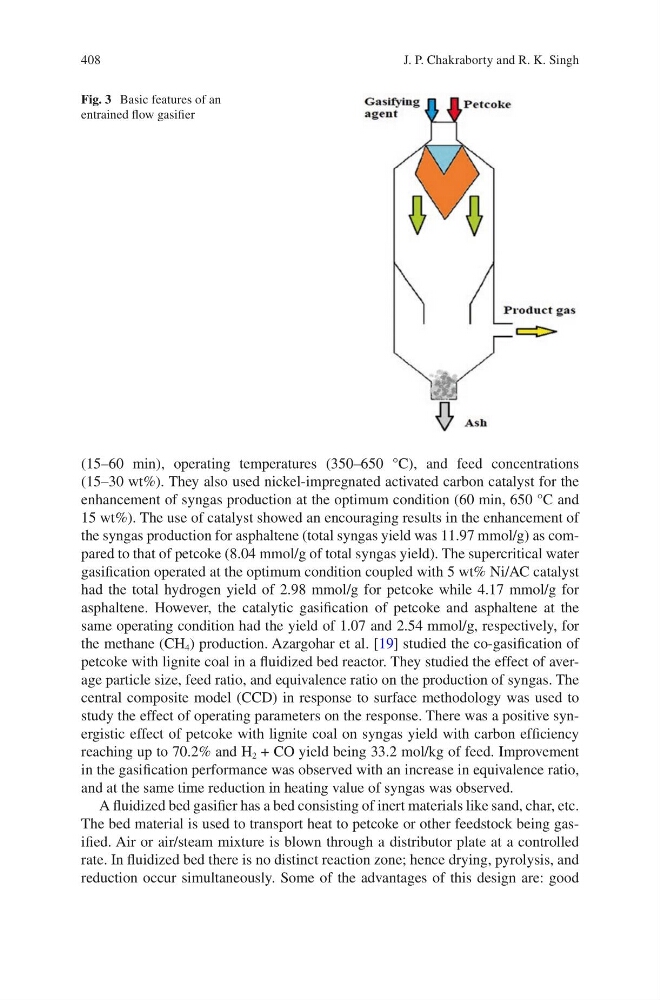
Fig. 3 Basic features of an
entrained flow gasifier
J. P. Chakraborty and R. K. Singh
(15–60 min), operating temperatures (350–650 °C), and feed concentrations
(15–30 wt%). They also used nickel-impregnated activated carbon catalyst for the
enhancement of syngas production at the optimum condition (60 min, 650 °C and
15 wt%). The use of catalyst showed an encouraging results in the enhancement of
the syngas production for asphaltene (total syngas yield was 11.97 mmol/g) as compared to that of petcoke (8.04 mmol/g of total syngas yield). The supercritical water
gasification operated at the optimum condition coupled with 5 wt% Ni/AC catalyst
had the total hydrogen yield of 2.98 mmol/g for petcoke while 4.17 mmol/g for
asphaltene. However, the catalytic gasification of petcoke and asphaltene at the
same operating condition had the yield of 1.07 and 2.54 mmol/g, respectively, for
the methane (CH 4 ) production. Azargohar et al. [19] studied the co-gasification of
petcoke with lignite coal in a fluidized bed reactor. They studied the effect of average particle size, feed ratio, and equivalence ratio on the production of syngas. The
central composite model (CCD) in response to surface methodology was used to
study the effect of operating parameters on the response. There was a positive synergistic effect of petcoke with lignite coal on syngas yield with carbon efficiency
reaching up to 70.2% and H 2 + CO yield being 33.2 mol/kg of feed. Improvement
in the gasification performance was observed with an increase in equivalence ratio,
and at the same time reduction in heating value of syngas was observed.
A fluidized bed gasifier has a bed consisting of inert materials like sand, char, etc.
The bed material is used to transport heat to petcoke or other feedstock being gasified. Air or air/steam mixture is blown through a distributor plate at a controlled
rate. In fluidized bed there is no distinct reaction zone; hence drying, pyrolysis, and
reduction occur simultaneously. Some of the advantages of this design are: good
Fig. 3 Basic features of an
entrained flow gasifier
J. P. Chakraborty and R. K. Singh