

379
• Cracking(FCC)—conversion of larger molecules into smaller by the cleavage of
C−C bonds
• Reforming—a combination of reactions leading to the formation of aromatic
compounds (e.g., dehydrogenation, isomerization, cyclization, aromatization, etc.)
• Hydroprocessing—inducing certain reactions (based on hydrogenation and
hydrogenolysis) by addition of hydrogen
• Isomerization—molecular conversion from one isomer to another isomer
• Coking—conversion of fluid hydrocarbon into coke
• Alkylation—reaction between an olefin and a paraffin to produce larger paraffin
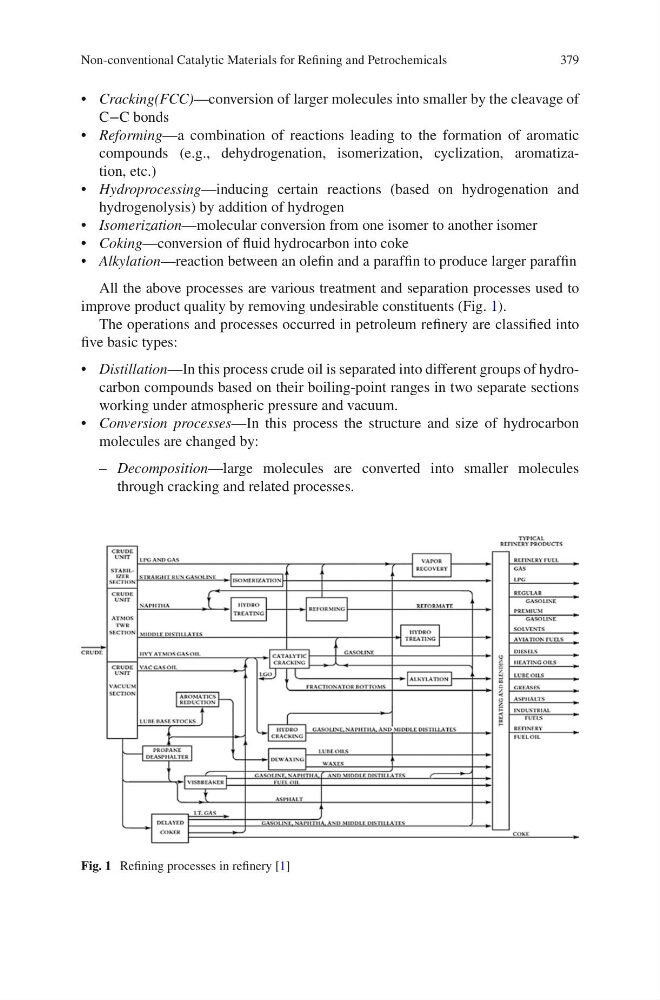
All the above processes are various treatment and separation processes used to
improve product quality by removing undesirable constituents (Fig. 1).
The operations and processes occurred in petroleum refinery are classified into
five basic types:
• Distillation—In this process crude oil is separated into different groups of hydrocarbon compounds based on their boiling-point ranges in two separate sections
working under atmospheric pressure and vacuum.
• Conversion processes—In this process the structure and size of hydrocarbon
molecules are changed by:
– Decomposition—large molecules are converted into smaller molecules
through cracking and related processes.
Fig. 1 Refining processes in refinery [1]
Non-conventional Catalytic Materials for Refining and Petrochemicals
• Cracking(FCC)—conversion of larger molecules into smaller by the cleavage of
C−C bonds
• Reforming—a combination of reactions leading to the formation of aromatic
compounds (e.g., dehydrogenation, isomerization, cyclization, aromatization, etc.)
• Hydroprocessing—inducing certain reactions (based on hydrogenation and
hydrogenolysis) by addition of hydrogen
• Isomerization—molecular conversion from one isomer to another isomer
• Coking—conversion of fluid hydrocarbon into coke
• Alkylation—reaction between an olefin and a paraffin to produce larger paraffin
All the above processes are various treatment and separation processes used to
improve product quality by removing undesirable constituents (Fig. 1).
The operations and processes occurred in petroleum refinery are classified into
five basic types:
• Distillation—In this process crude oil is separated into different groups of hydrocarbon compounds based on their boiling-point ranges in two separate sections
working under atmospheric pressure and vacuum.
• Conversion processes—In this process the structure and size of hydrocarbon
molecules are changed by:
– Decomposition—large molecules are converted into smaller molecules
through cracking and related processes.
Fig. 1 Refining processes in refinery [1]
Non-conventional Catalytic Materials for Refining and Petrochemicals