

378
matter. However, under such conditions of oxygen level, anaerobic bacteria prevail,
which reduces the organic matter and transforms it into fossil fuels. Thus, petroleum
reservoirs are the locations where ancient seas existed. Petroleum reservoirs can be
found beneath land or the ocean floor.
Petroleum is also used as a synonym for crude oil, but it is a widely defined class
of hydrocarbon mixtures in liquid state. The components of petroleum are crude oil,
lease condensate, unfinished oils, refined products, and natural gas plant liquids.
Out of all, crude oil is the most significant component of petroleum which is the
origin of energy for the world’s human race existence. The crude oil of petroleum
reservoirs is extracted with giant drilling machines of the refineries. Naturally
occurring crude oil is insignificant to consumers and thereby needs to be converted
into useful products. This transformation was carried out through a series of various
physical and chemical methods; this process is called refining. By refining processes, crude oil is converted into a variety of desired products such as fuels, gases,
lube oils, and solvents. These products are obtained from crude oil by applying various process variables such as heat, pressure, catalysts, and chemicals [1]. Crude oil
is composed of hydrocarbons (HC) having a wide variety of C/H ratio and molecular structures. It also contains other heteroatoms such as sulfur (S), oxygen (O),
nitrogen (N), and heavy metals, e.g., iron, nickel, and vanadium.
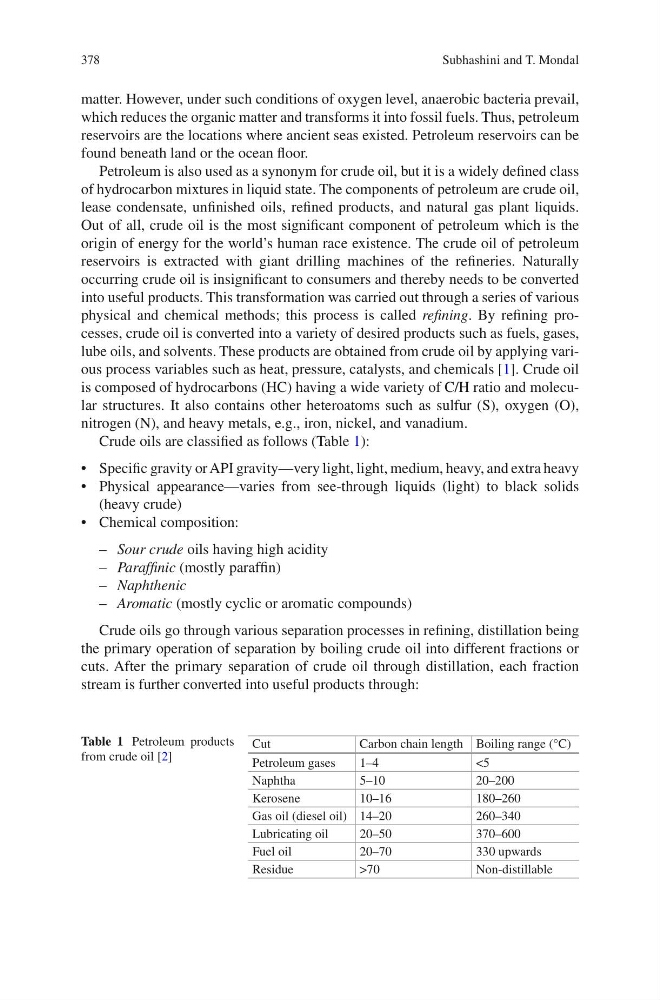
Crude oils are classified as follows (Table 1):
• Specific gravity or API gravity—very light, light, medium, heavy, and extra heavy
• Physical appearance—varies from see-through liquids (light) to black solids
(heavy crude)
• Chemical composition:
– Sour crude oils having high acidity
– Paraffinic (mostly paraffin)
– Naphthenic
– Aromatic (mostly cyclic or aromatic compounds)
Crude oils go through various separation processes in refining, distillation being
the primary operation of separation by boiling crude oil into different fractions or
cuts. After the primary separation of crude oil through distillation, each fraction
stream is further converted into useful products through:
Table 1 Petroleum products
from crude oil [2]
Cut
Carbon chain length Boiling range (°C)
Petroleum gases
1–4
<5
Naphtha
5–10
20–200
Kerosene
10–16
180–260
Gas oil (diesel oil) 14–20
260–340
Lubricating oil
20–50
370–600
Fuel oil
20–70
330 upwards
Residue
>70
Non-distillable
Subhashini and T. Mondal
matter. However, under such conditions of oxygen level, anaerobic bacteria prevail,
which reduces the organic matter and transforms it into fossil fuels. Thus, petroleum
reservoirs are the locations where ancient seas existed. Petroleum reservoirs can be
found beneath land or the ocean floor.
Petroleum is also used as a synonym for crude oil, but it is a widely defined class
of hydrocarbon mixtures in liquid state. The components of petroleum are crude oil,
lease condensate, unfinished oils, refined products, and natural gas plant liquids.
Out of all, crude oil is the most significant component of petroleum which is the
origin of energy for the world’s human race existence. The crude oil of petroleum
reservoirs is extracted with giant drilling machines of the refineries. Naturally
occurring crude oil is insignificant to consumers and thereby needs to be converted
into useful products. This transformation was carried out through a series of various
physical and chemical methods; this process is called refining. By refining processes, crude oil is converted into a variety of desired products such as fuels, gases,
lube oils, and solvents. These products are obtained from crude oil by applying various process variables such as heat, pressure, catalysts, and chemicals [1]. Crude oil
is composed of hydrocarbons (HC) having a wide variety of C/H ratio and molecular structures. It also contains other heteroatoms such as sulfur (S), oxygen (O),
nitrogen (N), and heavy metals, e.g., iron, nickel, and vanadium.
Crude oils are classified as follows (Table 1):
• Specific gravity or API gravity—very light, light, medium, heavy, and extra heavy
• Physical appearance—varies from see-through liquids (light) to black solids
(heavy crude)
• Chemical composition:
– Sour crude oils having high acidity
– Paraffinic (mostly paraffin)
– Naphthenic
– Aromatic (mostly cyclic or aromatic compounds)
Crude oils go through various separation processes in refining, distillation being
the primary operation of separation by boiling crude oil into different fractions or
cuts. After the primary separation of crude oil through distillation, each fraction
stream is further converted into useful products through:
Table 1 Petroleum products
from crude oil [2]
Cut
Carbon chain length Boiling range (°C)
Petroleum gases
1–4
<5
Naphtha
5–10
20–200
Kerosene
10–16
180–260
Gas oil (diesel oil) 14–20
260–340
Lubricating oil
20–50
370–600
Fuel oil
20–70
330 upwards
Residue
>70
Non-distillable
Subhashini and T. Mondal