

339
5.1 Eley-Rideal Model (ER)
In the ER model, it is assumed that one reactant is adsorbed on the surface while the
second reactant remains in the gas phase, reacting with the adsorbed species [37].
The adsorption step is assumed to be fast, while reaction of the second reactant is
assumed to be the rate-determining step [37]. There are two kinds of mechanism
proposed by Kathiraser et al. [37]. They are characterized as ER-I and ER-II.
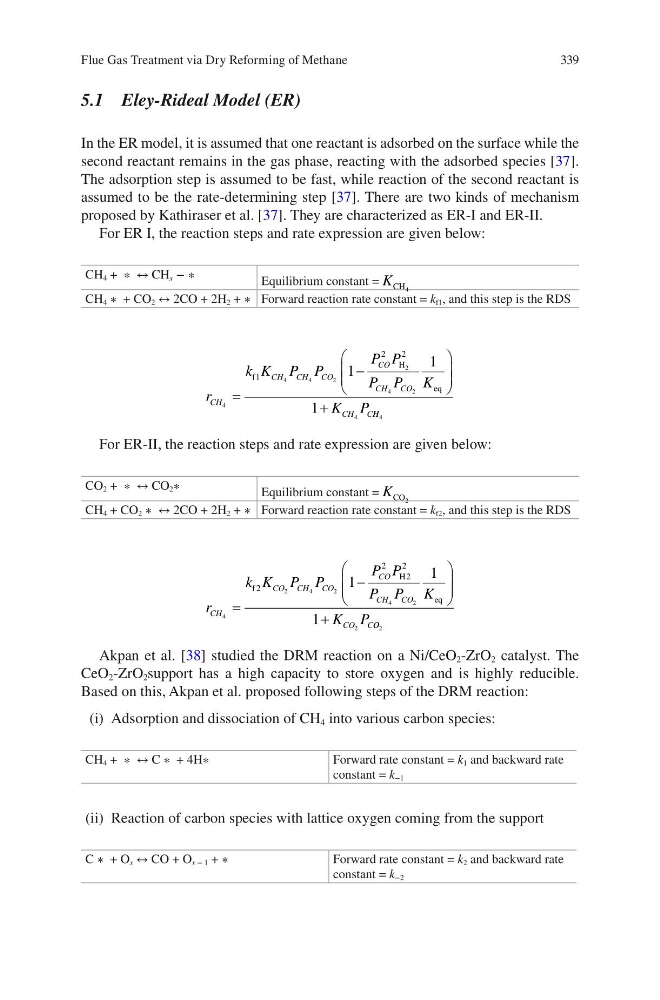
For ER I, the reaction steps and rate expression are given below:
CH 4 + ∗ ↔ CH x − ∗
Equilibrium constant = K CH 4
CH 4 ∗ + CO 2 ↔ 2CO + 2H 2 + ∗ Forward reaction rate constant = k f1 , and this step is the RDS
r
k K P P
P P
P P K
K P
CH
CH CH CO
CO
CH CO
CH C
4
4
4
2
2
4
2
4
1
2
2
1
1
1
=
−
+
f
H
eq
H H 4
For ER-II, the reaction steps and rate expression are given below:
CO 2 + ∗ ↔ CO 2 ∗
Equilibrium constant = K CO 2
CH 4 + CO 2 ∗ ↔ 2CO + 2H 2 + ∗ Forward reaction rate constant = k f2 , and this step is the RDS
r
k K P P
P P
P P K
K P
CH
CO CH CO
CO
CH CO
CO C
4
2
4
2
4
2
2
2
2
2
2
1
1
1
=
−
+
f
H
eq
O O 2
Akpan et al. [38] studied the DRM reaction on a Ni/CeO 2 -ZrO 2 catalyst. The
CeO 2 -ZrO 2 support has a high capacity to store oxygen and is highly reducible.
Based on this, Akpan et al. proposed following steps of the DRM reaction:
(i) Adsorption and dissociation of CH 4 into various carbon species:
CH 4 + ∗ ↔ C ∗ + 4H∗
Forward rate constant = k 1 and backward rate
constant = k −1
(ii) Reaction of carbon species with lattice oxygen coming from the support
C ∗ + O x ↔ CO + O x − 1 + ∗
Forward rate constant = k 2 and backward rate
constant = k −2
Flue Gas Treatment via Dry Reforming of Methane
5.1 Eley-Rideal Model (ER)
In the ER model, it is assumed that one reactant is adsorbed on the surface while the
second reactant remains in the gas phase, reacting with the adsorbed species [37].
The adsorption step is assumed to be fast, while reaction of the second reactant is
assumed to be the rate-determining step [37]. There are two kinds of mechanism
proposed by Kathiraser et al. [37]. They are characterized as ER-I and ER-II.
For ER I, the reaction steps and rate expression are given below:
CH 4 + ∗ ↔ CH x − ∗
Equilibrium constant = K CH 4
CH 4 ∗ + CO 2 ↔ 2CO + 2H 2 + ∗ Forward reaction rate constant = k f1 , and this step is the RDS
r
k K P P
P P
P P K
K P
CH
CH CH CO
CO
CH CO
CH C
4
4
4
2
2
4
2
4
1
2
2
1
1
1
=
−
+
f
H
eq
H H 4
For ER-II, the reaction steps and rate expression are given below:
CO 2 + ∗ ↔ CO 2 ∗
Equilibrium constant = K CO 2
CH 4 + CO 2 ∗ ↔ 2CO + 2H 2 + ∗ Forward reaction rate constant = k f2 , and this step is the RDS
r
k K P P
P P
P P K
K P
CH
CO CH CO
CO
CH CO
CO C
4
2
4
2
4
2
2
2
2
2
2
1
1
1
=
−
+
f
H
eq
O O 2
Akpan et al. [38] studied the DRM reaction on a Ni/CeO 2 -ZrO 2 catalyst. The
CeO 2 -ZrO 2 support has a high capacity to store oxygen and is highly reducible.
Based on this, Akpan et al. proposed following steps of the DRM reaction:
(i) Adsorption and dissociation of CH 4 into various carbon species:
CH 4 + ∗ ↔ C ∗ + 4H∗
Forward rate constant = k 1 and backward rate
constant = k −1
(ii) Reaction of carbon species with lattice oxygen coming from the support
C ∗ + O x ↔ CO + O x − 1 + ∗
Forward rate constant = k 2 and backward rate
constant = k −2
Flue Gas Treatment via Dry Reforming of Methane