

338
Doping Ni with other elements has also shown varying effects on the coking
property of catalysts. For example, adding Ce in case of a modified mineral clay
support has shown beneficial effect on activity while reducing the carbon deposition
by half [32, 33]. On the other hand, adding Co in alumina-supported Ni catalyst
increased the activity, but produced larger amounts of carbon [34]. However, the
carbon deposited was of non-deactivating type and did not affect the stability of the
catalyst. A similar increase in activity and amount of deactivation were shown by us
when Co was added to an alumina-supported Ni catalyst [12]. In contrast, adding Fe
to an alumina-supported Ni catalyst improved the stability of the catalyst while
maintaining similar conversion levels as the unpromoted alumina-supported Ni
catalyst [35]. In these studies, done by us, the amount of carbon deposited was not
determined. However, the stability of the catalyst was assumed to be related to the
amount of carbon deposited. Adding praseodymium (Pr) in Ni/delaminated clay
catalyst reduced the carbon deposition for catalyst calcined at 500 °C [36].
Interestingly, no carbon deposition was found for catalysts calcined at 800 °C [36].
Thus, like alkali metal, adding lanthanides may also improve the coke-resistant
property of Ni catalyst. It is important to note that carbon build up in a reactor is
detrimental to its continuous operation. Furthermore, analysis of carbon is critical
for judging the suitability of a catalyst since carbon formation and stability may not
be directly related.
5 Kinetics: Mechanisms and Models
The DRM reaction proceeds in presence of the reverse water gas shift reaction
(RWGS) given by the reverse of reaction, i.e.
H CO
CO H O
2
2
2
+
→
+
Often, RWGS reaction is at equilibrium under typical operating conditions of the
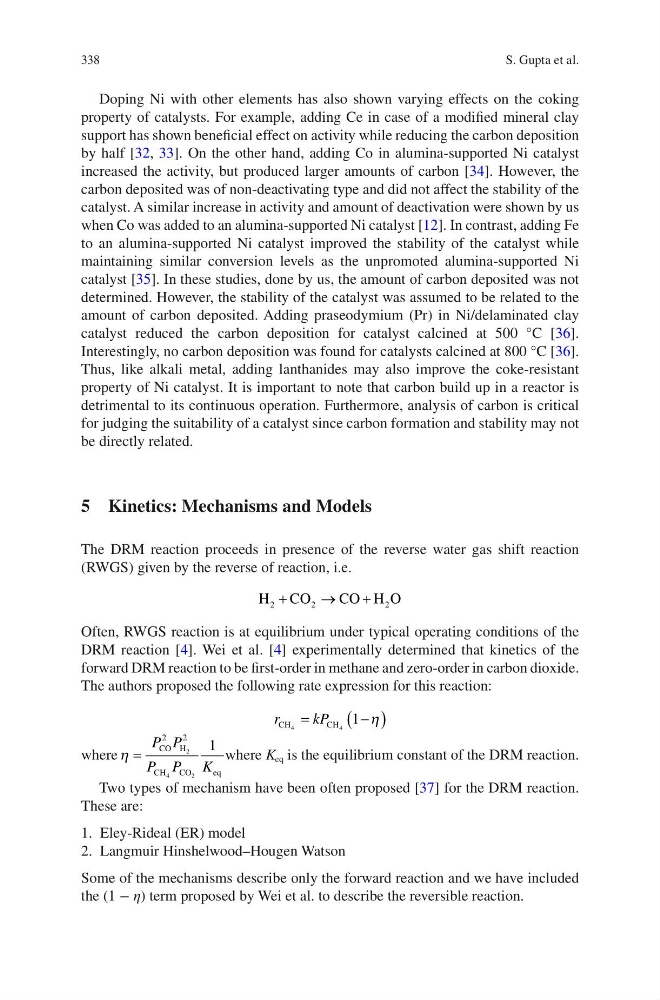
DRM reaction [4]. Wei et al. [4] experimentally determined that kinetics of the
forward DRM reaction to be first-order in methane and zero-order in carbon dioxide.
The authors proposed the following rate expression for this reaction:
r
kP
CH
CH
4
4
1
=
−
( )
η
where η =
P P
P P K
CO H
CH
CO
eq
2
2
2
4
2
1 where K eq is the equilibrium constant of the DRM reaction.
Two types of mechanism have been often proposed [37] for the DRM reaction.
These are:
1. Eley-Rideal (ER) model
2. Langmuir Hinshelwood–Hougen Watson
Some of the mechanisms describe only the forward reaction and we have included
the (1 − η) term proposed by Wei et al. to describe the reversible reaction.
S. Gupta et al.
Doping Ni with other elements has also shown varying effects on the coking
property of catalysts. For example, adding Ce in case of a modified mineral clay
support has shown beneficial effect on activity while reducing the carbon deposition
by half [32, 33]. On the other hand, adding Co in alumina-supported Ni catalyst
increased the activity, but produced larger amounts of carbon [34]. However, the
carbon deposited was of non-deactivating type and did not affect the stability of the
catalyst. A similar increase in activity and amount of deactivation were shown by us
when Co was added to an alumina-supported Ni catalyst [12]. In contrast, adding Fe
to an alumina-supported Ni catalyst improved the stability of the catalyst while
maintaining similar conversion levels as the unpromoted alumina-supported Ni
catalyst [35]. In these studies, done by us, the amount of carbon deposited was not
determined. However, the stability of the catalyst was assumed to be related to the
amount of carbon deposited. Adding praseodymium (Pr) in Ni/delaminated clay
catalyst reduced the carbon deposition for catalyst calcined at 500 °C [36].
Interestingly, no carbon deposition was found for catalysts calcined at 800 °C [36].
Thus, like alkali metal, adding lanthanides may also improve the coke-resistant
property of Ni catalyst. It is important to note that carbon build up in a reactor is
detrimental to its continuous operation. Furthermore, analysis of carbon is critical
for judging the suitability of a catalyst since carbon formation and stability may not
be directly related.
5 Kinetics: Mechanisms and Models
The DRM reaction proceeds in presence of the reverse water gas shift reaction
(RWGS) given by the reverse of reaction, i.e.
H CO
CO H O
2
2
2
+
→
+
Often, RWGS reaction is at equilibrium under typical operating conditions of the
DRM reaction [4]. Wei et al. [4] experimentally determined that kinetics of the
forward DRM reaction to be first-order in methane and zero-order in carbon dioxide.
The authors proposed the following rate expression for this reaction:
r
kP
CH
CH
4
4
1
=
−
( )
η
where η =
P P
P P K
CO H
CH
CO
eq
2
2
2
4
2
1 where K eq is the equilibrium constant of the DRM reaction.
Two types of mechanism have been often proposed [37] for the DRM reaction.
These are:
1. Eley-Rideal (ER) model
2. Langmuir Hinshelwood–Hougen Watson
Some of the mechanisms describe only the forward reaction and we have included
the (1 − η) term proposed by Wei et al. to describe the reversible reaction.
S. Gupta et al.