

325
3 Effect of Changing Operating Conditions of the Reactor
on Conversions, H 2 /CO Ratio and Carbon Deposition
from Experimental Observations Using a Ni/
MgAl 2 O 4 Catalyst
A 10% Ni/MgAl 2 O 4 catalyst (surface area = 62 m
2
/g) was synthesized using an
incipient wetness impregnations technique [11]. The catalyst was calcined at 850 °C
and then reduced in hydrogen at 752 °C. Using H 2 -chemisorption and temperatureprogrammed reduction, the effective dispersion of this Ni/MgAl 2 O 4 catalyst was
determined to be 5.3%. This catalyst was then tested for the variation of operating
conditions of a DRM reaction carried out in a down-flow fixed-bed reactor.
3.1 Increasing Reactor Temperature Increases Conversion
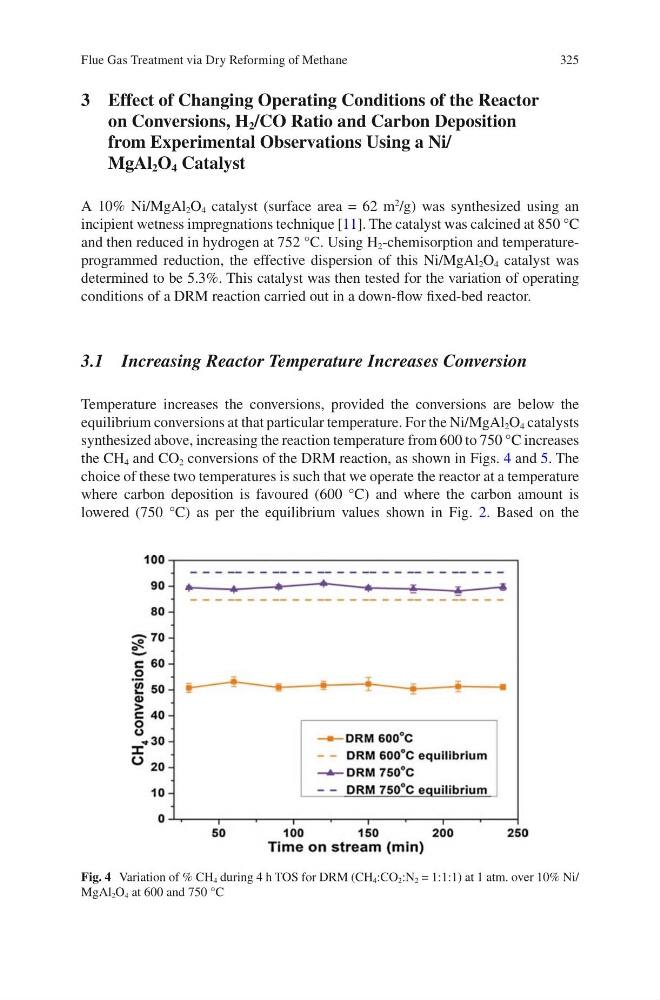
Temperature increases the conversions, provided the conversions are below the
equilibrium conversions at that particular temperature. For the Ni/MgAl 2 O 4 catalysts
synthesized above, increasing the reaction temperature from 600 to 750 °C increases
the CH 4 and CO 2 conversions of the DRM reaction, as shown in Figs. 4 and 5. The
choice of these two temperatures is such that we operate the reactor at a temperature
where carbon deposition is favoured (600 °C) and where the carbon amount is
lowered (750 °C) as per the equilibrium values shown in Fig. 2. Based on the
Fig. 4 Variation of % CH 4 during 4 h TOS for DRM (CH 4 :CO 2 :N 2 = 1:1:1) at 1 atm. over 10% Ni/
MgAl 2 O 4 at 600 and 750 °C
Flue Gas Treatment via Dry Reforming of Methane
3 Effect of Changing Operating Conditions of the Reactor
on Conversions, H 2 /CO Ratio and Carbon Deposition
from Experimental Observations Using a Ni/
MgAl 2 O 4 Catalyst
A 10% Ni/MgAl 2 O 4 catalyst (surface area = 62 m
2
/g) was synthesized using an
incipient wetness impregnations technique [11]. The catalyst was calcined at 850 °C
and then reduced in hydrogen at 752 °C. Using H 2 -chemisorption and temperatureprogrammed reduction, the effective dispersion of this Ni/MgAl 2 O 4 catalyst was
determined to be 5.3%. This catalyst was then tested for the variation of operating
conditions of a DRM reaction carried out in a down-flow fixed-bed reactor.
3.1 Increasing Reactor Temperature Increases Conversion
Temperature increases the conversions, provided the conversions are below the
equilibrium conversions at that particular temperature. For the Ni/MgAl 2 O 4 catalysts
synthesized above, increasing the reaction temperature from 600 to 750 °C increases
the CH 4 and CO 2 conversions of the DRM reaction, as shown in Figs. 4 and 5. The
choice of these two temperatures is such that we operate the reactor at a temperature
where carbon deposition is favoured (600 °C) and where the carbon amount is
lowered (750 °C) as per the equilibrium values shown in Fig. 2. Based on the
Fig. 4 Variation of % CH 4 during 4 h TOS for DRM (CH 4 :CO 2 :N 2 = 1:1:1) at 1 atm. over 10% Ni/
MgAl 2 O 4 at 600 and 750 °C
Flue Gas Treatment via Dry Reforming of Methane