

324
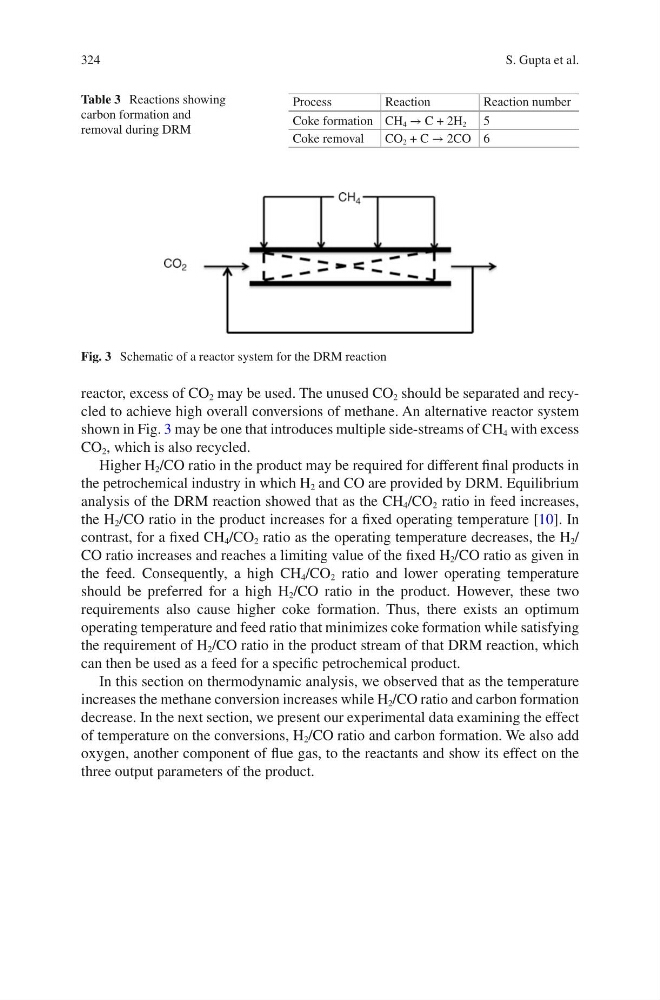
reactor, excess of CO 2 may be used. The unused CO 2 should be separated and recycled to achieve high overall conversions of methane. An alternative reactor system
shown in Fig. 3 may be one that introduces multiple side-streams of CH 4 with excess
CO 2 , which is also recycled.
Higher H 2 /CO ratio in the product may be required for different final products in
the petrochemical industry in which H 2 and CO are provided by DRM. Equilibrium
analysis of the DRM reaction showed that as the CH 4 /CO 2 ratio in feed increases,
the H 2 /CO ratio in the product increases for a fixed operating temperature [10]. In
contrast, for a fixed CH 4 /CO 2 ratio as the operating temperature decreases, the H 2 /
CO ratio increases and reaches a limiting value of the fixed H 2 /CO ratio as given in
the feed. Consequently, a high CH 4 /CO 2 ratio and lower operating temperature
should be preferred for a high H 2 /CO ratio in the product. However, these two
requirements also cause higher coke formation. Thus, there exists an optimum
operating temperature and feed ratio that minimizes coke formation while satisfying
the requirement of H 2 /CO ratio in the product stream of that DRM reaction, which
can then be used as a feed for a specific petrochemical product.
In this section on thermodynamic analysis, we observed that as the temperature
increases the methane conversion increases while H 2 /CO ratio and carbon formation
decrease. In the next section, we present our experimental data examining the effect
of temperature on the conversions, H 2 /CO ratio and carbon formation. We also add
oxygen, another component of flue gas, to the reactants and show its effect on the
three output parameters of the product.
Table 3 Reactions showing
carbon formation and
removal during DRM
Process
Reaction
Reaction number
Coke formation CH 4 → C + 2H 2 5
Coke removal
CO 2 + C → 2CO 6
Fig. 3 Schematic of a reactor system for the DRM reaction
S. Gupta et al.
reactor, excess of CO 2 may be used. The unused CO 2 should be separated and recycled to achieve high overall conversions of methane. An alternative reactor system
shown in Fig. 3 may be one that introduces multiple side-streams of CH 4 with excess
CO 2 , which is also recycled.
Higher H 2 /CO ratio in the product may be required for different final products in
the petrochemical industry in which H 2 and CO are provided by DRM. Equilibrium
analysis of the DRM reaction showed that as the CH 4 /CO 2 ratio in feed increases,
the H 2 /CO ratio in the product increases for a fixed operating temperature [10]. In
contrast, for a fixed CH 4 /CO 2 ratio as the operating temperature decreases, the H 2 /
CO ratio increases and reaches a limiting value of the fixed H 2 /CO ratio as given in
the feed. Consequently, a high CH 4 /CO 2 ratio and lower operating temperature
should be preferred for a high H 2 /CO ratio in the product. However, these two
requirements also cause higher coke formation. Thus, there exists an optimum
operating temperature and feed ratio that minimizes coke formation while satisfying
the requirement of H 2 /CO ratio in the product stream of that DRM reaction, which
can then be used as a feed for a specific petrochemical product.
In this section on thermodynamic analysis, we observed that as the temperature
increases the methane conversion increases while H 2 /CO ratio and carbon formation
decrease. In the next section, we present our experimental data examining the effect
of temperature on the conversions, H 2 /CO ratio and carbon formation. We also add
oxygen, another component of flue gas, to the reactants and show its effect on the
three output parameters of the product.
Table 3 Reactions showing
carbon formation and
removal during DRM
Process
Reaction
Reaction number
Coke formation CH 4 → C + 2H 2 5
Coke removal
CO 2 + C → 2CO 6
Fig. 3 Schematic of a reactor system for the DRM reaction
S. Gupta et al.