

23
structure due to lower metal–support interaction, lower reduction temperature of
molybdenum oxide, more active sites, high crystal phase dispersion, shorter crystal
length, higher degree of stacking, and lower pore diffusion effect. In this study,
HYD was found to be the dominant reaction pathway for the HDS of 4,6-DMDBT
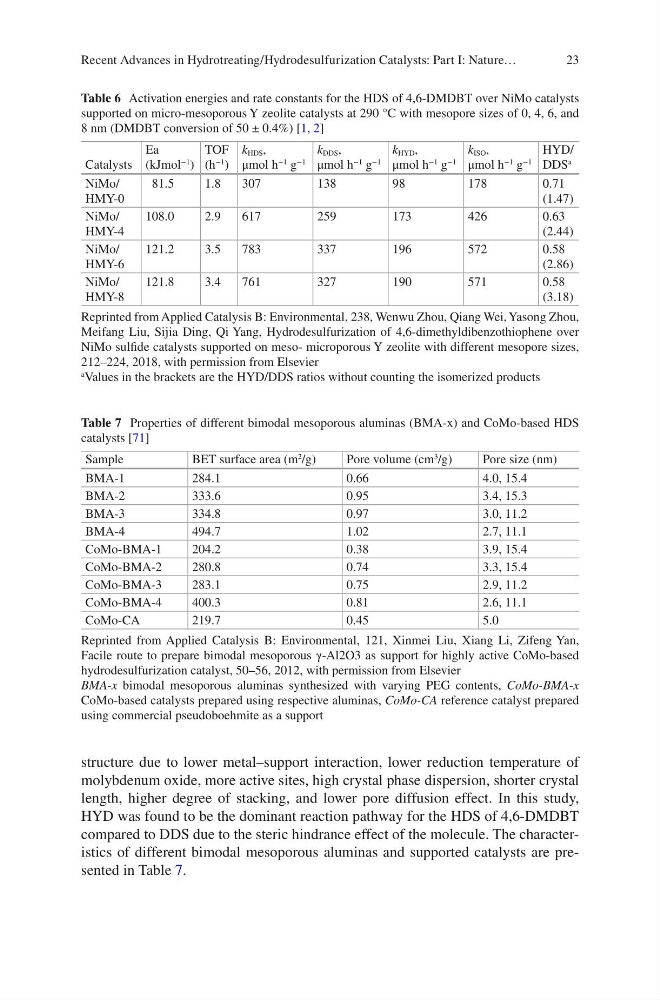
compared to DDS due to the steric hindrance effect of the molecule. The characteristics of different bimodal mesoporous aluminas and supported catalysts are presented in Table 7.
Table 6 Activation energies and rate constants for the HDS of 4,6-DMDBT over NiMo catalysts
supported on micro-mesoporous Y zeolite catalysts at 290 °C with mesopore sizes of 0, 4, 6, and
8 nm (DMDBT conversion of 50 ± 0.4%) [1, 2]
Catalysts
Ea
(kJmol
−1 )
TOF
(h
−1
)
k HDS ,
μmol h
−1 g
−1
k DDS ,
μmol h
−1 g
−1
k HYD ,
μmol h
−1
g
−1
k ISO ,
μmol h
−1
g
−1
HYD/
DDS
a
NiMo/
HMY-0
81.5
1.8
307
138
98
178
0.71
(1.47)
NiMo/
HMY-4
108.0
2.9
617
259
173
426
0.63
(2.44)
NiMo/
HMY-6
121.2
3.5
783
337
196
572
0.58
(2.86)
NiMo/
HMY-8
121.8
3.4
761
327
190
571
0.58
(3.18)
Reprinted from Applied Catalysis B: Environmental, 238, Wenwu Zhou, Qiang Wei, Yasong Zhou,
Meifang Liu, Sijia Ding, Qi Yang, Hydrodesulfurization of 4,6-dimethyldibenzothiophene over
NiMo sulfide catalysts supported on meso- microporous Y zeolite with different mesopore sizes,
212–224, 2018, with permission from Elsevier
a Values in the brackets are the HYD/DDS ratios without counting the isomerized products
Table 7 Properties of different bimodal mesoporous aluminas (BMA-x) and CoMo-based HDS
catalysts [71]
Sample
BET surface area (m
2
/g)
Pore volume (cm
3 /g)
Pore size (nm)
BMA-1
284.1
0.66
4.0, 15.4
BMA-2
333.6
0.95
3.4, 15.3
BMA-3
334.8
0.97
3.0, 11.2
BMA-4
494.7
1.02
2.7, 11.1
CoMo-BMA-1
204.2
0.38
3.9, 15.4
CoMo-BMA-2
280.8
0.74
3.3, 15.4
CoMo-BMA-3
283.1
0.75
2.9, 11.2
CoMo-BMA-4
400.3
0.81
2.6, 11.1
CoMo-CA
219.7
0.45
5.0
Reprinted from Applied Catalysis B: Environmental, 121, Xinmei Liu, Xiang Li, Zifeng Yan,
Facile route to prepare bimodal mesoporous γ-Al2O3 as support for highly active CoMo-based
hydrodesulfurization catalyst, 50–56, 2012, with permission from Elsevier
BMA-x bimodal mesoporous aluminas synthesized with varying PEG contents, CoMo-BMA-x
CoMo-based catalysts prepared using respective aluminas, CoMo-CA reference catalyst prepared
using commercial pseudoboehmite as a support
Recent Advances in Hydrotreating/Hydrodesulfurization Catalysts: Part I: Nature…
structure due to lower metal–support interaction, lower reduction temperature of
molybdenum oxide, more active sites, high crystal phase dispersion, shorter crystal
length, higher degree of stacking, and lower pore diffusion effect. In this study,
HYD was found to be the dominant reaction pathway for the HDS of 4,6-DMDBT
compared to DDS due to the steric hindrance effect of the molecule. The characteristics of different bimodal mesoporous aluminas and supported catalysts are presented in Table 7.
Table 6 Activation energies and rate constants for the HDS of 4,6-DMDBT over NiMo catalysts
supported on micro-mesoporous Y zeolite catalysts at 290 °C with mesopore sizes of 0, 4, 6, and
8 nm (DMDBT conversion of 50 ± 0.4%) [1, 2]
Catalysts
Ea
(kJmol
−1 )
TOF
(h
−1
)
k HDS ,
μmol h
−1 g
−1
k DDS ,
μmol h
−1 g
−1
k HYD ,
μmol h
−1
g
−1
k ISO ,
μmol h
−1
g
−1
HYD/
DDS
a
NiMo/
HMY-0
81.5
1.8
307
138
98
178
0.71
(1.47)
NiMo/
HMY-4
108.0
2.9
617
259
173
426
0.63
(2.44)
NiMo/
HMY-6
121.2
3.5
783
337
196
572
0.58
(2.86)
NiMo/
HMY-8
121.8
3.4
761
327
190
571
0.58
(3.18)
Reprinted from Applied Catalysis B: Environmental, 238, Wenwu Zhou, Qiang Wei, Yasong Zhou,
Meifang Liu, Sijia Ding, Qi Yang, Hydrodesulfurization of 4,6-dimethyldibenzothiophene over
NiMo sulfide catalysts supported on meso- microporous Y zeolite with different mesopore sizes,
212–224, 2018, with permission from Elsevier
a Values in the brackets are the HYD/DDS ratios without counting the isomerized products
Table 7 Properties of different bimodal mesoporous aluminas (BMA-x) and CoMo-based HDS
catalysts [71]
Sample
BET surface area (m
2
/g)
Pore volume (cm
3 /g)
Pore size (nm)
BMA-1
284.1
0.66
4.0, 15.4
BMA-2
333.6
0.95
3.4, 15.3
BMA-3
334.8
0.97
3.0, 11.2
BMA-4
494.7
1.02
2.7, 11.1
CoMo-BMA-1
204.2
0.38
3.9, 15.4
CoMo-BMA-2
280.8
0.74
3.3, 15.4
CoMo-BMA-3
283.1
0.75
2.9, 11.2
CoMo-BMA-4
400.3
0.81
2.6, 11.1
CoMo-CA
219.7
0.45
5.0
Reprinted from Applied Catalysis B: Environmental, 121, Xinmei Liu, Xiang Li, Zifeng Yan,
Facile route to prepare bimodal mesoporous γ-Al2O3 as support for highly active CoMo-based
hydrodesulfurization catalyst, 50–56, 2012, with permission from Elsevier
BMA-x bimodal mesoporous aluminas synthesized with varying PEG contents, CoMo-BMA-x
CoMo-based catalysts prepared using respective aluminas, CoMo-CA reference catalyst prepared
using commercial pseudoboehmite as a support
Recent Advances in Hydrotreating/Hydrodesulfurization Catalysts: Part I: Nature…