

22
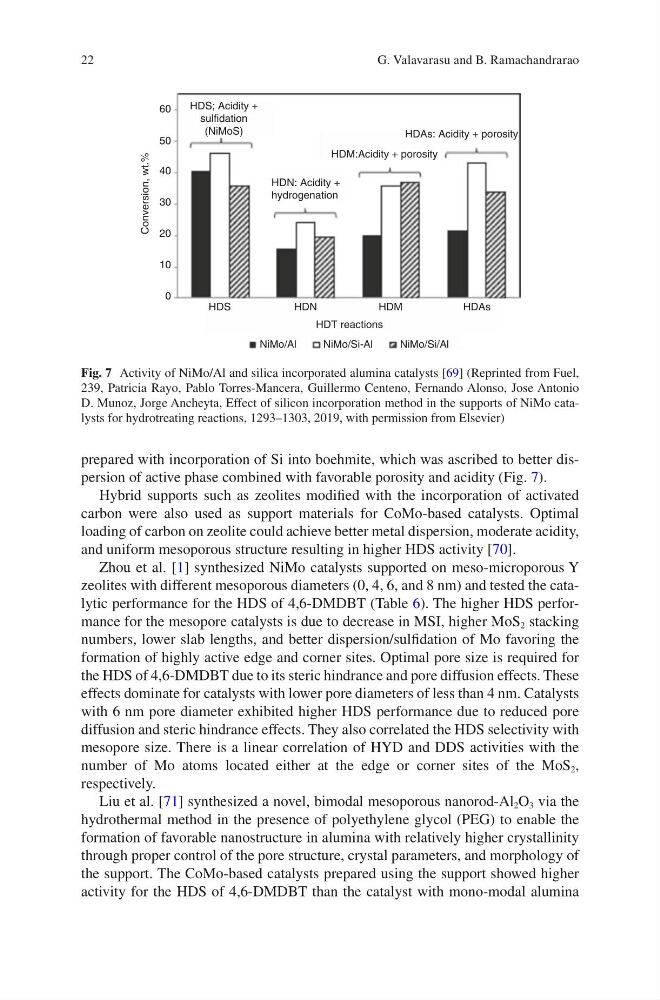
prepared with incorporation of Si into boehmite, which was ascribed to better dispersion of active phase combined with favorable porosity and acidity (Fig. 7).
Hybrid supports such as zeolites modified with the incorporation of activated
carbon were also used as support materials for CoMo-based catalysts. Optimal
loading of carbon on zeolite could achieve better metal dispersion, moderate acidity,
and uniform mesoporous structure resulting in higher HDS activity [70].
Zhou et al. [1] synthesized NiMo catalysts supported on meso-microporous Y
zeolites with different mesoporous diameters (0, 4, 6, and 8 nm) and tested the catalytic performance for the HDS of 4,6-DMDBT (Table 6). The higher HDS performance for the mesopore catalysts is due to decrease in MSI, higher MoS 2 stacking
numbers, lower slab lengths, and better dispersion/sulfidation of Mo favoring the
formation of highly active edge and corner sites. Optimal pore size is required for
the HDS of 4,6-DMDBT due to its steric hindrance and pore diffusion effects. These
effects dominate for catalysts with lower pore diameters of less than 4 nm. Catalysts
with 6 nm pore diameter exhibited higher HDS performance due to reduced pore
diffusion and steric hindrance effects. They also correlated the HDS selectivity with
mesopore size. There is a linear correlation of HYD and DDS activities with the
number of Mo atoms located either at the edge or corner sites of the MoS 2 ,
respectively.
Liu et al. [71] synthesized a novel, bimodal mesoporous nanorod-Al 2 O 3 via the
hydrothermal method in the presence of polyethylene glycol (PEG) to enable the
formation of favorable nanostructure in alumina with relatively higher crystallinity
through proper control of the pore structure, crystal parameters, and morphology of
the support. The CoMo-based catalysts prepared using the support showed higher
activity for the HDS of 4,6-DMDBT than the catalyst with mono-modal alumina
HDN: Acidity +
hydrogenation
HDN
HDT reactions
NiMo/Al
NiMo/Si-Al
NiMo/Si/Al
HDM
HDAs
HDS
Conversion, wt.%
HDS; Acidity +
sulfidation
(NiMoS)
0
10
20
30
40
50
60
HDM:Acidity + porosity
HDAs: Acidity + porosity
Fig. 7 Activity of NiMo/Al and silica incorporated alumina catalysts [69] (Reprinted from Fuel,
239, Patricia Rayo, Pablo Torres-Mancera, Guillermo Centeno, Fernando Alonso, Jose Antonio
D. Munoz, Jorge Ancheyta, Effect of silicon incorporation method in the supports of NiMo catalysts for hydrotreating reactions, 1293–1303, 2019, with permission from Elsevier)
G. Valavarasu and B. Ramachandrarao
prepared with incorporation of Si into boehmite, which was ascribed to better dispersion of active phase combined with favorable porosity and acidity (Fig. 7).
Hybrid supports such as zeolites modified with the incorporation of activated
carbon were also used as support materials for CoMo-based catalysts. Optimal
loading of carbon on zeolite could achieve better metal dispersion, moderate acidity,
and uniform mesoporous structure resulting in higher HDS activity [70].
Zhou et al. [1] synthesized NiMo catalysts supported on meso-microporous Y
zeolites with different mesoporous diameters (0, 4, 6, and 8 nm) and tested the catalytic performance for the HDS of 4,6-DMDBT (Table 6). The higher HDS performance for the mesopore catalysts is due to decrease in MSI, higher MoS 2 stacking
numbers, lower slab lengths, and better dispersion/sulfidation of Mo favoring the
formation of highly active edge and corner sites. Optimal pore size is required for
the HDS of 4,6-DMDBT due to its steric hindrance and pore diffusion effects. These
effects dominate for catalysts with lower pore diameters of less than 4 nm. Catalysts
with 6 nm pore diameter exhibited higher HDS performance due to reduced pore
diffusion and steric hindrance effects. They also correlated the HDS selectivity with
mesopore size. There is a linear correlation of HYD and DDS activities with the
number of Mo atoms located either at the edge or corner sites of the MoS 2 ,
respectively.
Liu et al. [71] synthesized a novel, bimodal mesoporous nanorod-Al 2 O 3 via the
hydrothermal method in the presence of polyethylene glycol (PEG) to enable the
formation of favorable nanostructure in alumina with relatively higher crystallinity
through proper control of the pore structure, crystal parameters, and morphology of
the support. The CoMo-based catalysts prepared using the support showed higher
activity for the HDS of 4,6-DMDBT than the catalyst with mono-modal alumina
HDN: Acidity +
hydrogenation
HDN
HDT reactions
NiMo/Al
NiMo/Si-Al
NiMo/Si/Al
HDM
HDAs
HDS
Conversion, wt.%
HDS; Acidity +
sulfidation
(NiMoS)
0
10
20
30
40
50
60
HDM:Acidity + porosity
HDAs: Acidity + porosity
Fig. 7 Activity of NiMo/Al and silica incorporated alumina catalysts [69] (Reprinted from Fuel,
239, Patricia Rayo, Pablo Torres-Mancera, Guillermo Centeno, Fernando Alonso, Jose Antonio
D. Munoz, Jorge Ancheyta, Effect of silicon incorporation method in the supports of NiMo catalysts for hydrotreating reactions, 1293–1303, 2019, with permission from Elsevier)
G. Valavarasu and B. Ramachandrarao