

303
catalyst, DMA, 0.075 M KBr,
c = 0.15 M, r.t., 4.5 F/mol
DMA: N,N -dimethylacetamide
SS 304 electrodes; J = 1.5 mA/cm 2
Ar
Br
(Ar)Het Br
n
Ar
H
n
Het(Ar)
N
N
Ni
Br
Br
Catalyst
Scheme 98 Electro-reductive cross-coupling of aryl and alkyl bromides
NaOAc (20 mol%)
LiClO 4 , MeCN. rt
C
C
N
H
R 1
R 2
P
EtO H
OEt
O
P
O
OEt
OEt
NH
R 1
R 2
Scheme 96 Directed C−H phosphorylation of amine
Room temp.
Citric acid (10 mol%)
DPPE (20 mol%)
KI (50 mol%)
R 1 S H
H
CN
NH 2
S
R 1
N
Scheme 97 Electrooxidative Csp
3 –H bond activation of acetonitrile
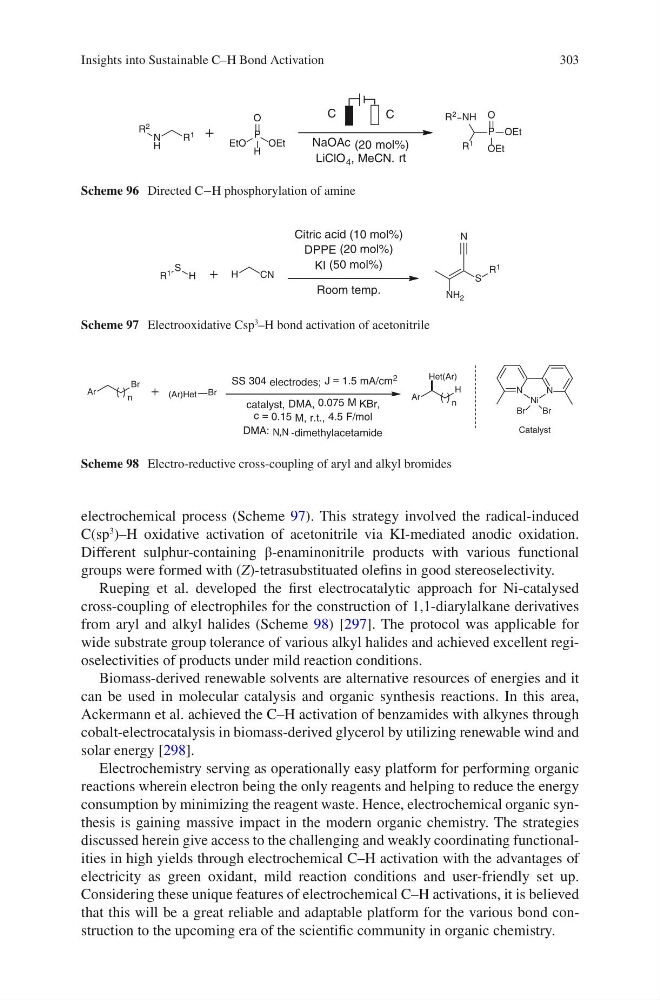
electrochemical process (Scheme 97). This strategy involved the radical-induced
C(sp
3
)–H oxidative activation of acetonitrile via KI-mediated anodic oxidation.
Different sulphur-containing β-enaminonitrile products with various functional
groups were formed with (Z)-tetrasubstituated olefins in good stereoselectivity.
Rueping et al. developed the first electrocatalytic approach for Ni-catalysed
cross-coupling of electrophiles for the construction of 1,1-diarylalkane derivatives
from aryl and alkyl halides (Scheme 98) [297]. The protocol was applicable for
wide substrate group tolerance of various alkyl halides and achieved excellent regioselectivities of products under mild reaction conditions.
Biomass-derived renewable solvents are alternative resources of energies and it
can be used in molecular catalysis and organic synthesis reactions. In this area,
Ackermann et al. achieved the C–H activation of benzamides with alkynes through
cobalt-electrocatalysis in biomass-derived glycerol by utilizing renewable wind and
solar energy [298].
Electrochemistry serving as operationally easy platform for performing organic
reactions wherein electron being the only reagents and helping to reduce the energy
consumption by minimizing the reagent waste. Hence, electrochemical organic synthesis is gaining massive impact in the modern organic chemistry. The strategies
discussed herein give access to the challenging and weakly coordinating functionalities in high yields through electrochemical C–H activation with the advantages of
electricity as green oxidant, mild reaction conditions and user-friendly set up.
Considering these unique features of electrochemical C–H activations, it is believed
that this will be a great reliable and adaptable platform for the various bond construction to the upcoming era of the scientific community in organic chemistry.
Insights into Sustainable C–H Bond Activation
catalyst, DMA, 0.075 M KBr,
c = 0.15 M, r.t., 4.5 F/mol
DMA: N,N -dimethylacetamide
SS 304 electrodes; J = 1.5 mA/cm 2
Ar
Br
(Ar)Het Br
n
Ar
H
n
Het(Ar)
N
N
Ni
Br
Br
Catalyst
Scheme 98 Electro-reductive cross-coupling of aryl and alkyl bromides
NaOAc (20 mol%)
LiClO 4 , MeCN. rt
C
C
N
H
R 1
R 2
P
EtO H
OEt
O
P
O
OEt
OEt
NH
R 1
R 2
Scheme 96 Directed C−H phosphorylation of amine
Room temp.
Citric acid (10 mol%)
DPPE (20 mol%)
KI (50 mol%)
R 1 S H
H
CN
NH 2
S
R 1
N
Scheme 97 Electrooxidative Csp
3 –H bond activation of acetonitrile
electrochemical process (Scheme 97). This strategy involved the radical-induced
C(sp
3
)–H oxidative activation of acetonitrile via KI-mediated anodic oxidation.
Different sulphur-containing β-enaminonitrile products with various functional
groups were formed with (Z)-tetrasubstituated olefins in good stereoselectivity.
Rueping et al. developed the first electrocatalytic approach for Ni-catalysed
cross-coupling of electrophiles for the construction of 1,1-diarylalkane derivatives
from aryl and alkyl halides (Scheme 98) [297]. The protocol was applicable for
wide substrate group tolerance of various alkyl halides and achieved excellent regioselectivities of products under mild reaction conditions.
Biomass-derived renewable solvents are alternative resources of energies and it
can be used in molecular catalysis and organic synthesis reactions. In this area,
Ackermann et al. achieved the C–H activation of benzamides with alkynes through
cobalt-electrocatalysis in biomass-derived glycerol by utilizing renewable wind and
solar energy [298].
Electrochemistry serving as operationally easy platform for performing organic
reactions wherein electron being the only reagents and helping to reduce the energy
consumption by minimizing the reagent waste. Hence, electrochemical organic synthesis is gaining massive impact in the modern organic chemistry. The strategies
discussed herein give access to the challenging and weakly coordinating functionalities in high yields through electrochemical C–H activation with the advantages of
electricity as green oxidant, mild reaction conditions and user-friendly set up.
Considering these unique features of electrochemical C–H activations, it is believed
that this will be a great reliable and adaptable platform for the various bond construction to the upcoming era of the scientific community in organic chemistry.
Insights into Sustainable C–H Bond Activation