

300
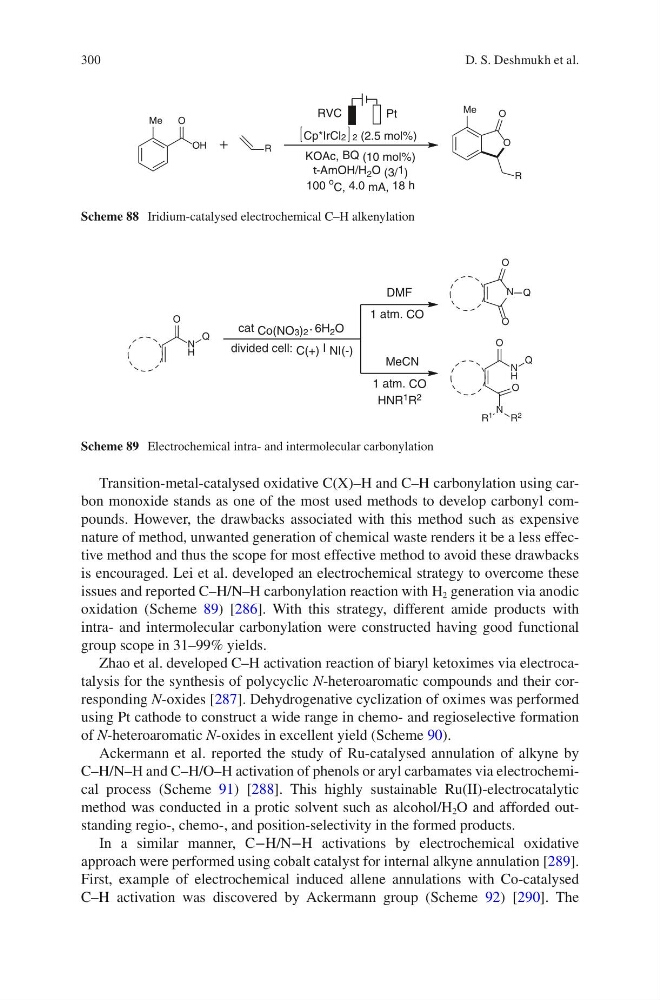
Transition-metal-catalysed oxidative C(X)–H and C–H carbonylation using carbon monoxide stands as one of the most used methods to develop carbonyl compounds. However, the drawbacks associated with this method such as expensive
nature of method, unwanted generation of chemical waste renders it be a less effective method and thus the scope for most effective method to avoid these drawbacks
is encouraged. Lei et al. developed an electrochemical strategy to overcome these
issues and reported C–H/N–H carbonylation reaction with H 2 generation via anodic
oxidation (Scheme 89) [286]. With this strategy, different amide products with
intra- and intermolecular carbonylation were constructed having good functional
group scope in 31–99% yields.
Zhao et al. developed C–H activation reaction of biaryl ketoximes via electrocatalysis for the synthesis of polycyclic N-heteroaromatic compounds and their corresponding N-oxides [287]. Dehydrogenative cyclization of oximes was performed
using Pt cathode to construct a wide range in chemo- and regioselective formation
of N-heteroaromatic N-oxides in excellent yield (Scheme 90).
Ackermann et al. reported the study of Ru-catalysed annulation of alkyne by
C–H/N–H and C–H/O–H activation of phenols or aryl carbamates via electrochemical process (Scheme 91) [288]. This highly sustainable Ru(II)-electrocatalytic
method was conducted in a protic solvent such as alcohol/H 2 O and afforded outstanding regio-, chemo-, and position-selectivity in the formed products.
In a similar manner, C−H/N−H activations by electrochemical oxidative
approach were performed using cobalt catalyst for internal alkyne annulation [289].
First, example of electrochemical induced allene annulations with Co-catalysed
C–H activation was discovered by Ackermann group (Scheme 92) [290]. The
Cp*IrCl2 2 (2.5 mol%)
KOAc, BQ (10 mol%)
t-AmOH/H 2 O (3/ 1 )
100
o C, 4.0 mA, 18 h
RVC
Pt
OH
O
R
O
O
R
Me
Me
Scheme 88 Iridium-catalysed electrochemical C–H alkenylation
N
H
O
Q
N
H
O
Q
N
O
O
Q
O
N
R 1
R 2
DMF
1 atm. CO
MeCN
1 atm. CO
HNR 1 R 2
cat Co(NO3)2 6H 2 O
divided cell: C(+) I NI(-)
Scheme 89 Electrochemical intra- and intermolecular carbonylation
D. S. Deshmukh et al.
Transition-metal-catalysed oxidative C(X)–H and C–H carbonylation using carbon monoxide stands as one of the most used methods to develop carbonyl compounds. However, the drawbacks associated with this method such as expensive
nature of method, unwanted generation of chemical waste renders it be a less effective method and thus the scope for most effective method to avoid these drawbacks
is encouraged. Lei et al. developed an electrochemical strategy to overcome these
issues and reported C–H/N–H carbonylation reaction with H 2 generation via anodic
oxidation (Scheme 89) [286]. With this strategy, different amide products with
intra- and intermolecular carbonylation were constructed having good functional
group scope in 31–99% yields.
Zhao et al. developed C–H activation reaction of biaryl ketoximes via electrocatalysis for the synthesis of polycyclic N-heteroaromatic compounds and their corresponding N-oxides [287]. Dehydrogenative cyclization of oximes was performed
using Pt cathode to construct a wide range in chemo- and regioselective formation
of N-heteroaromatic N-oxides in excellent yield (Scheme 90).
Ackermann et al. reported the study of Ru-catalysed annulation of alkyne by
C–H/N–H and C–H/O–H activation of phenols or aryl carbamates via electrochemical process (Scheme 91) [288]. This highly sustainable Ru(II)-electrocatalytic
method was conducted in a protic solvent such as alcohol/H 2 O and afforded outstanding regio-, chemo-, and position-selectivity in the formed products.
In a similar manner, C−H/N−H activations by electrochemical oxidative
approach were performed using cobalt catalyst for internal alkyne annulation [289].
First, example of electrochemical induced allene annulations with Co-catalysed
C–H activation was discovered by Ackermann group (Scheme 92) [290]. The
Cp*IrCl2 2 (2.5 mol%)
KOAc, BQ (10 mol%)
t-AmOH/H 2 O (3/ 1 )
100
o C, 4.0 mA, 18 h
RVC
Pt
OH
O
R
O
O
R
Me
Me
Scheme 88 Iridium-catalysed electrochemical C–H alkenylation
N
H
O
Q
N
H
O
Q
N
O
O
Q
O
N
R 1
R 2
DMF
1 atm. CO
MeCN
1 atm. CO
HNR 1 R 2
cat Co(NO3)2 6H 2 O
divided cell: C(+) I NI(-)
Scheme 89 Electrochemical intra- and intermolecular carbonylation
D. S. Deshmukh et al.