

288
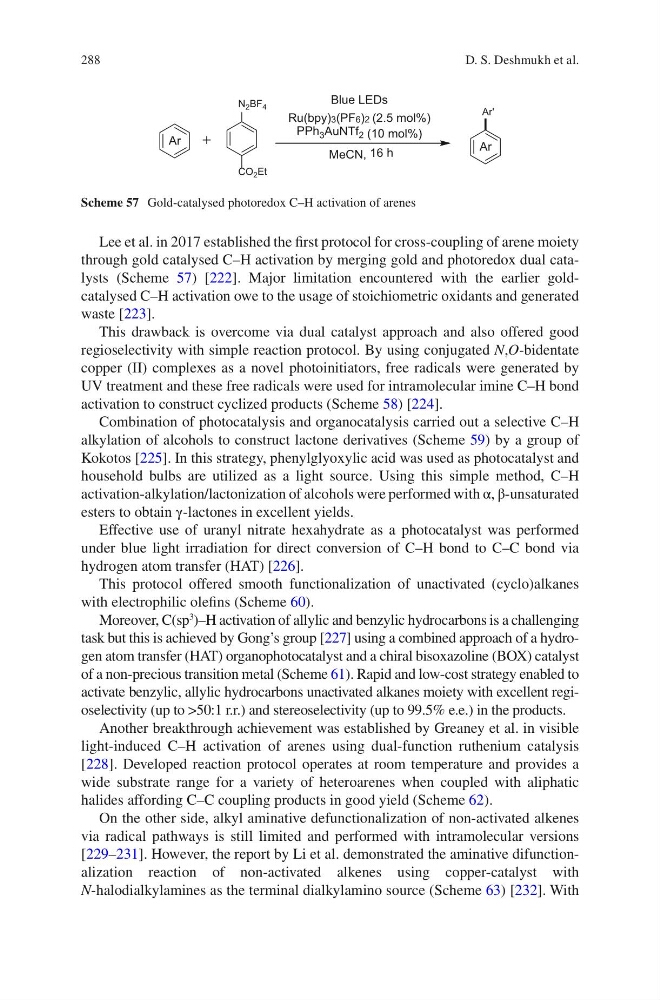
Lee et al. in 2017 established the first protocol for cross-coupling of arene moiety
through gold catalysed C–H activation by merging gold and photoredox dual catalysts (Scheme 57) [222]. Major limitation encountered with the earlier goldcatalysed C–H activation owe to the usage of stoichiometric oxidants and generated
waste [223].
This drawback is overcome via dual catalyst approach and also offered good
regioselectivity with simple reaction protocol. By using conjugated N,O-bidentate
copper (II) complexes as a novel photoinitiators, free radicals were generated by
UV treatment and these free radicals were used for intramolecular imine C–H bond
activation to construct cyclized products (Scheme 58) [224].
Combination of photocatalysis and organocatalysis carried out a selective C–H
alkylation of alcohols to construct lactone derivatives (Scheme 59) by a group of
Kokotos [225]. In this strategy, phenylglyoxylic acid was used as photocatalyst and
household bulbs are utilized as a light source. Using this simple method, C–H
activation- alkylation/lactonization of alcohols were performed with α, β-unsaturated
esters to obtain γ-lactones in excellent yields.
Effective use of uranyl nitrate hexahydrate as a photocatalyst was performed
under blue light irradiation for direct conversion of C–H bond to C–C bond via
hydrogen atom transfer (HAT) [226].
This protocol offered smooth functionalization of unactivated (cyclo)alkanes
with electrophilic olefins (Scheme 60).
Moreover, C(sp
3
)–H activation of allylic and benzylic hydrocarbons is a challenging
task but this is achieved by Gong’s group [227] using a combined approach of a hydrogen atom transfer (HAT) organophotocatalyst and a chiral bisoxazoline (BOX) catalyst
of a non-precious transition metal (Scheme 61). Rapid and low-cost strategy enabled to
activate benzylic, allylic hydrocarbons unactivated alkanes moiety with excellent regioselectivity (up to >50:1 r.r.) and stereoselectivity (up to 99.5% e.e.) in the products.
Another breakthrough achievement was established by Greaney et al. in visible
light-induced C–H activation of arenes using dual-function ruthenium catalysis
[228]. Developed reaction protocol operates at room temperature and provides a
wide substrate range for a variety of heteroarenes when coupled with aliphatic
halides affording C–C coupling products in good yield (Scheme 62).
On the other side, alkyl aminative defunctionalization of non-activated alkenes
via radical pathways is still limited and performed with intramolecular versions
[229–231]. However, the report by Li et al. demonstrated the aminative difunctionalization reaction of non-activated alkenes using copper-catalyst with
N-halodialkylamines as the terminal dialkylamino source (Scheme 63) [232]. With
Blue LEDs
Ru(bpy)3(PF6)2 (2.5 mol%)
PPh 3 AuNTf 2 (10 mol%)
MeCN, 16 h
Ar
N 2 BF 4
CO 2 Et
Ar
Ar'
Scheme 57 Gold-catalysed photoredox C–H activation of arenes
D. S. Deshmukh et al.
Lee et al. in 2017 established the first protocol for cross-coupling of arene moiety
through gold catalysed C–H activation by merging gold and photoredox dual catalysts (Scheme 57) [222]. Major limitation encountered with the earlier goldcatalysed C–H activation owe to the usage of stoichiometric oxidants and generated
waste [223].
This drawback is overcome via dual catalyst approach and also offered good
regioselectivity with simple reaction protocol. By using conjugated N,O-bidentate
copper (II) complexes as a novel photoinitiators, free radicals were generated by
UV treatment and these free radicals were used for intramolecular imine C–H bond
activation to construct cyclized products (Scheme 58) [224].
Combination of photocatalysis and organocatalysis carried out a selective C–H
alkylation of alcohols to construct lactone derivatives (Scheme 59) by a group of
Kokotos [225]. In this strategy, phenylglyoxylic acid was used as photocatalyst and
household bulbs are utilized as a light source. Using this simple method, C–H
activation- alkylation/lactonization of alcohols were performed with α, β-unsaturated
esters to obtain γ-lactones in excellent yields.
Effective use of uranyl nitrate hexahydrate as a photocatalyst was performed
under blue light irradiation for direct conversion of C–H bond to C–C bond via
hydrogen atom transfer (HAT) [226].
This protocol offered smooth functionalization of unactivated (cyclo)alkanes
with electrophilic olefins (Scheme 60).
Moreover, C(sp
3
)–H activation of allylic and benzylic hydrocarbons is a challenging
task but this is achieved by Gong’s group [227] using a combined approach of a hydrogen atom transfer (HAT) organophotocatalyst and a chiral bisoxazoline (BOX) catalyst
of a non-precious transition metal (Scheme 61). Rapid and low-cost strategy enabled to
activate benzylic, allylic hydrocarbons unactivated alkanes moiety with excellent regioselectivity (up to >50:1 r.r.) and stereoselectivity (up to 99.5% e.e.) in the products.
Another breakthrough achievement was established by Greaney et al. in visible
light-induced C–H activation of arenes using dual-function ruthenium catalysis
[228]. Developed reaction protocol operates at room temperature and provides a
wide substrate range for a variety of heteroarenes when coupled with aliphatic
halides affording C–C coupling products in good yield (Scheme 62).
On the other side, alkyl aminative defunctionalization of non-activated alkenes
via radical pathways is still limited and performed with intramolecular versions
[229–231]. However, the report by Li et al. demonstrated the aminative difunctionalization reaction of non-activated alkenes using copper-catalyst with
N-halodialkylamines as the terminal dialkylamino source (Scheme 63) [232]. With
Blue LEDs
Ru(bpy)3(PF6)2 (2.5 mol%)
PPh 3 AuNTf 2 (10 mol%)
MeCN, 16 h
Ar
N 2 BF 4
CO 2 Et
Ar
Ar'
Scheme 57 Gold-catalysed photoredox C–H activation of arenes
D. S. Deshmukh et al.