

280
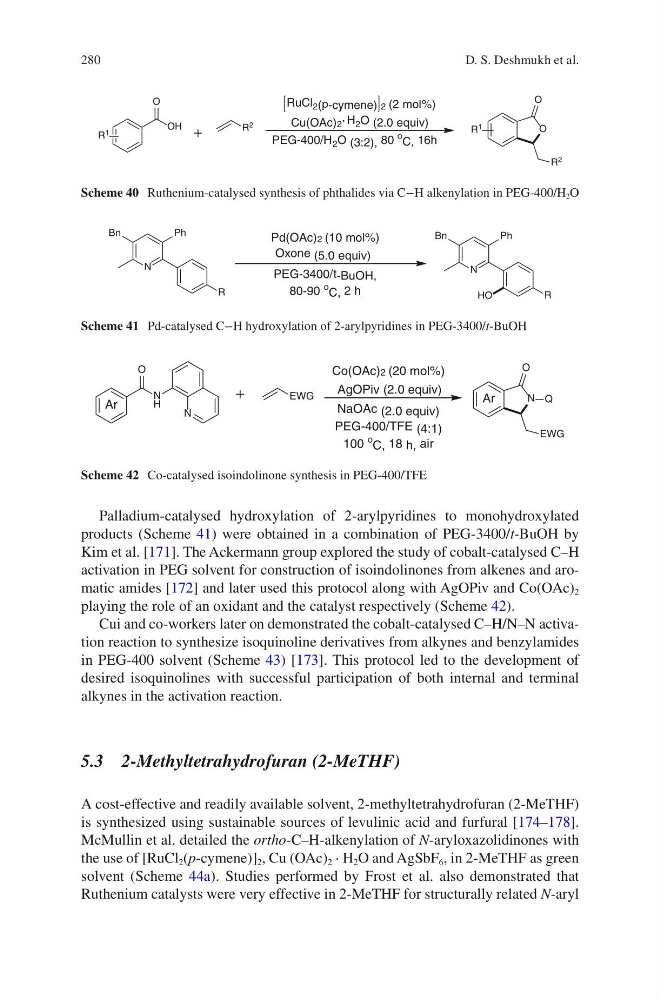
Palladium-catalysed hydroxylation of 2-arylpyridines to monohydroxylated
products (Scheme 41) were obtained in a combination of PEG-3400/t-BuOH by
Kim et al. [171]. The Ackermann group explored the study of cobalt-catalysed C–H
activation in PEG solvent for construction of isoindolinones from alkenes and aromatic amides [172] and later used this protocol along with AgOPiv and Co(OAc) 2
playing the role of an oxidant and the catalyst respectively (Scheme 42).
Cui and co-workers later on demonstrated the cobalt-catalysed C–H/N–N activation reaction to synthesize isoquinoline derivatives from alkynes and benzylamides
in PEG-400 solvent (Scheme 43) [173]. This protocol led to the development of
desired isoquinolines with successful participation of both internal and terminal
alkynes in the activation reaction.
5.3 2-Methyltetrahydrofuran (2-MeTHF)
A cost-effective and readily available solvent, 2-methyltetrahydrofuran (2-MeTHF)
is synthesized using sustainable sources of levulinic acid and furfural [174–178].
McMullin et al. detailed the ortho-C–H-alkenylation of N-aryloxazolidinones with
the use of [RuCl 2 (p-cymene)] 2 , Cu (OAc) 2 · H 2 O and AgSbF 6 , in 2-MeTHF as green
solvent (Scheme 44a). Studies performed by Frost et al. also demonstrated that
Ruthenium catalysts were very effective in 2-MeTHF for structurally related N-aryl
O
R 1
RuCl 2( p-cymene) 2 (2 mol%)
Cu(OAc)2 H 2 O (2.0 equiv)
PEG-400/H 2 O (3:2), 80
o C, 16h
R 1
R 2
OH
O
O
R 2
Scheme 40 Ruthenium-catalysed synthesis of phthalides via C−H alkenylation in PEG-400/H 2 O
Oxone (5.0 equiv)
PEG-3400/t -BuOH,
80-90
o C, 2 h
Pd(OAc)2 (10 mol%)
N
Bn
Ph
R
N
Bn
Ph
R
HO
Scheme 41 Pd-catalysed C−H hydroxylation of 2-arylpyridines in PEG-3400/t-BuOH
AgOPiv (2.0 equiv)
NaOAc (2.0 equiv)
PEG-400/TFE (4:1)
100
o C, 18 h, air
Co(OAc)2 (20 mol%)
Ar
Ar
N
H
O
N
EWG
N
O
EWG
Q
Scheme 42 Co-catalysed isoindolinone synthesis in PEG-400/TFE
D. S. Deshmukh et al.
Palladium-catalysed hydroxylation of 2-arylpyridines to monohydroxylated
products (Scheme 41) were obtained in a combination of PEG-3400/t-BuOH by
Kim et al. [171]. The Ackermann group explored the study of cobalt-catalysed C–H
activation in PEG solvent for construction of isoindolinones from alkenes and aromatic amides [172] and later used this protocol along with AgOPiv and Co(OAc) 2
playing the role of an oxidant and the catalyst respectively (Scheme 42).
Cui and co-workers later on demonstrated the cobalt-catalysed C–H/N–N activation reaction to synthesize isoquinoline derivatives from alkynes and benzylamides
in PEG-400 solvent (Scheme 43) [173]. This protocol led to the development of
desired isoquinolines with successful participation of both internal and terminal
alkynes in the activation reaction.
5.3 2-Methyltetrahydrofuran (2-MeTHF)
A cost-effective and readily available solvent, 2-methyltetrahydrofuran (2-MeTHF)
is synthesized using sustainable sources of levulinic acid and furfural [174–178].
McMullin et al. detailed the ortho-C–H-alkenylation of N-aryloxazolidinones with
the use of [RuCl 2 (p-cymene)] 2 , Cu (OAc) 2 · H 2 O and AgSbF 6 , in 2-MeTHF as green
solvent (Scheme 44a). Studies performed by Frost et al. also demonstrated that
Ruthenium catalysts were very effective in 2-MeTHF for structurally related N-aryl
O
R 1
RuCl 2( p-cymene) 2 (2 mol%)
Cu(OAc)2 H 2 O (2.0 equiv)
PEG-400/H 2 O (3:2), 80
o C, 16h
R 1
R 2
OH
O
O
R 2
Scheme 40 Ruthenium-catalysed synthesis of phthalides via C−H alkenylation in PEG-400/H 2 O
Oxone (5.0 equiv)
PEG-3400/t -BuOH,
80-90
o C, 2 h
Pd(OAc)2 (10 mol%)
N
Bn
Ph
R
N
Bn
Ph
R
HO
Scheme 41 Pd-catalysed C−H hydroxylation of 2-arylpyridines in PEG-3400/t-BuOH
AgOPiv (2.0 equiv)
NaOAc (2.0 equiv)
PEG-400/TFE (4:1)
100
o C, 18 h, air
Co(OAc)2 (20 mol%)
Ar
Ar
N
H
O
N
EWG
N
O
EWG
Q
Scheme 42 Co-catalysed isoindolinone synthesis in PEG-400/TFE
D. S. Deshmukh et al.