

243
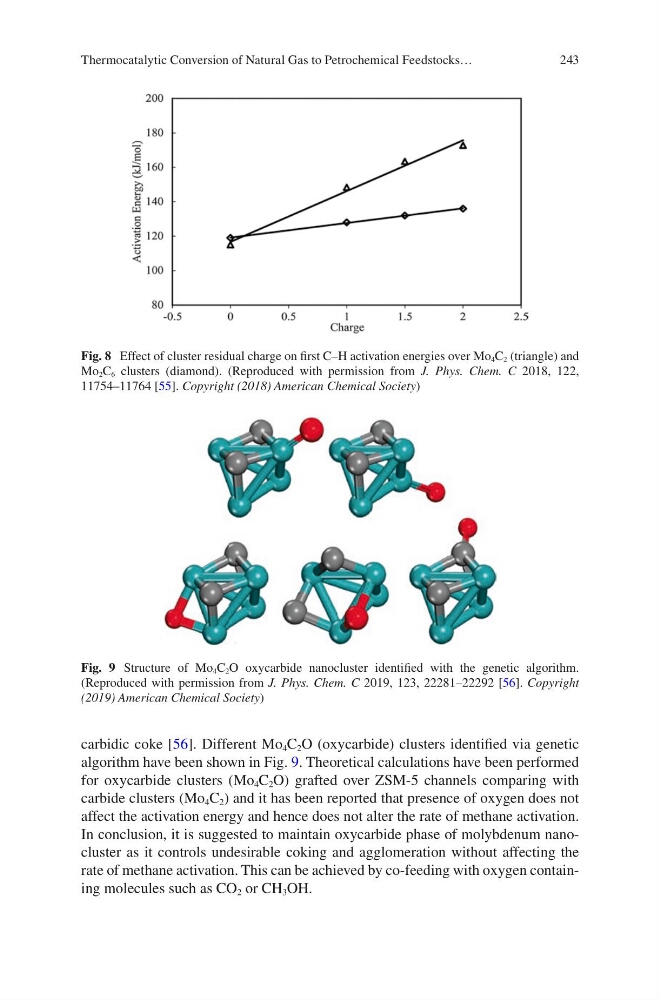
carbidic coke [56]. Different Mo 4 C 2 O (oxycarbide) clusters identified via genetic
algorithm have been shown in Fig. 9. Theoretical calculations have been performed
for oxycarbide clusters (Mo 4 C 2 O) grafted over ZSM-5 channels comparing with
carbide clusters (Mo 4 C 2 ) and it has been reported that presence of oxygen does not
affect the activation energy and hence does not alter the rate of methane activation.
In conclusion, it is suggested to maintain oxycarbide phase of molybdenum nanocluster as it controls undesirable coking and agglomeration without affecting the
rate of methane activation. This can be achieved by co-feeding with oxygen containing molecules such as CO 2 or CH 3 OH.
Fig. 8 Effect of cluster residual charge on first C–H activation energies over Mo 4 C 2 (triangle) and
Mo 2 C 6 clusters (diamond). (Reproduced with permission from J. Phys. Chem. C 2018, 122,
11754–11764 [55]. Copyright (2018) American Chemical Society)
Fig. 9 Structure of Mo 4 C 2 O oxycarbide nanocluster identified with the genetic algorithm.
(Reproduced with permission from J. Phys. Chem. C 2019, 123, 22281–22292 [56]. Copyright
(2019) American Chemical Society)
Thermocatalytic Conversion of Natural Gas to Petrochemical Feedstocks…
carbidic coke [56]. Different Mo 4 C 2 O (oxycarbide) clusters identified via genetic
algorithm have been shown in Fig. 9. Theoretical calculations have been performed
for oxycarbide clusters (Mo 4 C 2 O) grafted over ZSM-5 channels comparing with
carbide clusters (Mo 4 C 2 ) and it has been reported that presence of oxygen does not
affect the activation energy and hence does not alter the rate of methane activation.
In conclusion, it is suggested to maintain oxycarbide phase of molybdenum nanocluster as it controls undesirable coking and agglomeration without affecting the
rate of methane activation. This can be achieved by co-feeding with oxygen containing molecules such as CO 2 or CH 3 OH.
Fig. 8 Effect of cluster residual charge on first C–H activation energies over Mo 4 C 2 (triangle) and
Mo 2 C 6 clusters (diamond). (Reproduced with permission from J. Phys. Chem. C 2018, 122,
11754–11764 [55]. Copyright (2018) American Chemical Society)
Fig. 9 Structure of Mo 4 C 2 O oxycarbide nanocluster identified with the genetic algorithm.
(Reproduced with permission from J. Phys. Chem. C 2019, 123, 22281–22292 [56]. Copyright
(2019) American Chemical Society)
Thermocatalytic Conversion of Natural Gas to Petrochemical Feedstocks…