

242
results in significantly lower activation barriers for C–C coupling reaction step
which directs that whereas methane may be activated on both Mo 4 C 2 and Mo 2 C 6
clusters, the C–C coupling and subsequent higher coupling reactions to form aromatic product are likely to occur over Mo 2 C 6 clusters anchored inside the zeolite
channels. In the study, residual charge effect over the clusters which significantly
affects the elementary reaction energy barriers confirms that the reducibility of the
molybdenum carbide/oxycarbide is a key factor and controls the Mo/Zeolite activity
[55]. A linear correlation has been obtained between cluster residual charge and first
C–H activation barrier which directs that the lesser residual charge on Mo x C y cluster
results in lowering of methane dehydrogenation barrier as depicted in Fig. 8. Thus
the overall mechanistic study correlates the effect of Mo x C y clusters with charge to
activity which may help in improving the MDA catalyst activity and stability via
controlling the Mo x C y structure.
In recent studies of Gao et al. (2019), a comparative mechanistic studies on oxycarbide and carbide form of molybdenum have been reported in which oxycarbide
form is taken into account for effective MDA catalyst stability [56]. Generally,
molybdenum carbide species agglomerate during the progress of reaction and accumulate coke deposits which lead to deactivation. However, catalyst regeneration by
oxygen pulsing treatments can recover these active species. The agglomeration of
molybdenum species leading to coke formation can also be avoided by co-feeding
with oxygenates (O 2 /CO/CO 2 ) that partially transforms coked-Mo 2 C species into an
oxycarbide form of molybdenum during the course of reaction and controls agglomeration and coking. Thus it will be desirable to control the molybdenum structure in
an oxycarbide form instead of fully carbide structure of Mo which promotes
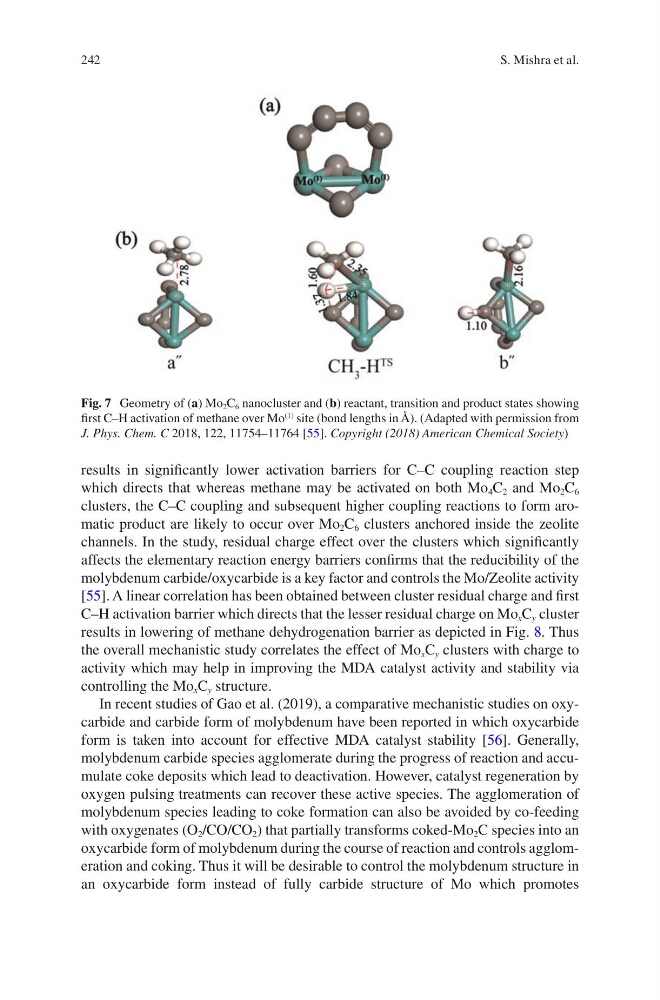
Fig. 7 Geometry of (a) Mo 2 C 6 nanocluster and (b) reactant, transition and product states showing
first C–H activation of methane over Mo
(1) site (bond lengths in Å). (Adapted with permission from
J. Phys. Chem. C 2018, 122, 11754–11764 [55]. Copyright (2018) American Chemical Society)
S. Mishra et al.
results in significantly lower activation barriers for C–C coupling reaction step
which directs that whereas methane may be activated on both Mo 4 C 2 and Mo 2 C 6
clusters, the C–C coupling and subsequent higher coupling reactions to form aromatic product are likely to occur over Mo 2 C 6 clusters anchored inside the zeolite
channels. In the study, residual charge effect over the clusters which significantly
affects the elementary reaction energy barriers confirms that the reducibility of the
molybdenum carbide/oxycarbide is a key factor and controls the Mo/Zeolite activity
[55]. A linear correlation has been obtained between cluster residual charge and first
C–H activation barrier which directs that the lesser residual charge on Mo x C y cluster
results in lowering of methane dehydrogenation barrier as depicted in Fig. 8. Thus
the overall mechanistic study correlates the effect of Mo x C y clusters with charge to
activity which may help in improving the MDA catalyst activity and stability via
controlling the Mo x C y structure.
In recent studies of Gao et al. (2019), a comparative mechanistic studies on oxycarbide and carbide form of molybdenum have been reported in which oxycarbide
form is taken into account for effective MDA catalyst stability [56]. Generally,
molybdenum carbide species agglomerate during the progress of reaction and accumulate coke deposits which lead to deactivation. However, catalyst regeneration by
oxygen pulsing treatments can recover these active species. The agglomeration of
molybdenum species leading to coke formation can also be avoided by co-feeding
with oxygenates (O 2 /CO/CO 2 ) that partially transforms coked-Mo 2 C species into an
oxycarbide form of molybdenum during the course of reaction and controls agglomeration and coking. Thus it will be desirable to control the molybdenum structure in
an oxycarbide form instead of fully carbide structure of Mo which promotes
Fig. 7 Geometry of (a) Mo 2 C 6 nanocluster and (b) reactant, transition and product states showing
first C–H activation of methane over Mo
(1) site (bond lengths in Å). (Adapted with permission from
J. Phys. Chem. C 2018, 122, 11754–11764 [55]. Copyright (2018) American Chemical Society)
S. Mishra et al.