

220
preferential reaction to the unsaturated coordinated sites (corners and edges) of
butadiene, which results in a local Pd lattice expansion and channels formation for
barriers less hydrogen diffusion into the pore volume of Pd nanoparticles. Due to
lower reaction barrier for H diffusion on Pd surface, the hydrogenation of C=C bond
is easily shattered, which facilitated the hydrogenation reaction.
2.6 The Use of Additives, Adspecies and Promoters
Several authors have suggested adding alkali additives on catalyst surface could
play a significant role in selective hydrogenation [28, 92]. Massardier [49]
investigated the effect of K and Na on Pt single crystals to modify the metal
electronic properties. It was found that the improved properties increased the
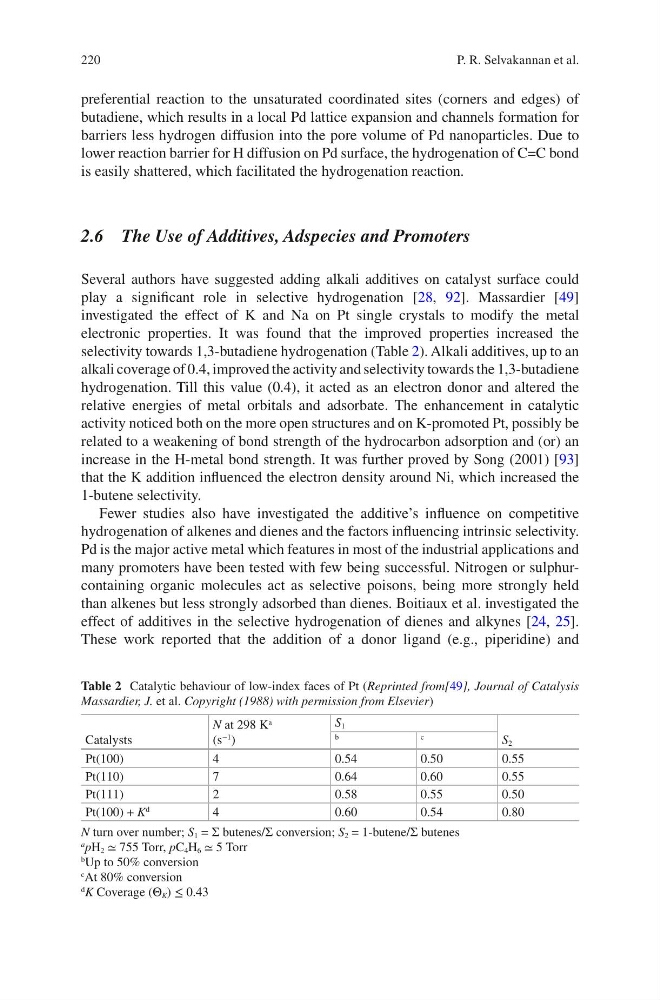
selectivity towards 1,3-butadiene hydrogenation (Table 2). Alkali additives, up to an
alkali coverage of 0.4, improved the activity and selectivity towards the 1,3-butadiene
hydrogenation. Till this value (0.4), it acted as an electron donor and altered the
relative energies of metal orbitals and adsorbate. The enhancement in catalytic
activity noticed both on the more open structures and on K-promoted Pt, possibly be
related to a weakening of bond strength of the hydrocarbon adsorption and (or) an
increase in the H-metal bond strength. It was further proved by Song (2001) [93]
that the K addition influenced the electron density around Ni, which increased the
1-butene selectivity.
Fewer studies also have investigated the additive’s influence on competitive
hydrogenation of alkenes and dienes and the factors influencing intrinsic selectivity.
Pd is the major active metal which features in most of the industrial applications and
many promoters have been tested with few being successful. Nitrogen or sulphurcontaining organic molecules act as selective poisons, being more strongly held
than alkenes but less strongly adsorbed than dienes. Boitiaux et al. investigated the
effect of additives in the selective hydrogenation of dienes and alkynes [24, 25].
These work reported that the addition of a donor ligand (e.g., piperidine) and
Table 2 Catalytic behaviour of low-index faces of Pt (Reprinted from[49], Journal of Catalysis
Massardier, J. et al. Copyright (1988) with permission from Elsevier)
Catalysts
N at 298 K
a
(s
−1 )
S 1
S 2
b
c
Pt(100)
4
0.54
0.50
0.55
Pt(110)
7
0.64
0.60
0.55
Pt(111)
2
0.58
0.55
0.50
Pt(100) + K
d
4
0.60
0.54
0.80
N turn over number; S 1 = Σ butenes/Σ conversion; S 2 = 1-butene/Σ butenes
a
pH 2 ≃ 755 Torr, pC 4 H 6 ≃ 5 Torr
b
Up to 50% conversion
c
At 80% conversion
d
K Coverage (Θ K ) ≤ 0.43
P. R. Selvakannan et al.
preferential reaction to the unsaturated coordinated sites (corners and edges) of
butadiene, which results in a local Pd lattice expansion and channels formation for
barriers less hydrogen diffusion into the pore volume of Pd nanoparticles. Due to
lower reaction barrier for H diffusion on Pd surface, the hydrogenation of C=C bond
is easily shattered, which facilitated the hydrogenation reaction.
2.6 The Use of Additives, Adspecies and Promoters
Several authors have suggested adding alkali additives on catalyst surface could
play a significant role in selective hydrogenation [28, 92]. Massardier [49]
investigated the effect of K and Na on Pt single crystals to modify the metal
electronic properties. It was found that the improved properties increased the
selectivity towards 1,3-butadiene hydrogenation (Table 2). Alkali additives, up to an
alkali coverage of 0.4, improved the activity and selectivity towards the 1,3-butadiene
hydrogenation. Till this value (0.4), it acted as an electron donor and altered the
relative energies of metal orbitals and adsorbate. The enhancement in catalytic
activity noticed both on the more open structures and on K-promoted Pt, possibly be
related to a weakening of bond strength of the hydrocarbon adsorption and (or) an
increase in the H-metal bond strength. It was further proved by Song (2001) [93]
that the K addition influenced the electron density around Ni, which increased the
1-butene selectivity.
Fewer studies also have investigated the additive’s influence on competitive
hydrogenation of alkenes and dienes and the factors influencing intrinsic selectivity.
Pd is the major active metal which features in most of the industrial applications and
many promoters have been tested with few being successful. Nitrogen or sulphurcontaining organic molecules act as selective poisons, being more strongly held
than alkenes but less strongly adsorbed than dienes. Boitiaux et al. investigated the
effect of additives in the selective hydrogenation of dienes and alkynes [24, 25].
These work reported that the addition of a donor ligand (e.g., piperidine) and
Table 2 Catalytic behaviour of low-index faces of Pt (Reprinted from[49], Journal of Catalysis
Massardier, J. et al. Copyright (1988) with permission from Elsevier)
Catalysts
N at 298 K
a
(s
−1 )
S 1
S 2
b
c
Pt(100)
4
0.54
0.50
0.55
Pt(110)
7
0.64
0.60
0.55
Pt(111)
2
0.58
0.55
0.50
Pt(100) + K
d
4
0.60
0.54
0.80
N turn over number; S 1 = Σ butenes/Σ conversion; S 2 = 1-butene/Σ butenes
a
pH 2 ≃ 755 Torr, pC 4 H 6 ≃ 5 Torr
b
Up to 50% conversion
c
At 80% conversion
d
K Coverage (Θ K ) ≤ 0.43
P. R. Selvakannan et al.